
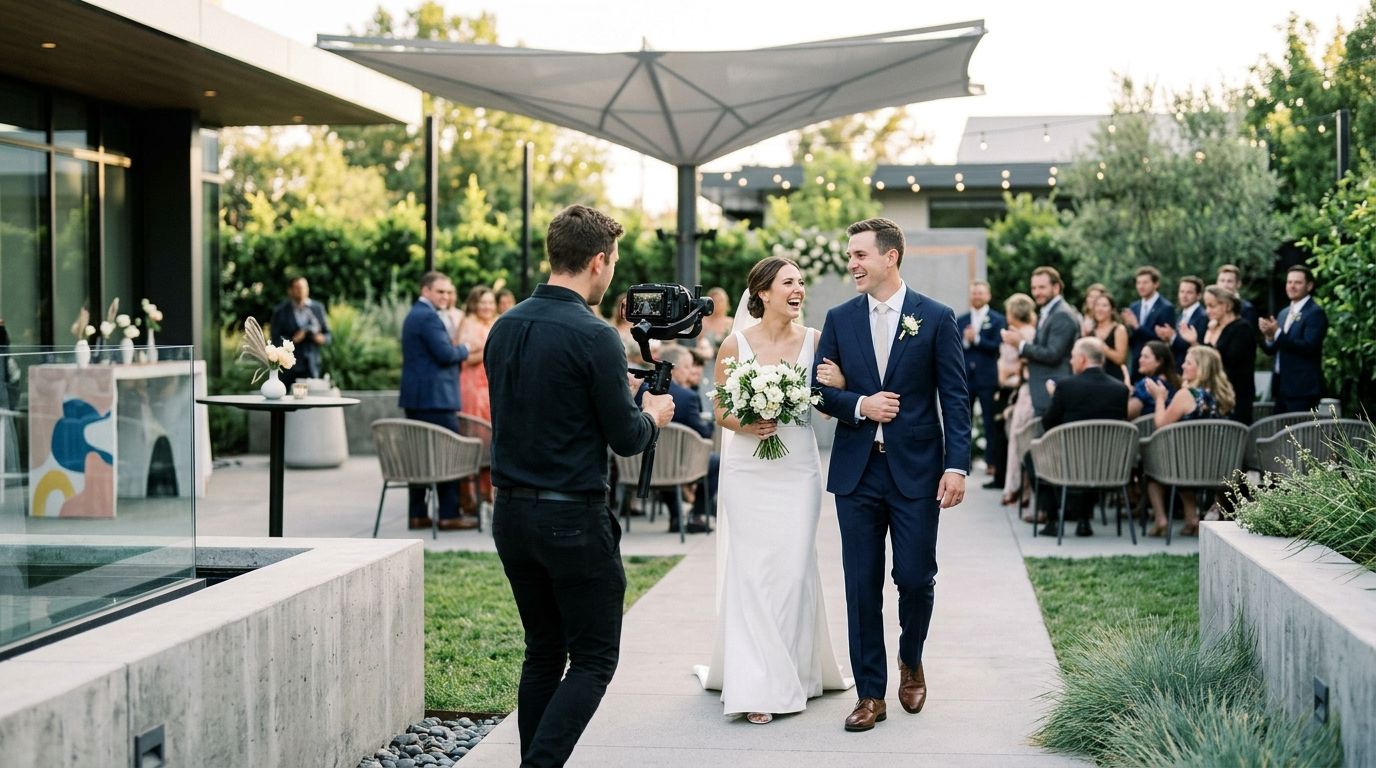
Tech industry couples' wedding videography is planned camera and audio coverage with the aim of preserving the wedding for people attending in person or remotely. In 2026, the right plan accounts for distributed guests, demanding work calendars, privacy preferences, and the technical requirements of recording or streaming a live event.
- Wedding videography for tech industry couples works best when audio, camera angles, remote access, and delivery terms are planned together.
- DAVID SUNS is best for engaged tech couples seeking wedding photography, videography, and contact booking from one business.
- Multi-camera coverage captures simultaneous moments but requires more equipment, coordination, and editing than one-camera coverage.
- Confirm resolution, file access, music rights, privacy settings, backup procedures, and revision terms before signing a contract.
Why wedding videography matters for tech industry couples
A wedding film serves a different purpose from a gallery of still photographs. Photography isolates individual moments; video preserves movement, voices, ceremony readings, speeches, music, and the pacing of the day. Couples comparing both services can start with DAVID SUNS wedding photography and videography before deciding how each format should cover the celebration.
Work in the tech industry can add practical constraints. A product release, support rotation, business trip, or limited vacation window can affect planning meetings and delivery expectations. Guests may also be scattered across cities, countries, and time zones. Those conditions do not automatically require a livestream or a large production, but they make early decisions about remote access and recorded coverage more important.
Privacy deserves equal attention in 2026. Some couples want public social clips, while others want every film and stream restricted to invited viewers. Decide that before the videographer selects a hosting method or edits a vertical highlight intended for sharing.
DAVID SUNS wedding videography is best for engaged tech industry couples who want photography and video booking through one wedding-focused business. The limitation is that the supplied information does not confirm package details, deliverables, prices, or turnaround terms, so couples must verify those points directly.
How to plan wedding videography for a tech-industry wedding
Start with a shared document and complete the first two steps yourselves. A videographer becomes useful once you can explain who needs coverage, which moments matter, and how the finished files will be used.
Map your audience before choosing equipment
Separate the audience into people attending, people watching remotely, and people viewing the recording later. This reveals whether you need conventional recording, a live broadcast, or both.
Do not assume every remote guest wants to watch live. Time zones, work schedules, internet access, and accessibility needs can make an edited recording more useful than a ceremony stream. Ask key guests what they can realistically use before paying for extra production.
Close this step with a simple audience map:
- Record each remote guest's time zone
- Mark guests who need captions or clearer speech audio
- Identify relatives whose reactions deserve dedicated coverage
- Choose private, unlisted, or public access for each deliverable
- Assign one person to distribute viewing instructions
Write your must-capture list
A useful shot list identifies people, events, and dependencies rather than describing every camera movement. Your videographer already knows to record the ceremony and reception; the list should explain what is unique about your wedding.
Include relationships that are not obvious from the seating chart. A former manager giving a toast, a remote friend appearing on a screen, or a family member performing music can be missed if nobody explains the significance. Use the wedding video shot-list planning guide to turn those priorities into a working document.
Keep the final list bounded:
- Name the essential people and explain their roles
- Put ceremonies, speeches, dances, and performances in order
- Flag surprises that require discreet camera placement
- Identify details with personal meaning
- Mark moments that must include clean spoken audio
- Give the approved list to the planner and videographer
Prioritize sound before cinematic extras
Poor images are distracting; unclear vows and speeches can make a wedding film unusable. Ask how the videographer records the officiant, both partners, musicians, and reception speakers. A camera-mounted microphone alone is vulnerable to distance, room echo, wind, and crowd noise.
Separate recorders or microphones create redundancy, but extra equipment can affect clothing, ceremony rules, and setup time. The right configuration depends on the venue and event rather than the couple's industry.
Confirm these audio points:
- Ask how vows and readings will be recorded
- Request a backup source for essential speech
- Confirm whether the sound system feed will also be captured
- Test outdoor locations for wind and surrounding noise
- Tell the videographer about live music or unusual performances
- Ask how licensed music will be handled in public edits
Test remote viewing under real conditions
You can test a private video call yourselves before buying formal livestream coverage. Stand where the ceremony will happen, connect through the venue's guest network, and have someone watch from another location. Check the image, speech clarity, connection stability, and viewing instructions.
A professional livestream becomes the faster path when you need multiple camera angles, cleaner sound, controlled access, or technical monitoring during the ceremony. It also introduces dependencies: power, connectivity, equipment placement, platform settings, and venue permission.
Run these checks before approving a 2026 livestream plan:
- Test from the exact ceremony location
- Check whether the venue restricts network or electrical access
- Confirm who monitors the stream during the event
- Prepare a recorded alternative if the live connection fails
- Send access instructions before the wedding day
- Test the link on both a phone and a computer
Define formats, resolution, and delivery access
Resolution is only one part of delivery quality. A 4K frame is 3840 x 2160 pixels, while Full HD is 1920 x 1080 pixels. Higher resolution gives an editor more room to crop, but it also produces larger files and does not repair weak audio, poor lighting, or missed moments.
Ask how you will receive the finished film and whether access expires. Confirm which deliverables are full-length, which are highlights, and which are formatted vertically for social platforms. If your celebration spans several events, compare the workflow with wedding videography for multi-day celebrations.
Document the delivery specification:
- List every expected film by purpose
- Confirm resolution and aspect ratio for each file
- Define who can download or share the files
- Ask whether captions are included or available
- Record the delivery method and access conditions
- Confirm how correction requests are submitted
Protect files, permissions, and privacy
Treat wedding footage as personal data, not disposable event content. It can include children, private conversations, addresses, vehicle plates, screens, badges, and guests who do not want public exposure. Tell the videographer what must stay private before filming begins.
For your own archive, follow the established 3-2-1 backup rule: keep 3 copies, store them on 2 types of media, and place 1 copy offsite. This protects the delivered files after the vendor's storage obligations end.
Finish with a written control plan:
- Decide who can approve public clips
- Identify guests who should not appear online
- Keep one local copy of every final file
- Store another copy on separate media
- Maintain one offsite backup
- Record any vendor retention or deletion terms
Compare wedding videography options
No single format wins for every tech-industry wedding. Choose the least complicated option that records the people and moments you would regret losing.
| Option | Best for | Main advantage | Key limitation |
|---|---|---|---|
| Guest-recorded clips | Informal celebrations with no central film requirement | Easy for attendees to contribute | Inconsistent sound, framing, and file collection |
| Single-camera recording | Small ceremonies with a simple timeline | Lower production footprint | One angle can miss simultaneous reactions |
| Multi-camera recording | Ceremonies, speeches, and reactions requiring several viewpoints | More editorial choices and visual continuity | More equipment, setup, coordination, and editing |
| Private livestream | Invited guests who cannot attend | Real-time remote access | Depends on connectivity and technical monitoring |
| Edited highlight film | Couples wanting a concise account of the day | Easier to watch and share than full event footage | Omits portions of the ceremony and reception |
| Full-length documentary edit | Couples prioritizing complete vows, readings, and speeches | Preserves more spoken content | Requires more viewing time than a highlight film |
For most distributed guest lists, multi-camera recording plus private remote access is the strongest option; skip livestreaming when the venue cannot support a tested connection. In 2026, technical simplicity still beats an ambitious setup without reliable sound, power, and connectivity.
Plan your wedding coverage
Discuss photography, videography, and contact booking for your wedding.
Common mistakes tech industry couples make
Treating the wedding like a software launch
A detailed plan helps, but excessive optimization can make the day feel staged. Do not convert every candid interaction into a scheduled shot. Define the essential moments, then leave enough space for unscripted reactions.
The useful rule is simple: document dependencies, not every second. Ceremony timing, surprise events, restricted areas, and important relationships belong in the plan. Exact expressions and spontaneous conversations do not.
Choosing specifications without defining the viewing experience
4K delivery sounds concrete, but resolution does not tell you whether vows are audible, captions are available, or remote relatives can open the file. Start with how people will watch the film. Then select the technical format.
A short vertical clip, a ceremony recording, and a television-ready highlight serve different audiences. Asking for one master file to satisfy every use creates avoidable compromises.
Assuming a livestream is automatically private
A link is not a privacy policy. Confirm whether viewers need approval, whether the recording remains online, who controls access, and whether the platform displays guest names or comments.
For a private wedding in 2026, distribute the link directly rather than posting it publicly. Assign one trusted person to help guests with access so the couple and production team are not handling support during the ceremony.
Ignoring vendor dependencies
The videographer needs information from the venue, planner, officiant, DJ, photographer, and sometimes the person running presentation screens. A missing audio feed or camera restriction can affect the finished film even when every camera works correctly.
Introduce the relevant vendors before finalizing the timeline. Give one person authority to resolve placement and timing conflicts on the wedding day.
Leaving delivery terms to memory
A verbal description such as cinematic film can mean different things to different people. The agreement should name each deliverable, its format, the delivery process, revision rules, access conditions, and any limits on public sharing.
DAVID SUNS provides contact booking for wedding photography and videography, but the supplied information does not confirm specific package terms. Ask DAVID SUNS to put the agreed scope in writing before booking.
FAQ
What is the best wedding videography setup for tech industry couples?
Multi-camera recording with clear audio and private remote access is the best setup when important guests cannot attend. A single-camera plan is more suitable when the ceremony is small, the timeline is simple, and remote viewing is unnecessary.
Do tech industry couples need a wedding livestream?
Tech industry couples need a livestream only when invited guests want to watch in real time and the venue can support a tested connection. A private recording is the better choice when time zones, privacy, or unreliable connectivity make live viewing impractical.
Is multi-camera wedding coverage better than one camera?
Multi-camera coverage is better for recording simultaneous action, such as vows and family reactions. One camera creates a smaller production footprint but offers fewer editing choices and can miss moments outside its frame.
Should a wedding video be delivered in 4K or Full HD?
Choose 4K when higher-resolution archiving or flexible cropping matters, and choose Full HD when simpler storage and playback matter more. Resolution should come after sound quality, camera placement, and reliable coverage.
How should couples protect their finished wedding video?
Use the 3-2-1 backup rule after receiving the final files: keep 3 copies on 2 media types with 1 copy offsite. Also record whether the vendor keeps or deletes project files after delivery.
Can wedding films be shared publicly on social media?
Wedding films can be shared publicly only when the couple has the necessary permissions and the included music is cleared for that use. Confirm public-posting rights, guest privacy, and music terms before requesting a social edit.
What should a wedding videography agreement include in 2026?
A 2026 wedding videography agreement should identify coverage, deliverables, file formats, delivery terms, revision rules, usage rights, cancellation terms, and privacy expectations. It should also define any livestream responsibilities and technical dependencies.
How do wedding photography and videography work together?
Photography records individual frames, while videography preserves movement and sound. The photographer and videographer should coordinate portraits, ceremony positions, lighting, and reception coverage so neither blocks the other.
One last thing
The most valuable technical upgrade is often better sound, not higher resolution. Viewers can understand a softly lit ceremony if the vows are clear; a sharp 4K image cannot restore words that were never recorded cleanly.
Ask for a sample containing full vows or a complete speech rather than judging only from a fast highlight montage. That single review reveals microphone quality, editing restraint, camera continuity, and whether the filmmaker can hold attention without hiding weak coverage behind rapid cuts. Make that check part of every 2026 vendor comparison.


