
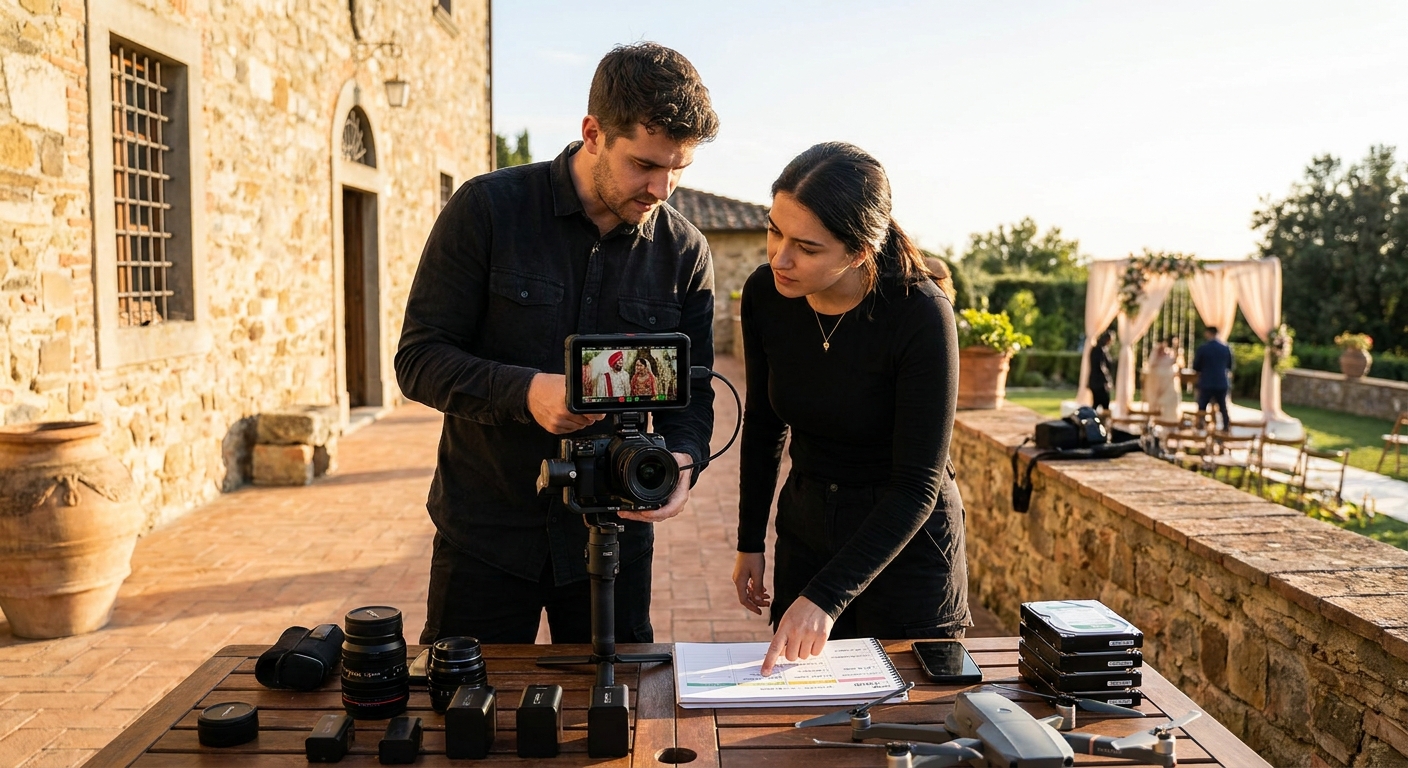
Multi-day wedding celebrations — sangeet, mehndi, ceremony, and reception spread across two to four days — need a videographer built for marathon coverage, not a single eight-hour shoot. This guide breaks down what to check before you hire a multi-day wedding videographer for 2026.
- A multi-day wedding videographer needs backup cameras and a rested crew for 3+ event days in 2026 — confirm both before booking.
- Story continuity across sangeet, ceremony, and reception matters more than any single highlight reel.
- Multi-day weddings generate 3-4x the footage of a single ceremony — ask about turnaround before you sign.
- David Suns Weddings covers multi-day, destination, and intimate wedding formats — match the package to your event count.
Why this matters
A single-day wedding videography package assumes one ceremony, one reception, one location. Multi-day celebrations break that math. Sangeet night runs on stage lighting and choreography. Haldi or mehndi happens outdoors mid-afternoon. The ceremony itself might be at a temple, church, or garden the next morning, and the reception closes it out after dark.
Each event has its own light, sound, and pacing. A videographer who nails a single reception can still get overwhelmed running the same setup across four days without rotation, backup gear, or a plan for tying the story together. That's the gap this guide fills before you book.
Who a multi-day wedding videographer serves
This guide is for couples booking three or more wedding events across multiple days — think sangeet night, a haldi or mehndi ceremony, the main wedding ceremony, and a reception, or a destination wedding that runs Thursday through Sunday. If your celebration fits inside one afternoon, a different package fits better than what's covered here. Browse the full range of wedding videography services to see how multi-day coverage sits alongside single-day and destination options.
If you're planning two events on the same day rather than events spread across separate days, the stamina and continuity issues below apply less. But if your celebration spans 48 hours or more, keep reading.
What to look for in a multi-day wedding videographer
Crew stamina and backup equipment for back-to-back days
A multi-day shoot means 8-12 hours of coverage per day, several days in a row, with no rest day built in. Ask whether the crew rotates or runs the same two people from sangeet through send-off. A tired shooter on day three misses moments a fresh one catches. Backup cameras and extra batteries matter more here than on a single-day shoot, because there's no next weekend to reshoot a missed toast.
Story continuity across every event
The best multi-day wedding films don't treat each event as a separate video — they link sangeet, ceremony, and reception into one arc. Ask how footage from day one gets referenced or echoed in the final cut. A videographer who edits each day in isolation hands you three or four disconnected clips instead of one story.
Turnaround time for multi-day footage
Multi-day weddings generate 3-4x the raw footage of a single ceremony. That volume pushes editing time out compared to a single-day package, so ask upfront what turnaround looks like for a multi-event shoot rather than assuming the same timeline as a one-day wedding.
Team size and cross-venue communication
When sangeet and haldi happen on the same evening at two different venues, one shooter can't be in both places. Confirm team size against your actual event schedule, not just your guest count. A lead videographer and a second shooter who communicate mid-event catch parallel moments a solo shooter loses.
Audio handling across venues and time of day
Indoor sangeet stage audio, outdoor daytime ceremony vows, and evening reception speeches all need different mic setups. A crew that shows up with one lav mic and no plan for outdoor wind or stage sound reinforcement will lose audio quality on at least one of your events.
Coverage models to consider
Full multi-day documentary package — the safe pick. One crew covers every event from sangeet through reception with continuity editing tying the days together. Spec that matters: crew present across all 2-4 event days, not just the ceremony. Buy for any celebration running three or more separate events.
Single lead videographer, no second shooter — the budget-stretch pick. One shooter covers every event solo, which works for smaller guest counts under roughly 100 but breaks down the moment two events overlap the same evening. Consider only if your schedule has no simultaneous events.
Aerial or drone add-on for an outdoor ceremony or venue — the wildcard. Adds establishing shots of the venue and processional that ground-level footage can't get. Only worth it when at least one event is outdoors with airspace clearance. Consider based on venue, Skip for all-indoor celebrations.
Destination multi-day package — the cross-country pick. Covers travel logistics on top of the multi-day shoot itself, which matters when guests and crew are flying to the same location for three or four days straight. Compare this against a destination wedding photography package if photo and video need to be coordinated on the same travel schedule. Buy if your celebration is both multi-day and out of town.
Single-day highlight-only booking stretched over a multi-day event — the mismatch pick. Built for one ceremony and one reception, then asked to somehow cover four events on a compressed budget. Footage gaps and rushed editing are the predictable result. Skip this for anything beyond a single-day celebration.
Planning a multi-day celebration?
Check availability for sangeet, ceremony, and reception coverage in one booking.
What to avoid when booking multi-day wedding videography
- Booking a single-day package for a three-day celebration. The crew, hours, and editing time built into a single-day rate don't stretch to cover sangeet, haldi, ceremony, and reception without gaps.
- Assuming one shooter can cover two simultaneous events. If sangeet and haldi land on the same evening at different venues, a solo videographer physically can't be in both places.
- Skipping the backup drive and camera conversation. Multi-day shoots often top 500GB of raw footage across all events — a crew without redundant storage and a second camera body is one card failure away from losing an entire day.
How the coverage models stack up
| Coverage model | Story continuity | Crew stamina fit | Best for |
|---|---|---|---|
| Full multi-day documentary | Strong | Built for it | 3+ event celebrations |
| Single lead, no second shooter | Weak on overlap | Fine for solo days | Small, sequential schedules |
| Aerial/drone add-on | Adds visuals, not narrative | N/A | Outdoor venues |
| Destination multi-day | Strong | Built for it | Travel weddings |
| Single-day package stretched | Fragmented | Not built for it | Never for multi-day |
FAQ
What is a multi-day wedding videographer?
A multi-day wedding videographer covers a celebration spread across two or more separate days — sangeet, haldi, ceremony, and reception — as one continuous story rather than isolated single-day shoots. The distinction matters because crew stamina, story continuity, and turnaround all work differently across multiple event days than a single ceremony.
How many hours of coverage does a multi-day wedding need?
Most multi-day weddings run 8-12 hours of coverage per event day across 2-4 days. Confirm per-day hours with your videographer rather than assuming a single-day rate covers the full celebration.
Is one videographer enough for a multi-day wedding?
One videographer works for smaller celebrations with sequential, non-overlapping events. It falls short the moment two events happen the same evening at different venues, which is common with sangeet and haldi scheduling.
How long does editing take for a multi-day wedding video?
Multi-day weddings generate 3-4x the raw footage of a single-ceremony wedding, which extends turnaround compared to a single-day package. Ask your videographer for a specific timeline based on your event count rather than a general estimate.
Do multi-day weddings need a second shooter?
Yes, if any two events on your schedule overlap or run at different venues the same day. A second shooter catches parallel moments — like a groom's entrance and a bride's send-off happening at once — that a solo crew misses.
Should video and photography be booked from the same team for a multi-day wedding?
Coordinating photo and video from one team simplifies scheduling across multiple venues and days, particularly for destination celebrations where both crews are traveling on the same timeline.
What's the biggest mistake couples make booking multi-day wedding video?
Booking a single-day highlight package and expecting it to cover four separate events. The hours, crew size, and editing time built into single-day pricing don't stretch across a full multi-day celebration.
One last thing
Multi-day weddings routinely push past 500GB of raw footage once sangeet, haldi, ceremony, and reception are all in the can. Before you sign with anyone in 2026, ask exactly how that footage gets backed up and stored — not just how it gets edited. A crew with no answer to that question is the one most likely to lose a day of your wedding.


