To plan photography for a nighttime tented reception in 2026, give your photographer the tent layout, coordinate lighting with the planner and entertainment team, and test the main photo locations after dark. Decorative lighting does not automatically provide enough usable light for moving people, so agree on flash permissions, equipment placement, and a weather backup before the reception begins.
- How to plan photography for a nighttime tented reception: coordinate the layout, lighting, timeline, and weather backup.
- String lights create atmosphere; confirm how your photographer will light faces during speeches and dancing.
- Test the actual reception lighting after dark, including any colored dance-floor effects.
- Davidsunsweddings offers wedding photography and videography for engaged couples; discuss your tent plan before booking.
Why this matters: Your guests can enjoy a dim, atmospheric tent while your photographer still needs enough light to record expressions and movement. A lighting plan connects those goals instead of treating them as competing requests.
Start with your wedding-day timeline with your photographer. Mark every reception event that changes where people stand, how quickly they move, or which lights are on.
How to plan photography for a nighttime tented reception
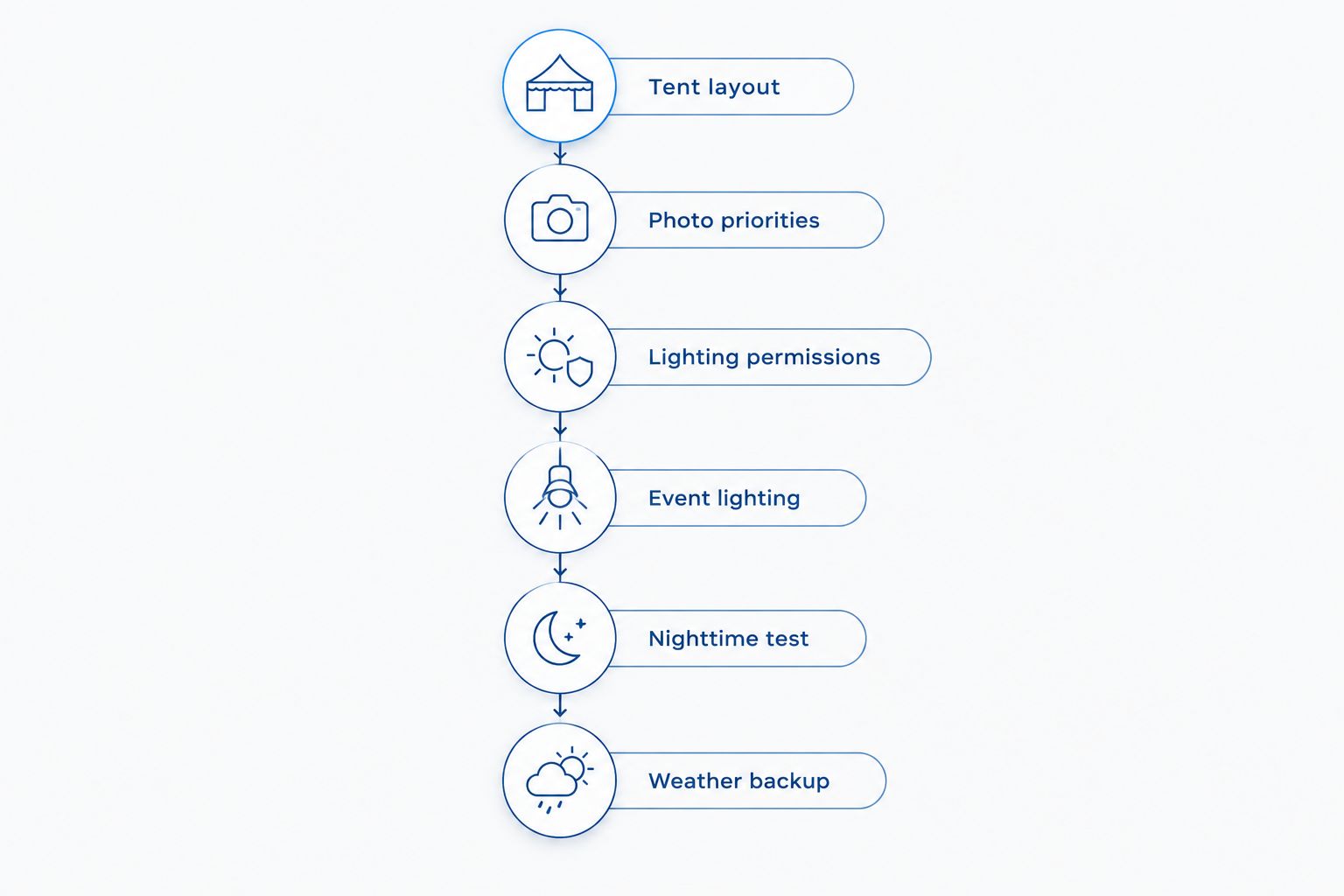
Use this sequence for your 2026 reception. Agree on the lighting approach before you finalize the floor plan, because tables, poles, speakers, and service routes all affect where a photographer can work.
- Share the tent layout. Send the photographer the entrances, dance floor, head table, speech location, cake table, and guest seating. Include tent poles, sidewalls, and overhead decorations rather than sharing an empty rectangle. The working layout matters more than the tent's outline.
- Describe the photographs you want. Identify whether your priority is warm dinner candids, crisp dance-floor action, dramatic nighttime portraits, or a balance of these. Share reception examples with people in them, not just photographs of empty decorated tents. Ask what lighting produced the look you like.
- Confirm lighting permissions. Ask the venue and tent provider about restrictions on stands, attachments, electrical access, and equipment near exits. Your photographer should determine the photographic setup; the venue and rental team should approve how it fits safely into the space. Do not assume tent poles are approved mounting points.
- Coordinate the event lighting. Connect the photographer with the planner, lighting provider, DJ or band, and videographer. Explain when house lights dim and when colored effects begin. Agree on the lighting for entrances, speeches, and formal dances before those moments happen.
- Test the finished setup after dark. Check faces at the actual speech position, head table, dance floor, and portrait location. Test with the reception lighting in its intended state, not with temporary setup lights still on. Include movement, because a satisfactory photograph of an empty table does not prove the same setup works for dancing.
- Document the fallback. Decide what changes if rain closes the sidewalls, wind prevents an equipment position, or part of the lighting loses power. Name the person authorized to coordinate changes. Put the revised photography positions into the same plan used by the reception team.
Keep the sequence in one shared document. A conversation about lighting is useful; a floor plan that everyone can reference is easier to act on when dinner service, speeches, and dancing overlap.
Choose lighting by the moment, not by the decoration
Different lighting methods solve different problems. For a 2026 tented reception, ask your photographer to explain the approach for dinner, speeches, and dancing separately rather than promising one setup for the entire evening.
| Lighting approach | Best for | What it contributes | Main limitation |
|---|---|---|---|
| Existing reception light | Atmosphere and relatively still moments | Records the light guests actually experience | Dim light makes sharp photographs of moving people harder |
| On-camera flash | Mobile guest candids | Travels with the photographer as people move | Direct flash produces a different look from soft ambient light |
| Off-camera flash | Planned speeches and dance-floor coverage | Gives the photographer control over light direction | Requires approved positions and clear working space |
| Continuous lighting | Coordinated photo and video coverage | Shows its effect before the photograph is taken | Remains visible to guests and requires careful placement |
These are approaches to discuss, not a shopping list. Your photographer should select equipment and settings based on the tent, the event, and the intended photographs.
Do not ask decorative lights to do every job. String lights can appear bright in the background while leaving faces below them poorly lit. Candles create small pools of light; they do not light an entire dance floor.
Flash can record a sharp subject while the photographer also preserves surrounding ambient light. The balance depends on exposure choices and movement, so request examples of both quiet dinner moments and active dancing from comparable nighttime settings.
Map 3 lighting zones before guests arrive
As a planning exercise, divide your reception into 3 lighting zones: dinner, speeches, and dancing. These are organizational categories, not a requirement for separate equipment in every area.
Dinner
Mark the head table, guest tables, and the paths between them. Tall centerpieces and overhead installations can obstruct faces or cast shadows, so show the photographer their planned positions. Leave enough working access for photography without disrupting servers or seated guests.
Ask how the photographer will cover conversations without repeatedly stopping them. A reception gallery should not depend entirely on guests looking at the camera, but unobtrusive coverage still requires usable sightlines and light.
Speeches
Choose the microphone location deliberately. A speaker standing beside a dark opening presents a different lighting problem from a speaker facing into the tent beneath a light source.
Include the couple's reaction position in the plan. Lighting the speaker alone does not guarantee usable reaction photographs, especially if the couple sits across the room or beneath a different color of light.
Dancing
Show the photographer the entrance route and the area reserved for formal dances. Ask the entertainment team which lights will be active during those moments and whether effects can remain consistent through them.
Treat open dancing separately. Colored lights and changing effects can suit party photographs, but they also alter skin color and exposure. Agree on where that creative look is welcome and where you want more neutral photographs.
Account for the tent roof, walls, and surroundings
A tent is not automatically a usable surface for bounced flash. Bouncing means directing flash toward a surface so reflected light reaches the subject; its effectiveness depends on the surface's color, distance, and reflectivity.
A light-colored opaque roof offers a different situation from a transparent roof. A clear roof does not behave like a nearby white ceiling, and an open side does not provide the same reflected light as a wall. Let the photographer assess the actual material rather than assuming every tent permits soft overhead bounce.
Sidewalls also change the background. Open walls can reveal darkness beyond the reception, while closed walls introduce nearby surfaces and reflections. Share whether those walls are clear, opaque, or undecided.
Ask for background choices as well as lighting choices. A photograph toward the lit interior tells a different visual story from one toward the dark grounds outside. Neither is inherently wrong, but the choice should be intentional.
Why nighttime tent photography plans vary
The right 2026 plan follows the actual reception conditions. Review these factors together rather than selecting an approach from decorative inspiration alone:
- Roof and wall materials: Opaque fabric, transparent panels, and open sides create different opportunities for reflection and different backgrounds.
- Lighting placement and color: Lights above tables, colored uplights, and moving dance effects illuminate subjects differently. A bright background does not establish that faces are well lit.
- Movement: Seated conversation and energetic dancing require different exposure decisions. Assess both when reviewing reception examples.
- Floor-plan obstructions: Poles, tall flowers, speakers, and crowded aisles affect sightlines and safe equipment placement.
- Weather configuration: Closing sidewalls changes the shooting environment. Equipment positions approved for an open tent need review when the setup changes.
- Photo and video coordination: Flash is brief; continuous light stays on. Both teams need to understand how their lighting affects the other's work and the guest experience.
Choose a photographer based on complete nighttime reception coverage, not one striking portrait. Look for consistent faces, expressions, and event coverage across a gallery, including the quieter moments between scheduled highlights.
Put 2 floor plans and 1 shared brief into your reception file
For your 2026 planning file, prepare 2 floor plans: the intended reception layout and the weather-backup layout. If the layout stays the same, annotate the second version with closed sidewalls, changed access, and revised equipment positions.
Then create 1 shared brief for your planner, photographer, videographer, and entertainment team. Keep the brief practical:
- Identify the reception events you want photographed and their actual scheduled times.
- Mark where entrances, speeches, formal dances, and cake cutting happen.
- Record who controls decorative lighting and who can approve a change.
- Show approved equipment areas and routes that must remain clear.
- Explain the weather decision and who communicates it.
- Identify any flash restrictions and agreed alternatives.
Do not fill the brief with camera settings copied from an online checklist. Your photographer should determine those settings after evaluating the light and movement.
Before the reception opens, ask the planner to confirm that the final setup matches the brief. If the cake moves or the speeches shift to another location, tell the photography team before the event starts, not as the microphone is handed over.
Coordinate photography and video before formal events
Photography and video share the same room but do not always use light in the same way. A flash exposure helps a photograph; sustained illumination lets video record a subject over time.
Discuss where each team will stand during entrances, speeches, and dances. Avoid placing a photographer's lighting stand in a videographer's intended frame or positioning a continuous light where it distracts guests facing the head table.
Agree on the desired atmosphere for formal events. If the couple wants neutral-looking speech coverage, that preference needs to reach the entertainment team before colored effects begin. Editing is not a substitute for controlling unwanted light on faces.
Rehearse the handoff verbally: who signals that the speaker is ready, who confirms the teams are in position, and who starts the event. The goal is coordination without interrupting the reception.
Discuss your tent plan with Davidsunsweddings
Davidsunsweddings is for engaged couples seeking wedding photography and videography services. Bring your tent layout and reception priorities to Davidsunsweddings when discussing coverage.
Coordinating photography and videography within the same booking discussion gives you a place to raise shared lighting concerns. It does not establish any particular staffing arrangement, equipment setup, or nighttime experience; confirm those details directly and request relevant reception examples.
For a 2026 inquiry, describe the tent material, sidewalls, decorative lighting, scheduled events, and weather backup. Ask Davidsunsweddings how the proposed coverage would address those conditions rather than assuming a package name answers the technical questions.
Can string lights provide enough light for reception photos?
String lights alone do not establish that a nighttime reception has enough light for sharp photographs of moving guests. Their placement and brightness matter, and your photographer needs to evaluate the subjects beneath them, not just the glowing background.
Should we take all our portraits before dark?
You do not need to take every portrait before dark, but completing essential family group photographs earlier reduces competing demands during the reception. Keep optional nighttime couple portraits separate from the must-have family list and choose their location with your photographer.
Should the photographer test the tent during daylight?
A daylight visit helps assess layout and access, but it does not replace a test under the actual nighttime lighting. Confirm faces, backgrounds, and movement after dark with the event lights set as planned.
FAQ
What's the first step in planning photography for a nighttime tented reception?
Share the actual tent floor plan with your photographer. Include entrances, seating, the dance floor, speech positions, poles, and sidewalls so lighting and access can be planned together.
Can a photographer use flash inside a wedding tent?
Flash use depends on venue permissions and the agreed photography approach. Confirm restrictions and safe equipment placement with the venue, tent provider, and photographer before the reception.
Are candles enough for nighttime wedding reception photography?
Candles do not establish adequate light for moving guests across a reception space. Use them for atmosphere and ask your photographer how faces and movement will be photographed.
Will colored DJ lights affect our wedding photos?
Colored DJ lights change the light falling on faces and clothing. Agree on the lighting for speeches and formal dances, then discuss the creative look you want during open dancing.
What happens if we close the tent sidewalls because of rain?
Closing sidewalls changes backgrounds, reflections, and access within the tent. Give your photographer the weather-backup layout and confirm revised equipment positions before the reception continues.
Do we need to choose camera settings for our reception photographer?
You do not need to choose camera settings for your reception photographer. Describe your priorities and conditions, then let the photographer determine exposure and lighting after assessing the setup.
What should we send Davidsunsweddings about our tented reception?
Send Davidsunsweddings your tent layout, lighting details, event timeline, and weather-backup plan. Ask how photography and videography would be coordinated and request relevant nighttime reception examples.
One last thing
Check the speech location from the couple's seats, not only from the microphone. You want photographs of the person speaking and the people reacting, and those subjects often face different directions under different lights.
Walk through that exchange with your planner and photographer. A carefully decorated speech backdrop does not solve a dark reaction position; identifying both before guests arrive gives the team a chance to plan them together.