Choose photo-only wedding coverage if your priority is portraits, printed images, and a gallery you can browse; choose video-only coverage if your priority is hearing vows, replaying speeches, and seeing people move. For a 2026 wedding, the deciding trade-off is what you will lose: photography does not preserve voices, while video-only coverage does not promise a dedicated collection of finished photographs.
- Photo only vs video only wedding coverage comes down to still images versus recorded movement and sound.
- Photo-only wedding photography is best for couples who prioritize portraits, albums, and prints.
- Video-only wedding videography is best for couples who prioritize vows, speeches, and moving memories.
- David Suns Weddings offers wedding photography and videography; confirm the deliverables for your chosen format.
How do you choose between photo-only and video-only wedding coverage?
Choose the format that preserves the part of your wedding you most want to revisit. Start with the finished record, not the equipment, editing terminology, or how impressive a sample looks on a phone.
This comparison applies to coverage formats, not promises about an individual provider. Before discussing wedding photography or videography with David Suns Weddings, decide which column describes your priorities.
| Decision point | Photo-only coverage | Video-only coverage |
|---|---|---|
| Best for | Couples who want portraits, prints, and a browsable gallery | Couples who want recorded voices, movement, and a film |
| Main strength | Preserves individual expressions and compositions as still images | Preserves events unfolding over time, with sound when recorded |
| Main limitation | Does not record vows, speeches, or laughter as audio | Does not automatically include finished portrait photographs |
| Family keepsakes | Dedicated group portraits can become prints | Recorded interactions can preserve gestures and voices |
| Ceremony record | Selected still moments | Recorded sequences; completeness depends on the deliverables |
| How you revisit it | Browse individual images or arrange them in an album | Watch a sequence or play a specific recorded event |
| What to verify | Portrait coverage, editing, file delivery, and usage permissions | Audio capture, film contents, editing, and file delivery |
Neither format is the universal winner. A beautiful film does not replace the family portrait you wanted to frame, and a beautiful portrait does not let you hear a parent's toast.
Why this matters
Your coverage choice determines what the professional record can preserve. Once a spoken moment has passed without audio recording, a still image cannot recover the words or the speaker's voice.
For your 2026 wedding, separate emotional priorities from expectations about what couples are supposed to book. You do not need video because someone else loved their film, and you do not need photography merely because an album is traditional. You need a record that fits how you want to remember the day.
Photo-only coverage: best for portraits and printed memories
Photo-only wedding coverage is the stronger fit when finished still images are your non-negotiable keepsake. It lets you prioritize couple portraits, family groups, candid expressions, and details without treating those images as extracts from a moving sequence.
Think about where your wedding memories will live. If you picture a framed photograph at home, an album on a shelf, or individual images shared with relatives, photography matches that intended use directly.
The limitation is equally clear: photographs cannot replay a voice. They can show a speaker laughing or a partner reacting, but they cannot preserve the exact delivery of a joke, the sound of applause, or the words exchanged during vows.
What to check before choosing photo-only coverage
Ask to see a complete wedding gallery, not only a selection of standout images. Look for consistency across portraits, ceremony moments, and reception lighting; then confirm which parts of your own schedule the photographer will cover.
Check whether your preferred family combinations require a planned portrait session. A candid approach and a formal group photograph serve different purposes, so do not assume one will produce the other without discussion.
Choose photo-only coverage when you accept losing recorded sound in exchange for prioritizing a dedicated photographic record. That is a deliberate choice, not an incomplete version of video.
Video-only coverage: best for voices and movement
Video-only wedding coverage is the stronger fit when hearing and watching the day matters more than receiving a portrait gallery. Vows, speeches, dancing, and interactions all have a time-based quality that still images cannot reproduce.
The benefit depends on what the videographer actually records and delivers. A music-led highlight film and a complete ceremony recording are different outputs; neither label guarantees the other.
For a 2026 booking, ask specifically whether spoken audio appears in the finished work. If hearing a grandparent or your partner is the reason you want video, audio capture is a core requirement, not a minor production detail.
What to check before choosing video-only coverage
Watch a complete example of the type of film you want. Listen as carefully as you look: speech clarity, the balance between music and voices, and the treatment of uninterrupted moments should match your priorities.
Then ask about still images. A frame taken from footage is not the same service as a photographer composing, directing, selecting, and finishing a portrait collection.
Choose video-only coverage when recorded voices and movement outweigh the absence of dedicated wedding photographs. Do not choose it on the assumption that you can turn the film into an equivalent photo gallery later.
Use this decision process before you book
Follow this sequence together rather than choosing separately and comparing conclusions afterward. The goal is to identify the loss you can accept, not to prove that one medium is better.
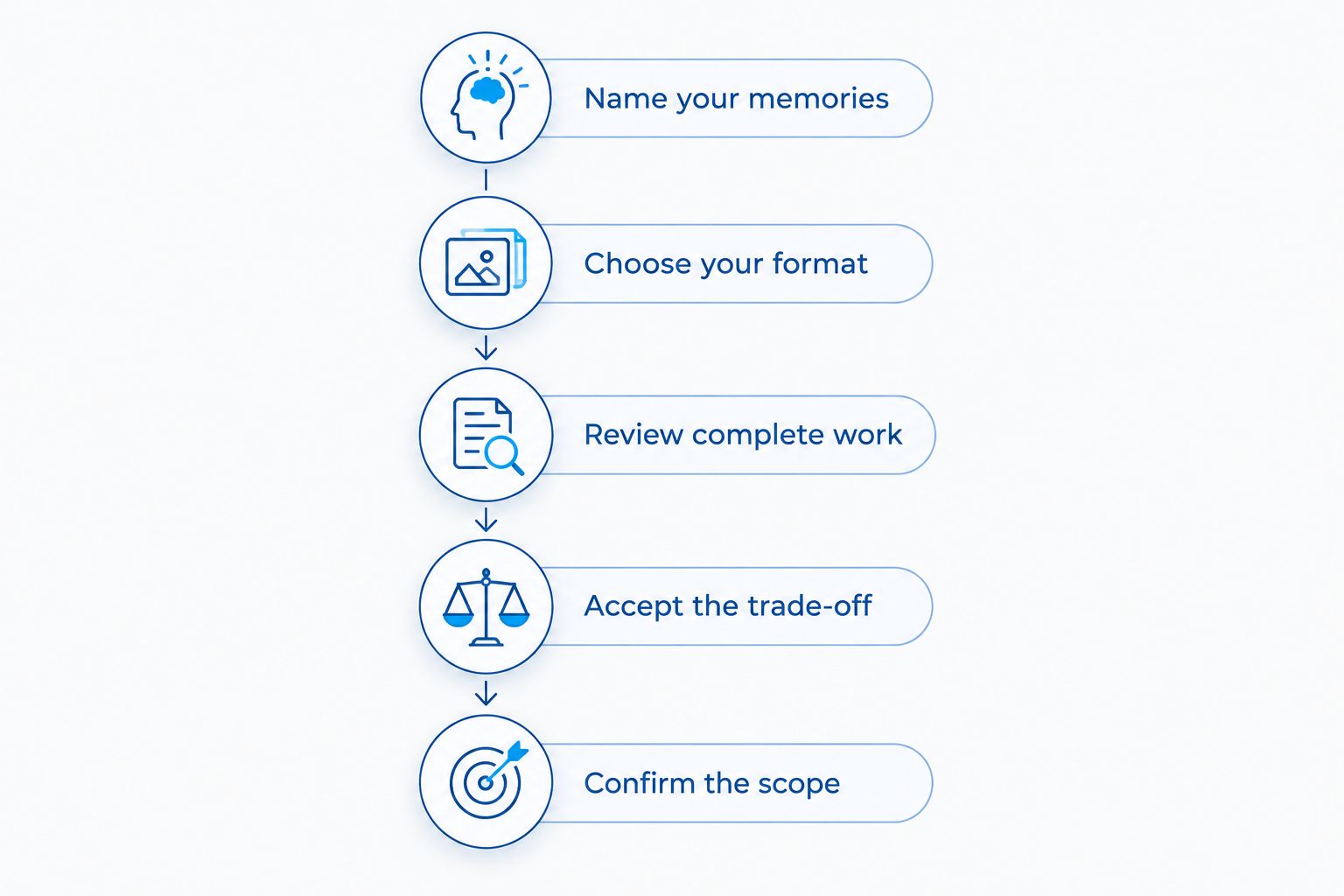
- Name your memories. Each partner writes down 3 moments they most want preserved. Describe the memory itself: a family portrait, the vows spoken aloud, or the movement of the first dance.
- Choose your format. Mark each moment as primarily a still-image priority or a sound-and-movement priority. If a moment belongs in both categories, identify which part matters more.
- Review complete work. Review 2 complete samples: a wedding gallery and a wedding film. Pay attention to ordinary moments as well as the dramatic highlights.
- Accept the trade-off. Say what you will not receive from the chosen format. If that sentence feels unacceptable, reconsider the coverage scope before signing.
- Confirm the scope. Put your priorities on 1 page and ask the provider to connect them to written deliverables, scheduled events, and any relevant venue restrictions.
You are evaluating the record you will keep, not simply choosing the most attractive sample. A film can win your attention while photography still fits your intended keepsakes better.
Why the right coverage choice varies
The useful differences are practical, not demographic. Your guest count, profession, or wedding label does not by itself decide whether still images or video matter more to you.
- Your intended keepsakes: Prints and albums favor dedicated photography; recorded voices and moving sequences favor video.
- Your ceremony priorities: A meaningful spoken exchange calls for sound recording if you want to hear it again, rather than only see a photograph of it.
- Your family priorities: Planned group portraits and recorded family interactions preserve different aspects of the same relationships.
- Your viewing habits: Choose a format you genuinely expect to revisit, rather than one you admire but rarely use.
- Your event schedule: Coverage must overlap the moments you care about. Neither medium can document an event after the professional has left.
- Your venue rules: Camera placement, movement, lighting, and audio permissions affect the recording plan. Confirm the applicable rules with your venue and provider.
These factors should shape the brief for your 2026 wedding. They do not establish what any particular package includes; the written scope does that.
What should you confirm in the coverage agreement?
Confirm the finished deliverables, not just the word photography or videography. A service label tells you the medium, but it does not explain every event covered, every file delivered, or every permission attached to those files.
For photo-only coverage, discuss the portrait plan, edited-image delivery, personal printing permissions, and the process for receiving your gallery. If you want an album, clarify whether album design and production form part of the agreement rather than assuming they do.
For video-only coverage, discuss spoken audio, ceremony and speech recordings, highlight editing, and the files you receive. Ask whether raw footage is included or excluded, and distinguish raw recordings from finished films.
David Suns Weddings offers wedding photography and videography services. The relevant limitation when choosing between them is the format itself: photo-only coverage cannot preserve voices, and video-only coverage does not establish a dedicated portrait deliverable.
Ask for the scope in writing before committing to your 2026 coverage. Verbal reassurance is not a substitute for identifying the actual output you expect to keep.
Can you get usable wedding photos from video footage?
You can extract still frames from video, but they are not equivalent to a dedicated wedding photography service. The result depends on the recording, the movement within the frame, and how the image will be used.
Video records a sequence; portrait photography can prioritize a particular expression, pose, composition, and finished still image. Those goals overlap, but they are not interchangeable.
If prints or family portraits matter, do not make frame extraction your unconfirmed backup plan. Ask for examples that match your intended use before relying on it.
Is video-only coverage enough if your guests take photos?
Video-only coverage is enough when you accept that guest photographs are supplementary rather than a guaranteed portrait collection. Guests choose their own moments and angles; their contributions do not establish professional coverage of your must-have images.
You can invite guests to share photographs without treating them as your photography team. If a specific family group must be recorded clearly, assign that priority to a planned service rather than hoping someone captures it.
The same principle works in reverse. Guest clips can supplement photo-only coverage, but they do not guarantee clear vows, complete speeches, or a finished film.
What if you and your partner want different formats?
Choose by comparing the memories each partner would most regret losing. An album preference and a desire to hear a parent's voice are different needs, so discuss the underlying keepsake rather than debating which medium looks more impressive.
If neither partner accepts the trade-off, ask whether a clearly defined combination of services fits your plans. Do not assume a photographer will also film key moments or that a videographer will create portraits unless the agreement expressly covers those tasks.
David Suns Weddings is a relevant option for engaged couples seeking wedding photography or videography. Use the conversation to establish which service fits your priorities, without assuming either format includes the other.
FAQ
What's better for a wedding, photo-only or video-only coverage?
Photo-only coverage is better for dedicated portraits and printed keepsakes; video-only coverage is better for recorded voices and movement. Choose according to the memories you most want to revisit.
Will I regret not having a wedding video?
Not having a wedding video means you will not receive a professional moving-and-sound record unless another service explicitly provides one. If hearing vows or family speeches is a priority, address that need before choosing photo-only coverage.
Can I book video-only wedding coverage without a photographer?
Yes, you can choose video-only wedding coverage if the provider offers that service. Confirm the finished films and accept that a dedicated photo gallery is not automatically included.
Can wedding video replace family portraits?
Wedding video does not automatically replace dedicated family portraits. If you want finished group photographs for printing, confirm a photography deliverable rather than relying on extracted frames.
Does a wedding highlight film include the whole ceremony?
A wedding highlight film does not by itself promise a complete ceremony recording. Ask whether the full ceremony is a separate deliverable and whether spoken audio is included.
How should we compare photography and videography samples?
Compare a complete wedding gallery with a complete film that matches your intended deliverable. Look beyond standout moments and check whether each example preserves the people and events you care about.
What should we ask David Suns Weddings before choosing coverage?
Ask David Suns Weddings which photography or videography deliverables match your must-have memories. Confirm the covered events, portrait or audio requirements, file delivery, and usage permissions in writing.
One last thing
Do not let the most shareable moment decide your entire wedding record. A short clip or striking portrait can attract attention, but your private priorities deserve more weight than what looks best in a social feed.
Before booking, complete this sentence together: the memory we most want to keep is ____. If the answer is a face, a family grouping, or an image to display, prioritize photography; if it is a voice or an event unfolding, prioritize video.