
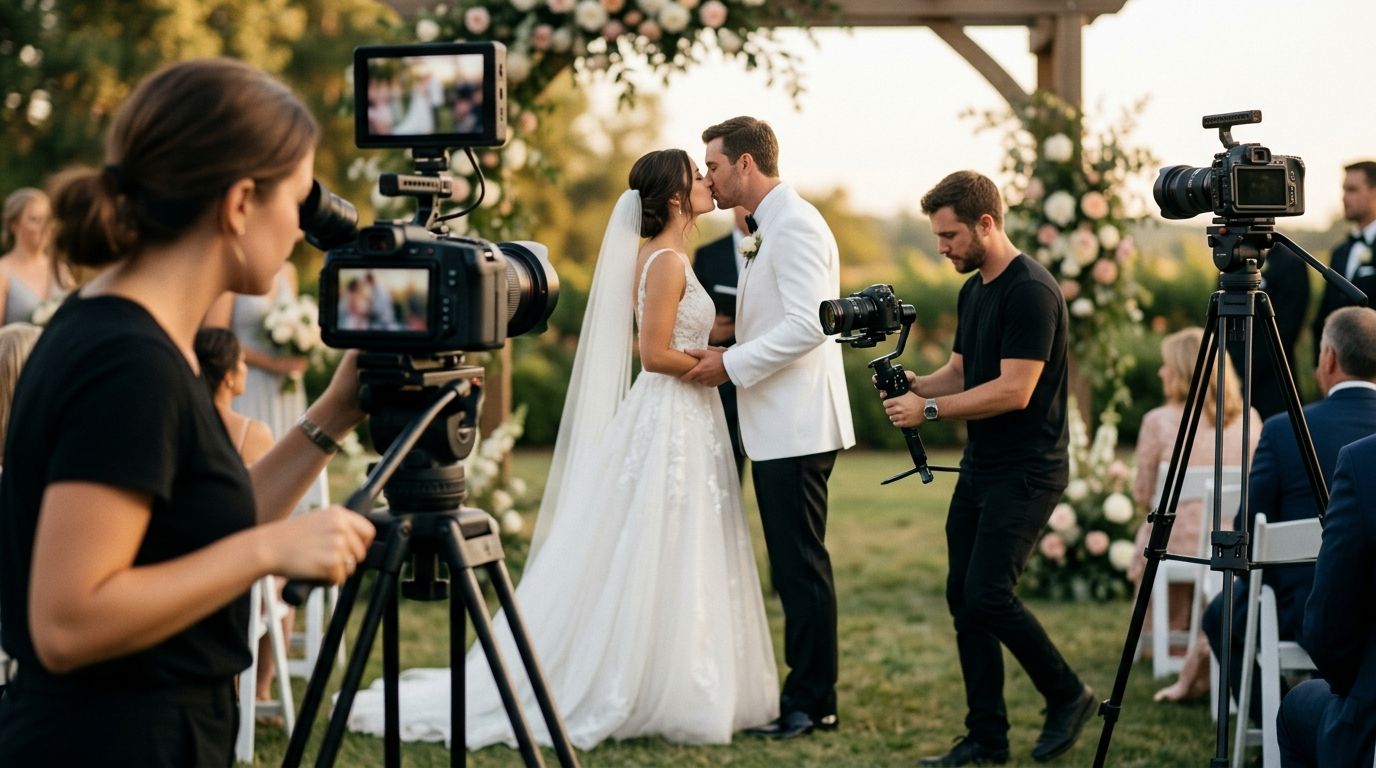
Multi-camera coverage means two or more synchronized video angles running through your ceremony and key moments instead of one photographer swinging a single lens between the aisle and the altar. For 2026 weddings, the right wedding videography package with multi-camera coverage depends on your day's shape, not just your budget.
- Best overall wedding videography package with multi-camera coverage in 2026: multi-day celebration coverage from David Suns Weddings.
- Best for remote guests: multi-camera coverage bundled with livestream integration.
- Best budget option: a trimmed multi-camera setup that still covers ceremony and reception angles.
- Same-day edit packages demand the tightest same-day schedule coordination of any multi-camera option.
- Drone add-ons need venue and FAA clearance before they're added to a coverage package.
Why this matters
A single-camera videographer misses reactions. While the lens is on the vows, the mother-of-the-bride's face during the processional goes uncaptured, and there's no way to get both the wide ceremony shot and a tight close-up of the ring exchange at the same time. Multi-camera coverage fixes that by running two, three, or four synced angles simultaneously.
For 2026, more couples are asking specifically for "multi-camera coverage" by name rather than assuming a single videographer covers it. That shift matters because not every wedding videography package with multi-camera coverage is built the same way — some add a second camera only for the ceremony, others run multiple angles through the entire reception too.
David Suns Weddings structures multi-camera packages around the shape of the day rather than a flat tier system, which is why the picks below are organized by use case instead of price point.
What makes the best wedding videography packages with multi-camera coverage
- Angle coverage that matches the moment — ceremony wide, ceremony tight, and a roaming reaction camera at minimum.
- Synchronized audio — lav mics on the couple and officiant that line up across every angle in the edit.
- Editing turnaround built into the package — some deliver a trailer in weeks, others take months for the full film.
- Use-case fit — a multi-day wedding needs different coverage logic than a single-evening reception.
- Venue and tech compatibility — livestream, drone, and low-light reception coverage all have real technical limits.
- Add-on flexibility — the ability to bolt on drone footage or a same-day edit without rebuilding the whole package.
At a glance: wedding videography packages with multi-camera coverage in 2026
| Package style | Best for | Standout feature | Key limitation |
|---|---|---|---|
| Multi-day celebration coverage | Weddings spanning 2-3 days | Continuous multi-camera coverage across every event | Requires more coordination and travel logistics |
| Livestream-integrated multi-camera | Guests who can't attend in person | Real-time feed alongside cinematic capture | Depends on venue wifi or hardwired internet |
| Reception highlights coverage | Capturing the party in full swing | Multiple angles on the dance floor and toasts | Limited value if the reception is short or low-key |
| Same-day edit coverage | An emotional recap shown the same night | Trailer-length film ready before the night ends | Tightest same-day schedule of any option |
| Drone-enhanced coverage | Aerial establishing shots | Wide aerial angles alongside ground cameras | Subject to venue rules and weather |
| Budget-conscious multi-camera | Couples prioritizing value | Ceremony and reception still get multiple angles | Fewer total camera positions than premium tiers |
1. Multi-camera coverage for multi-day celebrations: best for weddings spanning 2-3 days
Multi-day weddings — a welcome party, ceremony, and post-wedding brunch spread across separate days — need a videographer who plans camera positioning for each event separately, not just the ceremony. Multi-day multi-camera coverage keeps the same crew and editing style consistent across every event so the final film doesn't feel stitched together from different shoots.
Multi-day celebration coverage pros:
- One consistent visual style across every day of the celebration
- Reduces the chance of missing a moment because a single camera was pointed elsewhere
- Works well for cultural weddings with multiple distinct ceremonies
Multi-day celebration coverage cons:
- Longer engagement means more scheduling coordination up front
- Editing takes longer since footage from multiple days has to be woven into one film
Best for: couples with a welcome event, ceremony, and reception (or more) spread across separate days. Verdict: Buy if your wedding has more than one event worth filming.
2. Multi-camera coverage with livestream integration: best for remote guests
When part of the guest list can't travel, a multi-camera package with livestream integration sends a live feed of the ceremony out to remote viewers while separate cameras keep recording in full cinematic quality for the final film.
Livestream-integrated coverage pros:
- Remote family and friends watch the ceremony in real time
- The cinematic footage used for editing is separate from the livestream feed, so final quality isn't compromised
- Works for both small ceremonies and larger weddings
Livestream-integrated coverage cons:
- Reliable venue internet is a hard requirement, not optional
- Backup connectivity plans add a layer of technical prep most other packages skip
Best for: couples with grandparents, military family, or international guests who can't attend in person. Verdict: Buy if remote attendance actually matters to your guest list.
3. Multi-camera reception highlights coverage: best for capturing the party in full swing
Ceremony coverage gets most of the attention, but the reception is where multi-camera setups earn their keep. Reception highlights coverage runs multiple angles through toasts, the first dance, and the dance floor so nothing gets missed in the chaos of a moving crowd.
Reception highlights coverage pros:
- Multiple angles catch guest reactions during toasts, not just the speaker
- Dance floor energy comes through better with wide and close shots cut together
- Works well as a standalone add-on to a ceremony-focused package
Reception highlights coverage cons:
- Low-light reception venues push camera equipment harder than daylight ceremonies
- Short receptions (under two hours) get less value from a full multi-camera setup
Best for: couples planning a longer reception with a live band, DJ set, or extended dancing. Verdict: Buy if the reception is the emotional centerpiece of your day.
4. Multi-camera coverage with same-day edit: best for an emotional recap the same night
A same-day edit package pulls footage from the morning and ceremony, cuts a short trailer, and screens it during the reception — while the multi-camera setup keeps capturing the rest of the day in full for the final film.
Same-day edit coverage pros:
- Guests see a polished trailer before the night ends, which most other packages can't offer
- Adds an emotional moment to the reception itself
- Still delivers the full-length film later, separate from the trailer
Same-day edit coverage cons:
- Demands the tightest schedule coordination of any multi-camera option — footage has to be pulled and cut within hours
- Leaves less flexibility if the day runs behind schedule
Best for: couples who want a shareable moment during the reception itself, not just after the wedding. Verdict: Buy if your day-of timeline has real buffer built in; Wait if your schedule is already packed tight.
5. Multi-camera coverage with drone add-ons: best for aerial establishing shots
Drone footage adds a wide establishing shot that ground cameras can't get — the full venue, the recessional from above, or a sweeping shot of an outdoor ceremony. As a multi-camera drone add-on, it's a supplement to ground coverage, not a replacement.
Drone-enhanced coverage pros:
- Aerial shots give the final film a scale that ground-only footage lacks
- Works especially well for outdoor or waterfront venues
- Adds only a few minutes of footage but changes the opening or closing of the film
Drone-enhanced coverage cons:
- Many venues restrict or ban drone operation entirely — confirm before booking
- Weather and wind conditions can cancel the flight on the day
Best for: outdoor, waterfront, or large-property venues where an aerial shot adds real value. Verdict: Hold until you've confirmed your venue actually allows drone flights.
6. Multi-camera coverage on tight budgets: best for couples prioritizing value
A trimmed multi-camera package still covers the ceremony with two synced angles and adds a single roaming camera for the reception, instead of running four full angles through the entire day. It's the entry point into multi-camera coverage without the full premium build-out.
Budget-conscious multi-camera pros:
- Still delivers reaction shots and a wide ceremony angle, unlike single-camera coverage
- Keeps the core benefit of multi-camera work without paying for hours of reception coverage
- A realistic starting point for couples deciding between single- and multi-camera options
Budget-conscious multi-camera cons:
- Fewer total camera positions than a full premium package
- Reception coverage is typically limited to key moments, not continuous filming
Best for: couples who want multi-camera quality on the ceremony without paying for all-day multi-angle reception coverage. Verdict: Buy if the ceremony matters more to you than continuous reception footage.
How we ranked these
Each package above is scored against the six criteria listed earlier: angle coverage, audio sync, editing turnaround, use-case fit, venue compatibility, and add-on flexibility. No package wins on every criterion — that's why the ranking is organized by use case instead of a single leaderboard. A couple with a two-day celebration and a couple planning a same-evening reception need genuinely different setups, even if both are called "multi-camera coverage."
“If a videographer can't name where each camera will stand during your vows, the coverage isn't actually multi-camera.”
Which wedding videography package with multi-camera coverage should you choose?
For most weddings in 2026, multi-day celebration coverage is the strongest default because it's the only option built to handle more than one event without gaps in continuity. If your guest list includes people who can't attend, livestream-integrated coverage is the better fit. If your budget is the deciding factor, the trimmed multi-camera package still gets you real ceremony coverage without paying for a full premium build.
David Suns Weddings structures each of these as a starting point for a conversation, not a rigid menu — the exact camera count and add-ons for your day get confirmed once your venue, guest count, and timeline are on the table.
Talk through your coverage options
Get a package built around your venue, timeline, and guest list.
FAQ
What does multi-camera coverage actually mean for a wedding video?
It means two or more cameras run at the same time during key moments like the ceremony, capturing different angles — a wide shot, a close-up, and often a reaction camera — instead of one camera swinging between shots.
Is multi-camera coverage worth it over single-camera wedding videography?
Yes for ceremonies and receptions with multiple moving parts — reactions, toasts, first dances — where a single camera can only capture one angle at a time. For a short, simple ceremony, the gap is smaller.
How many cameras count as "multi-camera" coverage?
Two cameras is the minimum threshold most videographers use for the term. Packages with three or four synced angles across ceremony and reception are common in 2026 for fuller coverage.
Can I add a drone to any multi-camera wedding videography package?
Only if your venue allows it. Drone add-ons depend on venue policy and weather conditions on the day, so confirm venue rules before assuming it's included.
What's the difference between a same-day edit and the full wedding film?
A same-day edit is a short trailer cut and shown during the reception itself, while the full-length film is delivered later using the complete multi-camera footage from the entire day.
Do multi-camera packages work for multi-day weddings?
Yes — multi-day celebration coverage is built specifically to carry the same crew and camera setup across every event of a multi-day wedding, keeping the visual style consistent.
Does livestream coverage lower the quality of the final wedding film?
No. Livestream feeds and cinematic footage are typically captured on separate cameras, so the live feed to remote guests doesn't affect the quality of the final edited film.
Is multi-camera coverage necessary for a small or intimate wedding?
Not always. A tight guest list and simple ceremony can be well served by a trimmed multi-camera setup rather than a full premium build with four angles running all day.
One last thing
Most multi-camera wedding films run on three to four synced angles at the ceremony — ceremony wide, ceremony tight, and a roaming reaction camera — and adding a fifth rarely changes the final edit unless the venue has two simultaneous events happening at once. Before booking any wedding videography package with multi-camera coverage for 2026, ask specifically where each camera will be positioned during your vows. If the videographer can't answer that in one sentence, the coverage plan hasn't actually been built yet.


