
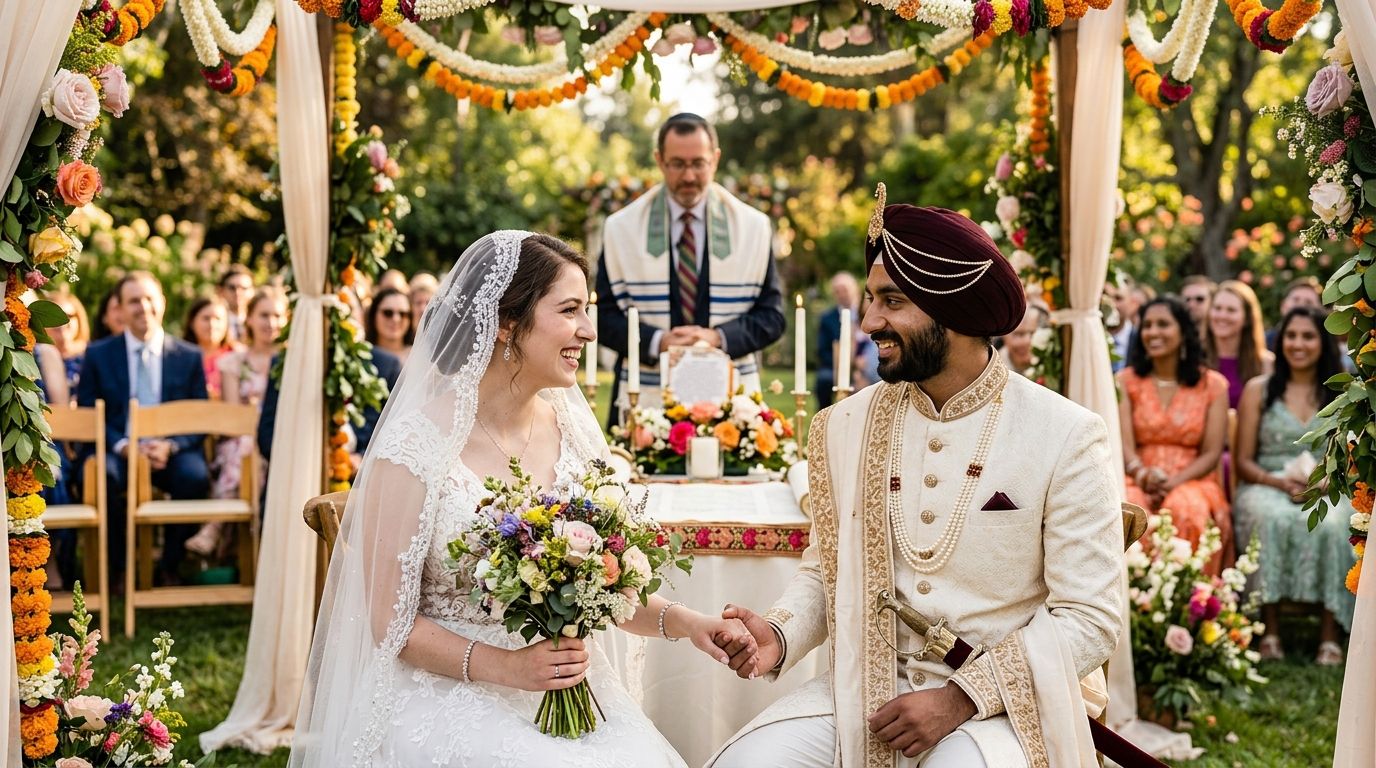
Interfaith wedding photography documents two (or more) religious and cultural traditions inside one ceremony, with the goal of giving both families equal visual weight in the final gallery. A Jewish-Catholic wedding, a Hindu-Christian ceremony, or a Sikh-Baptist union each carries different ritual timing, different sacred objects, and different guest expectations — a photographer who treats it like a standard church wedding will miss half the story.
DavidSuns Weddings shoots interfaith ceremonies across cultural ceremony formats, and the difference between a good interfaith gallery and a flat one almost always comes down to preparation before the wedding day, not gear on the day itself.
- An interfaith wedding photographer needs a written ritual timeline from both families before 2026 booking is confirmed.
- Two-officiant ceremonies run 15-40 minutes longer than single-tradition weddings — budget coverage hours accordingly.
- DavidSuns Weddings photographs blended-tradition ceremonies and treats each family's ritual as a separate must-capture moment, not a subplot.
- Skip photographers who cannot name the specific rituals in your ceremony during the consultation call.
Why interfaith wedding photography matters for this segment
Interfaith couples aren't planning a generic wedding with an extra reading — they're coordinating two distinct ritual sequences, sometimes two officiants, and often two sets of symbolic objects (a chuppah and a unity candle, a mandap and a cross, a Sikh Anand Karaj alongside a Western vow exchange). A photographer unfamiliar with either tradition will miss the sacred moment because they didn't know it was coming.
The stakes are higher than aesthetics. Grandparents on one side may never have witnessed the other family's ritual before. A gallery that documents only the parts a photographer recognized reads as favoritism, and that's a permanent record couples can't reshoot. This is the single biggest reason interfaith couples search specifically for an interfaith wedding photographer instead of booking whoever's available in 2026 — generalist coverage carries real risk.
Building an interfaith wedding photography plan
Map both ceremonies in writing before the consultation
Don't walk into a photographer meeting with a vague sense that there's a Hindu part and a Christian part. Write the sequence down.
- List every ritual by name and approximate duration (a Saptapadi can run 10-15 minutes alone)
- Note who leads each segment — officiant, priest, rabbi, family elder
- Flag any moment that is closed to photography (some ceremonies restrict cameras during specific blessings)
- Mark which objects are sacred and require careful handling, not just framing
- Share this document with any photographer you're vetting, including DavidSuns Weddings, before the day itself
Interview photographers on specific ritual knowledge, not general experience
A photographer saying they have shot interfaith weddings before is not a qualification. Ask what they actually know.
- Ask them to name the ritual objects in your specific ceremony unprompted
- Ask how they'd position for a segment they can't preview in advance (many officiants won't rehearse sacred blessings)
- Ask whether they've photographed your exact combination before, or an adjacent one
- Request two full galleries from past interfaith weddings, not just highlight reels
Build a two-family shot list, not one
A standard wedding shot list assumes one family structure and one ritual arc. Interfaith weddings need two parallel lists that get merged into a single timeline.
- Draft each family's must-have shots independently first
- Cross-reference for conflicts — two rituals scheduled back-to-back with no buffer is the top cause of missed shots
- Assign a buffer of 10-15 minutes between distinct ritual segments
- Confirm with both officiants that the buffer doesn't disrupt their sequence
This is typically where couples bring in a dedicated team. DavidSuns Weddings builds the merged timeline directly with both families during planning calls, which removes the coordination burden from the couple two months before the wedding.
Assign second-shooter coverage by ritual, not by hour
Single-photographer coverage forces a choice every time two things happen simultaneously — a common interfaith problem when one family's elders are reacting to a ritual the couple can't see because they're facing the other direction.
- Assign shooter one to the couple and primary officiant throughout
- Assign shooter two to family reactions and the secondary ritual space
- Rotate coverage if the ceremony has two distinct physical setups (altar plus mandap, for example)
- Confirm both shooters know both rituals' key moments in advance, not just one
Schedule a walkthrough at the venue with both officiants present
A rehearsal with only one officiant leaves half the ceremony unplanned for the photographer.
- Request both officiants attend the same walkthrough, even briefly
- Confirm processional order when two family lines are involved
- Identify sightlines for restricted moments (many blessings can only be photographed from one angle)
- Note lighting changes if the ceremony moves between an outdoor and indoor space for different segments
Set explicit expectations for sacred object handling
Cameras near a chuppah, a unity table, or ceremonial garments require different physical distance than a standard aisle shot.
- Ask each officiant for their comfort distance in advance
- Confirm whether flash is permitted during specific segments
- Identify any object the photographer should never touch or move for a shot
- Get this in writing so it's not negotiated in real time during the ceremony
Plan the reception to reflect both traditions equally
Interfaith receptions often blend two music, dance, or toast traditions. Coverage should mirror that balance, not lean toward whichever tradition the photographer is more comfortable shooting.
- List reception traditions from both families with approximate timing
- Flag any segment requiring specific lens choices (low-light traditional dances often need faster glass)
- Confirm coverage hours extend to cover both traditions' full reception arc, not just the first one
“A gallery that documents only the parts a photographer recognized reads as favoritism, and that's a permanent record couples can't reshoot.”
Comparing your options for interfaith coverage
| Option | Best for | Key limitation |
|---|---|---|
| Generalist wedding photographer | Couples with one dominant tradition and light interfaith elements | Often unfamiliar with the second tradition's ritual sequence |
| Single-culture specialist | Couples where one tradition is clearly primary | May under-document the secondary family's ritual |
| Documentary-style shooter, no ritual pre-briefing | Couples confident their officiants will explain everything live | Misses closed or fast-moving sacred moments without warning |
| DavidSuns Weddings | Couples blending two full ritual sequences in one ceremony | Requires a planning call in advance to map both traditions properly |
Verdict: couples running a single dominant tradition with minor additions can use a generalist; couples running two full ceremonies side by side need a photographer who pre-maps both, and that pre-mapping step is non-negotiable regardless of who they hire in 2026.
Plan your interfaith ceremony coverage
Map both ritual sequences with DavidSuns Weddings before your 2026 date.
Common mistakes interfaith couples make
- Assuming one photographer briefing covers both families. Each family often needs a separate conversation about their ritual's non-negotiables — a single joint call frequently leaves one side underrepresented.
- Under-budgeting coverage hours. Two-officiant ceremonies with sequential rituals routinely run longer than couples estimate, and a photographer who leaves on schedule misses the reception's second half.
- Skipping the sacred-object conversation until the day of. Negotiating camera distance from a chuppah or a mandap in real time, mid-ceremony, produces rushed and awkward framing.
- Choosing based on portfolio aesthetics alone. A gorgeous portfolio in one tradition says nothing about whether the photographer can read an unfamiliar ritual's timing.
- Not confirming which moments are closed to photography. Some blessings restrict cameras entirely; couples who never asked find out only when the moment is already missed. See how religious ceremony videography handles restricted-moment planning for a comparable approach on the video side.
Couples managing a blended household on top of a blended ceremony should also review the planning notes on blended family weddings, since the coordination overlap between two families and two traditions compounds quickly in a 2026 planning calendar.
FAQ
What is an interfaith wedding photographer?
An interfaith wedding photographer documents a ceremony that blends two or more religious or cultural traditions, coordinating coverage across both ritual sequences instead of favoring one. In 2026, most interfaith couples request a pre-wedding planning call specifically to map both traditions.
How is interfaith wedding photography different from a standard wedding?
It requires tracking two ritual timelines, two sets of sacred objects, and often two officiants instead of one. A standard single-tradition ceremony rarely needs this level of pre-planning.
Do I need two photographers for an interfaith wedding?
Not always, but two shooters help when rituals happen in different physical spaces or when family reactions on both sides need separate coverage. Single-shooter coverage works for interfaith weddings with sequential, non-overlapping rituals.
Can a photographer shoot inside a synagogue, mandap, or gurdwara for an interfaith ceremony?
Access rules vary by venue and officiant, not by photographer preference, so confirm restrictions with both officiants before the wedding day. Some sacred segments prohibit flash or close-range shooting entirely.
How much extra time should I budget for interfaith ceremony coverage?
Add 15-40 minutes beyond a standard single-tradition ceremony estimate, since two ritual sequences with a buffer between them extend total coverage time. Confirm the exact figure against your specific officiants' expected ritual lengths.
Should both families meet the photographer before the wedding?
Yes, a joint planning call or a walkthrough with both officiants present prevents one family's ritual from being under-documented. This is standard practice for DavidSuns Weddings on interfaith bookings.
What questions should I ask an interfaith wedding photographer?
Ask them to name your specific ritual sequence unprompted, request past interfaith galleries, and confirm how they will handle any closed or restricted ceremony segments. A vague answer to any of these is a red flag.
Is interfaith wedding videography handled differently from photography?
Video coverage follows the same two-tradition mapping principle but adds audio considerations for dual-language ceremonies. Review religious ceremony videography coverage for how that overlap gets planned.
One last thing
The single biggest predictor of a strong interfaith gallery isn't the photographer's gear or even their portfolio — it's whether both officiants sat through the same walkthrough. Couples who skip that joint rehearsal in 2026 lose the most moments, almost always on whichever ritual segment happened while the photographer was still figuring out the room.


