
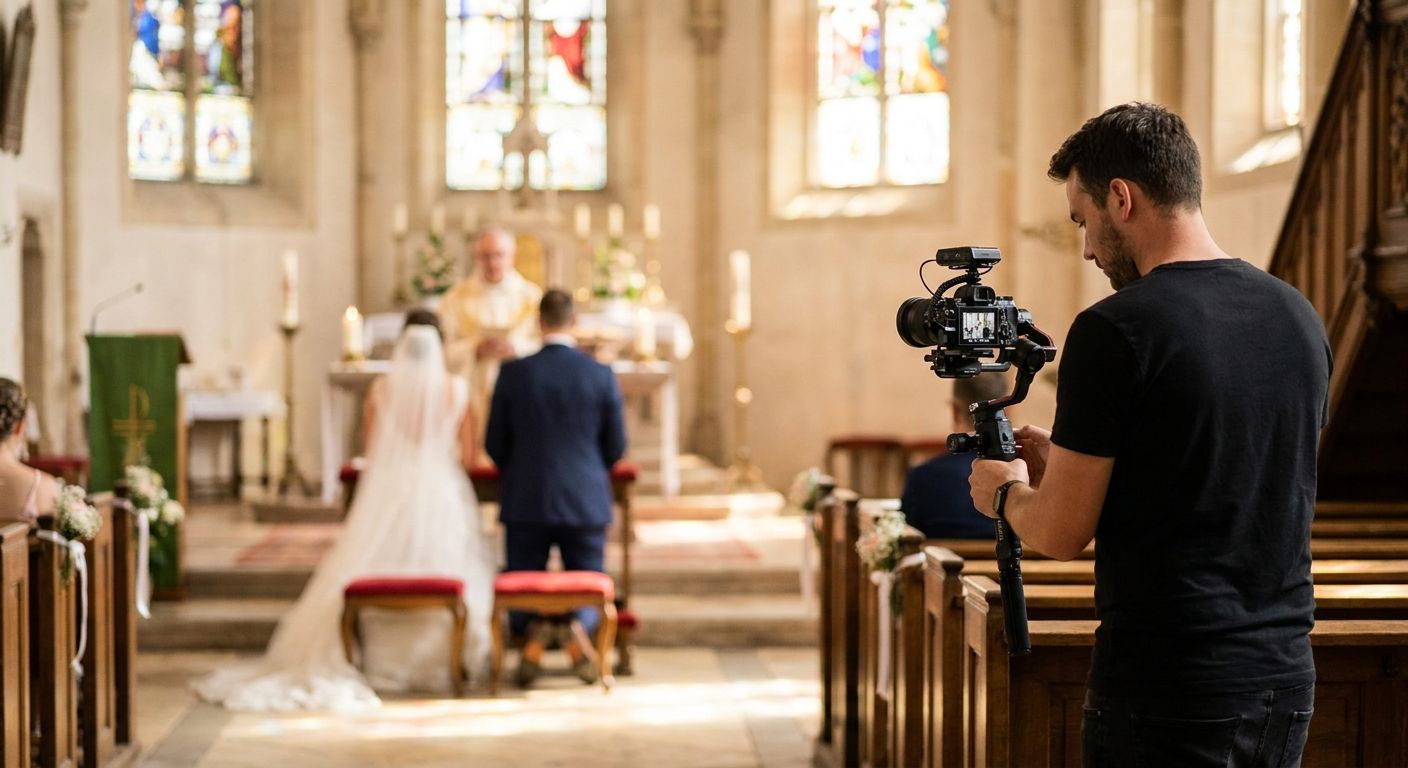
A religious ceremony videographer needs more than a good lens — they need to know when to move, when to stay still, and when the officiant's rules matter more than the shot list. This guide breaks down what actually matters when you're hiring wedding videography for a Catholic Mass, Jewish ceremony, Hindu ceremony, or any faith-based rite, and which coverage approach fits your ceremony rather than a generic timeline.
- Documentary-style coverage is the safest religious ceremony videographer pick for Mass, chuppah, or mandap rituals in 2026 — buy it.
- Skip single-camera packages for ceremonies over 45 minutes; you'll miss reactions during processionals and blessings.
- Civil ceremony videography works for courthouse or officiant-led services under 30 minutes but under-delivers for multi-ritual faith ceremonies.
- A lav mic on the officiant plus a second audio source is non-negotiable for vows, readings, and blessings.
- Ceremony highlight add-ons are worth it when your faith tradition includes a ritual you want as a standalone film, not buried in the full edit.
Why this matters
Religious ceremonies run on someone else's clock and someone else's rules. A priest, rabbi, imam, or officiant sets restrictions on where a camera can stand, whether a videographer can move during a blessing, and how close anyone gets to the altar, chuppah, or mandap. A wedding videographer who's only shot backyard and vineyard weddings often doesn't know these constraints exist until they're standing in the aisle during a live ceremony.
Getting this wrong costs you footage you can't reshoot. A missed ring exchange, a blown audio track during vows, or a videographer asked to leave mid-ceremony for standing too close — these are permanent losses, not editing problems.
Who this is for
This guide is for couples having a ceremony rooted in a specific faith tradition — Catholic Mass, Jewish ceremony under a chuppah, Hindu Vedic rites, Muslim nikah, Orthodox service, or any ceremony where a religious officiant, not a hired celebrant, runs the proceedings. If your ceremony has fixed liturgy, ritual sequences, or venue rules set by a church, synagogue, temple, or mosque, the coverage decisions below apply directly to you.
What to look for in a religious ceremony videographer
Experience with your specific tradition
A videographer who has shot Catholic Mass weddings before knows the sequence: processional, liturgy of the word, vows, Eucharist (if included), and recessional — and knows which parts allow movement. Someone who has never worked a Hindu wedding won't anticipate that Vedic ceremonies frequently span 2-3 hours across multiple rituals, from the baraat arrival to the saptapadi (seven steps). Ask for footage from ceremonies matching your faith before booking wedding videography for 2026.
Camera discretion and venue restrictions
Many churches restrict flash photography and require videographers to stay in fixed positions near the back or side aisles during Mass. Orthodox Jewish ceremonies often separate seating and limit where a non-family member — including a videographer — can stand during the chuppah. A videographer unfamiliar with these rules either gets footage from a bad angle or gets stopped by an usher mid-ceremony.
Multi-camera coverage for ritual-heavy ceremonies
A single camera catches the officiant. It misses the groom's reaction during the badeken, the parents' faces during a Hindu var mala exchange, or the congregation's response during a nikah. Ceremonies running longer than 30-45 minutes need at least two camera positions to catch both the ritual and the reactions around it.
Audio capture built for liturgy
Vows, blessings, readings, and officiant remarks are the audio backbone of ceremony footage. A lav mic clipped to the officiant plus a secondary shotgun mic on a second camera protects against feedback, echo in a stone church, or a dead battery. Ceremonies without dedicated audio gear routinely lose the vows entirely to ambient noise.
Backup equipment and a second shooter
Religious ceremonies don't pause for a dead battery or a full memory card. A videographer working alone with no backup body risks losing the ring exchange or the recessional to equipment failure. For ceremonies over an hour, a second shooter isn't a luxury add-on — it's coverage insurance.
Top picks for religious ceremony coverage
Documentary-Style Full Ceremony Coverage — the safe pick
This approach shoots the ceremony as it unfolds, minimal staging, two or more camera angles, full audio capture of vows and blessings. It's built for Mass, chuppah, mandap, or nikah ceremonies where the liturgy itself is the story. One spec that matters: continuous multi-camera rolling from processional to recessional, so no ritual moment gets cut for a lens change. Verdict: Buy — this is the default for any faith-based ceremony with fixed liturgy. See the documentary-style wedding film approach for what full-ceremony coverage actually includes.
Streamlined Civil Ceremony Package — the budget pick
Built for shorter, officiant-led ceremonies without extended liturgy — courthouse weddings, brief interfaith blessings, or civil ceremonies under 30 minutes. One spec that matters: single-camera setup is workable here because the ceremony itself is short and low-ritual. Verdict: Consider for a brief civil ceremony, Skip if your ceremony includes extended rites like a full Mass or multi-hour Hindu ceremony — this package under-delivers on ritual-heavy footage. Compare it against your ceremony length using the civil ceremony videography breakdown.
Cultural and Multi-Faith Ceremony Coverage — the specialist pick
For Jewish, Indian, or other culturally specific ceremonies, coverage built around the actual ritual sequence — badeken, chuppah, mandap entrance, saptapadi — beats a generic wedding timeline. One number that matters: Jewish ceremonies can run as short as 30 minutes total, but the chuppah blessings alone often take 10-15 minutes and need dedicated audio focus. Verdict: Buy if your officiant follows a structured cultural or interfaith sequence; a generalist videographer without this planning will miss the sequence entirely.
Ceremony Highlight Add-On — the polish pick
A standalone short film built just from ceremony footage — vows, ring exchange, key blessings — separate from the full wedding film. One spec that matters: typically delivered as a 3-5 minute cut, distinct from the full-length ceremony video. Verdict: Buy if you want a shareable piece focused entirely on the religious rite itself, Skip if your full ceremony coverage already delivers a complete edit. Details on what's typically included are in the ceremony highlight add-on guide.
What to avoid
- Single-camera livestream-only packages. These look affordable but leave no coverage of reactions, processional entries, or side-angle ritual moments — fine for a 20-minute civil ceremony, wrong for a full Mass or Hindu ceremony.
- Videographers with no clergy-rules experience. A videographer who hasn't worked with officiants before will improvise camera placement during the ceremony itself, risking being stopped mid-rite by an usher or clergy member.
- Packages with no dedicated audio for the officiant. If the package description doesn't mention a lav mic or audio drop on the officiant, assume the vows and blessings will be picked up by ambient room mics only — a common failure point in ceremony footage.
Book ceremony coverage for 2026
Talk through your ceremony's rituals, length, and venue rules before booking.
Verdict comparison
| Coverage type | Tradition experience | Camera discretion | Audio capture | Backup coverage | Verdict |
|---|---|---|---|---|---|
| Documentary-Style Full Ceremony | Built for liturgy-heavy rites | Multi-angle, minimal disruption | Lav + shotgun standard | Second camera included | Buy |
| Streamlined Civil Ceremony | Fine for short services | Single fixed angle | Basic audio only | Single shooter | Consider / Skip |
| Cultural & Multi-Faith | Built around ritual sequence | Positioned for specific rites | Focused on blessing audio | Varies by package | Buy |
| Ceremony Highlight Add-On | Depends on base package | N/A — uses existing footage | Pulled from ceremony audio | N/A | Buy |
FAQ
What's the best videography style for a religious ceremony?
Documentary-style coverage is the best fit for religious ceremonies in 2026 because it captures liturgy, blessings, and reactions without staging interruptions. Ceremonies with fixed ritual sequences, like Mass or a chuppah service, need continuous multi-camera rolling rather than posed setups.
Is documentary style better than a cinematic trailer for church weddings?
For the ceremony itself, documentary style is better because it prioritizes complete liturgy capture over stylized cuts. A cinematic trailer works well as a supplementary highlight after the full ceremony has been documented, not as a replacement for it.
Can a videographer film during a Catholic Mass or Jewish ceremony?
Yes, but most churches and synagogues set specific rules on camera position, movement, and flash use during the ceremony. A videographer experienced with religious ceremonies will confirm these rules with the officiant or venue ahead of the wedding day.
Do we need two videographers for a long religious ceremony?
For ceremonies running longer than 30-45 minutes, yes — a second camera catches reactions and side-angle ritual moments a single shooter misses. Hindu ceremonies spanning 2-3 hours and full Catholic Masses both benefit from multi-camera coverage.
What's the difference between wedding photography and videography for a ceremony?
Photography captures still moments at key points in the ceremony, while videography captures the full sequence including audio of vows and blessings. Most couples book both, but videography is the only format that preserves the spoken parts of a religious ceremony.
How early should we book a religious ceremony videographer?
Book as soon as your ceremony date and venue are confirmed, since religious ceremony videographers with tradition-specific experience get booked well ahead of peak wedding months. Waiting until a few months out limits your options to whoever's still available.
Do ceremony highlight add-ons cost extra?
Ceremony highlight add-ons are typically priced separately from full-length ceremony coverage since they involve additional editing time for a standalone cut. Ask directly what's included in your base package before assuming a highlight reel is bundled in.
Will a videographer coordinate with our officiant beforehand?
An experienced religious ceremony videographer will reach out to the officiant or venue coordinator before the wedding day to confirm camera placement and movement rules. This step prevents mid-ceremony conflicts over where the camera can stand.
One last thing
The single biggest ceremony footage failure isn't a bad angle — it's dead audio during the vows because nobody mic'd the officiant. Confirm the lav mic setup in writing before the 2026 wedding day, not the morning of.


