
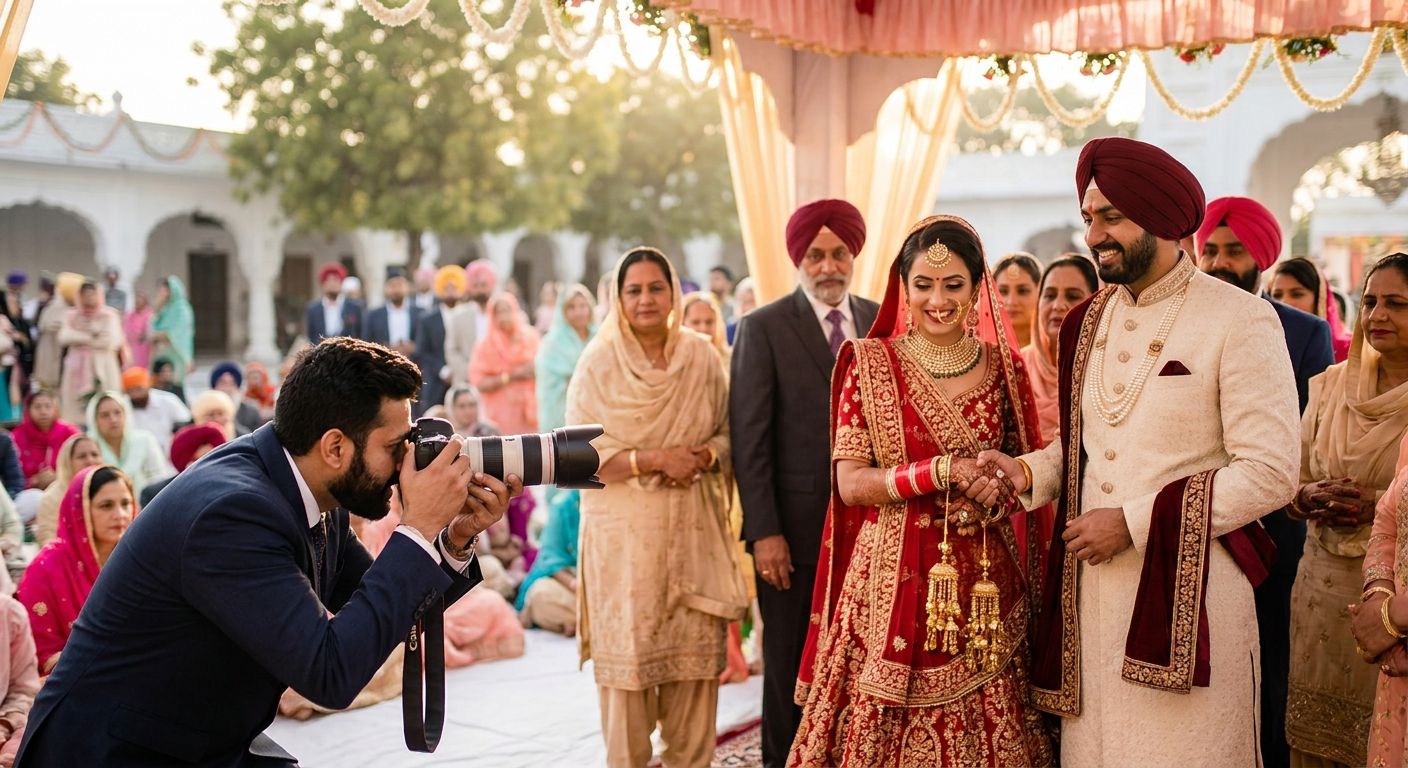
Sikh wedding photography is coverage built around the Anand Karaj ceremony, the Milni greeting ritual, and the multi-day celebrations that surround them, with the aim of documenting ritual detail without disrupting Gurdwara protocol. A generalist wedding photographer who has never stood through four laavan rounds will miss the moments that matter most to Sikh families, and that gap shows up in the final gallery, not on the invoice.
- A sikh wedding photographer needs a written shot list covering Milni, the four laavan rounds, and the Doli farewell before 2026 booking is confirmed.
- Gurdwara photography rules on flash and head coverings must be confirmed with the committee at least 30 days before the ceremony.
- Family portrait blocks for 60-plus relatives need a dedicated time slot, separate from candid coverage.
- David Suns Weddings builds coverage plans around multi-day Sikh celebrations rather than treating each event as a standalone booking.
Why hiring a sikh wedding photographer matters for Sikh ceremonies
The Anand Karaj happens once, inside the Gurdwara, and it moves on its own schedule set by the Granthi, not by a photography timeline. A photographer who doesn't know that the four laavan mark the core of the ceremony will burn time repositioning instead of shooting.
Sikh weddings also run across multiple events rather than a single day: Sangeet, Mehndi, the Anand Karaj morning ceremony, and an evening reception often stack across 2-4 days. Coverage that treats each event as an isolated booking loses the narrative thread a family actually wants in David Suns Weddings galleries and films.
Update your search criteria before you contact anyone
Start by filtering for photographers who can name the rituals unprompted, not ones who need a briefing document to get through the day.
- Ask whether they've shot inside a Gurdwara before and what the flash policy was
- Ask them to describe the Milni sequence between the two families
- Ask how they handle the Doli farewell, which moves fast and happens without warning
- Check whether their portfolio shows full ceremony coverage, not just reception portraits
Build a two-camera shot list for ceremony and reception
A written list, agreed before the wedding day, is the single biggest predictor of whether the gallery matches what the family actually wanted.
- List each of the four laavan rounds around the Guru Granth Sahib
- List the Milni handshakes and garland exchanges between both families
- List the Doli farewell and the emotional reactions around it
- List reception entrance, Bhangra or Giddha performances, and cake cutting
This is where a specialist earns the booking over a generalist. David Suns Weddings works from a shot list confirmed in advance, so the four laavan rounds get covered from both angles instead of one missed frame per round.
Plan coverage across every day of the celebration
Treat Sikh wedding photography as one connected project, not four separate shoots.
- Sangeet night with choreographed dance sets
- Mehndi with close-up hand and henna detail work
- Anand Karaj morning ceremony inside the Gurdwara
- Reception evening with formal portraits and open dancing
Coverage that spans this many days needs a plan for hours, crew, and hand-off between events. The multi-day celebration coverage page breaks down how that schedule gets built for videography, and the same logic applies to stills.
Confirm Gurdwara photography rules before you sign anything
Every Gurdwara sets its own protocol, and the family planning the wedding may not know the current rules if it's their first time working with that specific committee.
- Head coverings are required for all attendees, including the camera crew
- Flash photography near the Guru Granth Sahib is restricted at many Gurdwaras
- Aisle movement during the four rounds may be limited to specific zones
- Footwear removal applies to photographers the same as guests
Confirm these rules with the Gurdwara committee at least 30 days before the ceremony, not the morning of. A photographer who asks this question unprompted has done this before.
Schedule multigenerational family portraits as a separate block
Sikh weddings routinely bring together extended families of 60-plus relatives, and that portrait session needs its own dedicated slot rather than being squeezed between Milni and the ceremony.
- Allocate a fixed time block before the Milni greeting starts
- Assign one family member to call names and organize groups
- Shoot formal multigenerational portraits before the crowd disperses
- Build in buffer time for outfit and jewelry adjustments between groups
The multigenerational family portrait guide covers how to structure that block so it doesn't eat into ceremony coverage time.
Decide between photography-only, videography-only, or combined coverage
This decision shapes the crew size and the shot list more than any other choice a couple makes.
Book early for peak Sikh wedding season
Gurdwara and venue availability clusters around specific weekends, and popular dates within Sikh communities book out well ahead of 2026's peak months. Waiting until three months out limits the pool to whoever happens to be free, not whoever fits the ceremony.
Coverage options compared
| Option | Best for | Key limitation |
|---|---|---|
| Photography-only | Couples who want a printed album as the primary keepsake | No moving footage of the four laavan or the Doli farewell |
| Videography-only | Couples prioritizing a same-day-edit reception film | Misses the still-frame detail shots families frame and share |
| Combined photo + video | Couples covering a full multi-day celebration | Requires a larger crew and tighter scheduling coordination |
| Photography + second shooter | Large families with 60-plus relatives across multiple events | Adds a coordination layer between two shooters' shot lists |
Ready to book your Sikh wedding coverage?
Talk through your ceremony schedule and shot list before you commit.
Common mistakes Sikh couples make when booking a photographer
- Hiring a generalist who's never worked a Gurdwara ceremony — the four laavan rounds and the Milni sequence catch unprepared photographers off guard every time.
- Leaving the flash and head-covering conversation until wedding morning — Gurdwara committees expect this confirmed weeks ahead, not on arrival.
- Underestimating portrait time for large extended families — a 60-plus relative group needs 30-45 minutes minimum, not the 10 minutes generalist timelines allow.
- Treating Sangeet, Mehndi, and the Anand Karaj as three separate bookings — the gallery reads disjointed when there's no continuity plan across days.
- Skipping the written shot list — verbal instructions on the day get lost once the ceremony starts moving.
FAQ
What's the best sikh wedding photographer for Anand Karaj coverage?
The best sikh wedding photographer for Anand Karaj coverage is one who can describe the four laavan rounds and Milni sequence unprompted during your first consultation. Portfolio samples showing full Gurdwara ceremonies, not just reception shots, confirm the experience.
Is videography necessary for a Sikh wedding?
Videography isn't mandatory, but it captures moving moments like the Doli farewell and Bhangra performances that still photos can't fully convey. Couples covering multi-day celebrations often pair photography with video specifically for the ceremony and reception.
How many days does Sikh wedding photography typically cover?
Sikh wedding photography often spans 2-4 days, covering Sangeet, Mehndi, the Anand Karaj ceremony, and the reception. Each event needs its own shot list even when the same crew covers all of them.
Can photographers use flash during the Anand Karaj ceremony?
Flash policy near the Guru Granth Sahib varies by Gurdwara, and many restrict it entirely. Confirm the specific rule with the Gurdwara committee at least 30 days before the ceremony.
What should be included in a Sikh wedding shot list?
A Sikh wedding shot list should include the Milni greeting, all four laavan rounds, the Doli farewell, and reception moments like the entrance and cake cutting. Family portrait blocks belong on the list as a separate scheduled item.
Do Sikh weddings need a dedicated family portrait block?
Yes, extended Sikh families often number 60-plus relatives, and that group needs a fixed time slot before the Milni greeting starts. Squeezing portraits between other events causes rushed, incomplete groupings.
How early should you book a sikh wedding photographer?
Book a sikh wedding photographer as early as possible once your Gurdwara and reception dates are confirmed, since popular weekends in 2026 book out well ahead of the season. Waiting until a few months out narrows your options significantly.
Do Gurdwaras require head coverings for the photography crew?
Yes, head coverings apply to everyone inside the Gurdwara, including photographers and videographers, not just wedding guests. Confirm this along with footwear and flash rules before the ceremony date.
One last thing
The Doli farewell often happens within minutes of the reception winding down, not the next morning, and it catches unprepared crews without a camera in position. Assign a second shooter whose only job during that window is the farewell, so the primary photographer can stay locked on formal reception coverage without splitting attention.


