
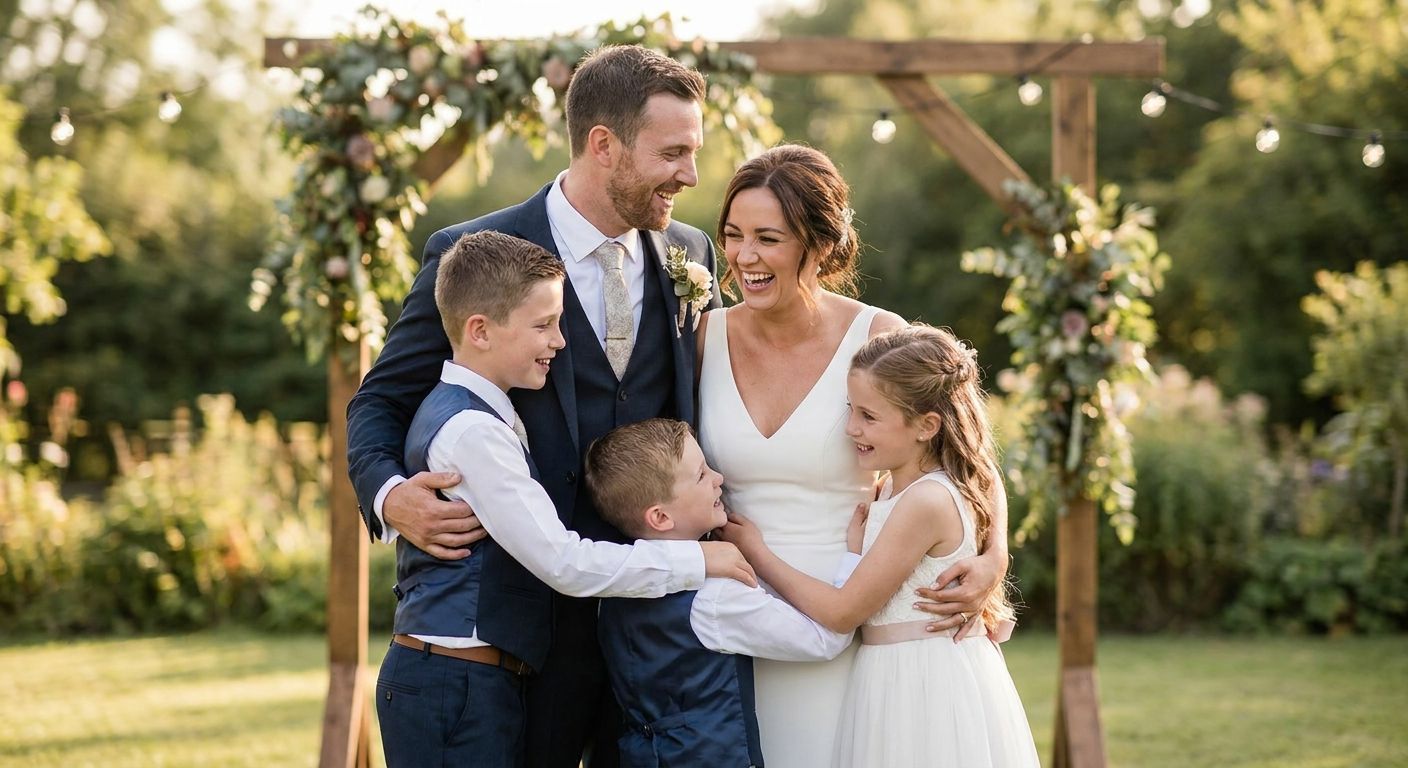
Wedding photography for blended families is a portrait and coverage plan built around two or more parental units, step-siblings, and children from a previous marriage standing together on camera. The needs differ from a standard wedding shoot because the photographer has to manage seating politics, custody-schedule constraints, and portrait groupings a single-family wedding never requires.
- Wedding photography for blended families needs a written family-grouping list before your 2026 date.
- Budget 30-45 minutes for family formals when three or more parental units are involved.
- Photograph biological parents first, step-parent combinations second, combined groups last.
- David Suns Weddings plans blended-family portrait lists separately from standard formals.
- A second shooter matters most during blended-family speeches at the reception.
Why wedding photography for blended families matters
A blended-family wedding has more people who need individual portrait time than a first-marriage wedding: two sets of parents, step-parents, half-siblings, and grandparents from as many as four separate branches. Every combination costs camera setup time that a standard formal list does not budget for.
Get the grouping wrong and the one photo everyone wanted is missing from the gallery — the couple with all four parents, or the kids from both sides together as one family. The fix is planning the shot list before the wedding day, not during it.
David Suns Weddings treats blended-family portrait sessions as their own planning category, separate from the standard formal-photo checklist, because a rushed 10-minute block cannot cover seven parent-child combinations cleanly. If you are mapping coverage for a blended family wedding, start with the family map before the shot list.
How to plan wedding photography for blended families
Map the family tree before the shoot
Write down every adult and child who will appear in family portraits and note their relationship to both partners. It sounds basic, but it is the step most couples skip, and the one that stops a photographer guessing who belongs in which group.
- List biological parents, step-parents and any parent's new partner separately
- Note half-siblings and step-siblings by which side they belong to
- Flag relationships that need a group photo but not an individual one
- Mark any two people who should not be posed side by side
- Share the finished map with your photographer at least two weeks out
Build a flexible family portrait list
A standard wedding formal list runs 10-12 combinations. A blended-family list often needs 18-25, because every parent pairing, step-relationship and sibling group needs its own frame.
- Start with the couple plus each set of parents separately
- Add step-parent combinations once biological-parent shots are done
- Group all children as one unit before splitting them by side
- Include a whole-extended-family shot even if it costs five extra minutes
- Number each combination on a printed card the photographer can check off
Brief your photographer on step-sibling dynamics
Photographers cannot read a family's history. If two step-siblings barely speak, or a parent's new spouse is meeting the other side for the first time at the wedding, say so before the day arrives.
- Say which combinations are sensitive and which are easy
- Identify who stands next to whom in the large group shots
- Flag anyone who prefers to stay out of candid coverage
- Note if a parent arrives separately and wants a discreet greeting shot
Plan seating and staging for divorced parents
Seating is where blended-family friction shows up most in photos. A photographer working from the seating chart frames ceremony wides so divorced parents are not awkwardly adjacent in every shot.
- Share the ceremony seating chart before the processional
- Decide who walks the aisle with whom, and in what order
- Plan reception tables so each parent group is covered separately
- Confirm whether both sets of parents appear in the first-dance frame
Schedule buffer time for family formals
This is the biggest planning error in blended-family wedding photography: treating the family-photo block like a first-marriage wedding's 15-minute slot. Budget 30-45 minutes for family formals when three or more parental units are involved.
- Add 5 minutes per extra combination beyond a standard 12-combination list
- Schedule formals before the reception starts, not squeezed into cocktail hour
- Build a 10-minute cushion for late arrivals and breaks
- Lock the block into a full wedding-day schedule instead of improvising it
Communicate the plan to the whole family
A shot list only works if the people in it know it exists. Send a plain summary to every parent and step-parent ahead of the wedding so nobody is confused or hurt when asked to step in or out of a frame.
- Email the finished combination list to all parents at least one week out
- Assign one wedding-party member to wrangle family during the formal block
- Tell parents roughly how long the family-photo segment will run
- Set the expectation that combinations move fast, one after another
Decide on video coverage for blended-family speeches
Speeches at blended-family weddings carry more weight than a typical toast — a step-parent thanking the couple, or siblings from both sides addressing each other publicly for the first time. Coordinate camera coverage in advance instead of relying on one fixed angle.
- Confirm whether coverage includes a second shooter for reaction shots
- Ask whether speech audio comes from the microphone, not just ambient sound
- Consider a dedicated second-marriage wedding film covering speeches in full
- Flag any speaker whose remarks need editing sensitivity around family history
Plan your blended-family coverage
Talk through your family list and timeline before you book a date.
Comparison: coverage approaches for blended-family weddings
| Approach | Best for | Key limitation |
|---|---|---|
| Single photographer, standard timeline | Small blended families with 2-3 extra combinations | Too little time for an 18-25 combination list |
| Photographer plus second shooter | Four or more parental units, or split parent seating | Needs more coordination during the formal block |
| Photography plus videography | Families who want formals and speeches both documented | Requires a longer total wedding-day timeline |
| Photography only, extended timeline | Couples prioritizing portraits over moving footage | No footage of speeches or live reactions |
Verdict: a second shooter is worth the extra planning conversation for any blended family with more than three parental units — one camera cannot clear a 25-combination list in the window built for 12.
Common mistakes blended families make
- Skipping the family map. No written list means the photographer improvises groupings on the spot, and the improvised version is rarely the one everyone wanted.
- Underestimating formal-photo time. A 15-minute block built for a first-marriage wedding overruns fast with six parent combinations instead of two.
- Not briefing on sensitivities. A photographer who does not know two relatives avoid each other will pose them shoulder to shoulder in the biggest group shot of 2026.
- Forgetting step-parents. Step-parents left off the list end up absent from photos that matter to them and to the couple.
- Treating photo and video timelines separately. When both are booked, the formal block serves two crews at once, and that needs its own buffer.
FAQ
What makes wedding photography for blended families different?
It requires a longer portrait list covering multiple parental units, step-siblings and sensitive combinations a standard shot list ignores. Planning those groupings before the 2026 wedding date, not during the reception, prevents missed or awkward photos.
How much extra time should blended-family formals take?
Budget 30-45 minutes when three or more parental units are involved, roughly 5 extra minutes per combination beyond a standard 12-shot list. A 15-minute slot built for a first-marriage wedding almost always overruns.
Should divorced parents be seated together at the ceremony?
That decision belongs to the couple, but it must reach the photographer in advance so ceremony framing avoids putting divorced parents awkwardly adjacent in every wide shot. A seating chart shared ahead of time allows discreet coverage.
Do blended families need a second photographer?
Families with four or more parental units benefit most, since one camera cannot move through a 20-25 combination list at the pace of a 12-combination one. Smaller blended families usually manage with one photographer and a longer formal block.
How do we handle step-siblings who do not get along in photos?
Tell the photographer before the wedding day which combinations are sensitive, then let them adjust group order and timing. Photographers cannot read family history on sight, so a short written brief keeps an uncomfortable moment out of the gallery.
Is video coverage worth it for blended-family speeches?
Yes, when speeches carry family weight, because reaction shots and direct microphone audio need planning rather than luck. Confirm whether a second shooter covers reactions instead of assuming one fixed camera catches everything.
When should we send the family portrait list to our photographer?
At least two weeks before the wedding, with the finished list emailed to all parents and step-parents at least one week out. That gives everyone time to ask questions and the photographer time to sequence the formal block.
What is the biggest mistake blended families make with wedding photography?
Skipping the written family map and assuming the photographer will work out groupings on the day. Without a plan, formals run long, combinations get missed, and the photos that mattered most never get taken.
One last thing
The family-formal block is the one part of a blended-family wedding that cannot be reshot later — cocktail hour moves on, guests scatter, and four parents standing in one frame rarely happens twice. Lock the shot list and the 30-45 minute buffer while your 2026 timeline is still flexible, not the week of the wedding.


