
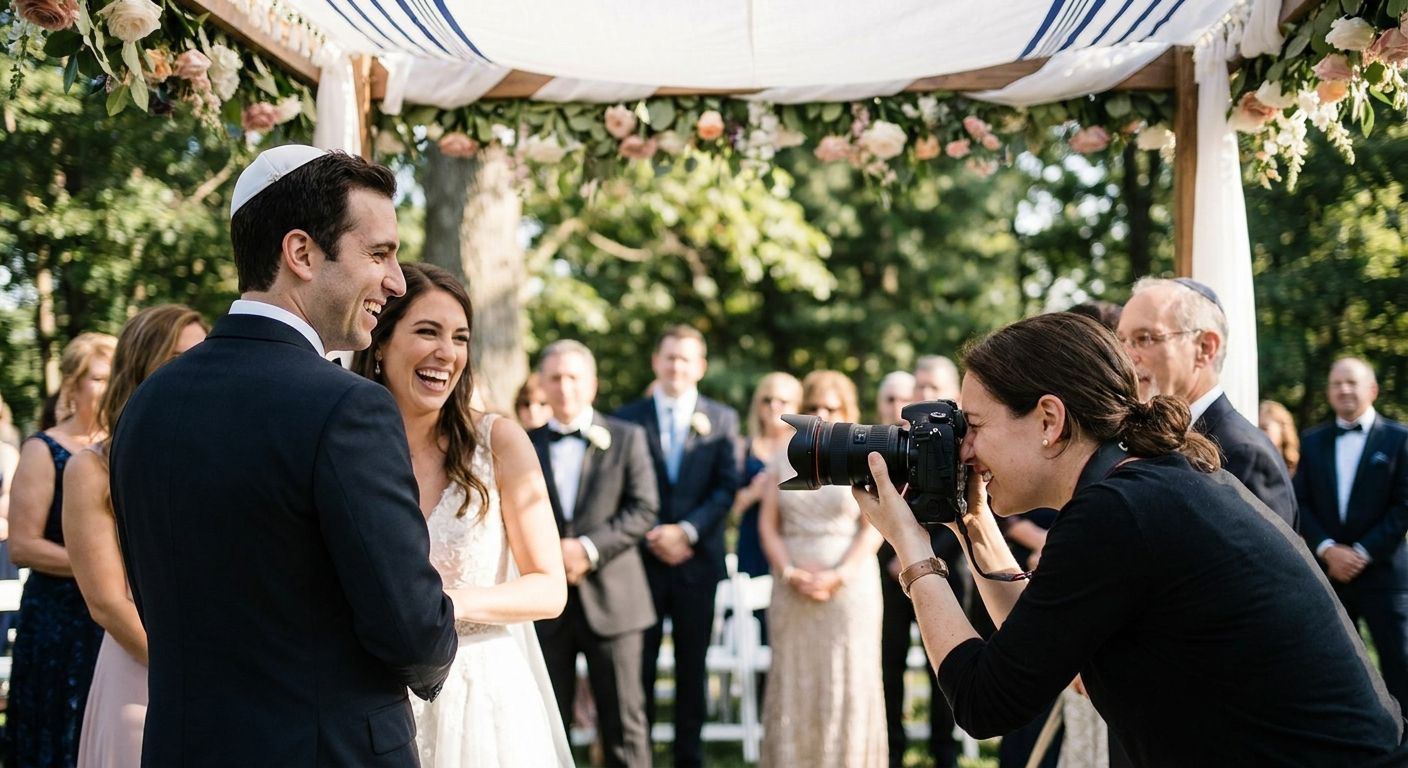
A Jewish wedding packs a badeken, a ketubah signing, a chuppah, a hora, and often a private yichud into one afternoon, and a jewish wedding photographer who has not shot that sequence before spends the day guessing instead of shooting.
- Book a jewish wedding photographer who covers the full ritual arc: badeken, chuppah, hora, and yichud, not just formal portraits.
- All-day coverage of 8 to 10 hours beats a 6-hour package for Jewish weddings because the reception runs long. Buy the longer block.
- Documentary-style wedding videography catches the hora and toasts better than a rigid shot list. Consider it over a scripted highlight reel.
- Skip any photographer who asks what a chuppah is during the first consult call in 2026.
Why this matters
A Jewish wedding is not one ceremony followed by one party. It is a sequence of distinct ritual moments, and each one has its own visual language: the tish and badeken before the ceremony, the circling and vows under the chuppah, the breaking of the glass, and then a reception built around the hora and chair lifts.
Denomination changes the shot list too. A Reform ceremony often looks close to a standard wedding with a chuppah added. An Orthodox ceremony may include separate seating, restrictions on flash during specific moments, and a longer pre-ceremony schedule. A jewish wedding photographer who has not asked which tradition a couple follows is planning blind going into 2026.
Who this is for
This guide is for couples marrying under a chuppah in 2026, whether the ceremony is Reform, Conservative, Orthodox, or interfaith, who need a photographer comfortable with cultural ceremony coverage rather than a generic wedding shot list. It also applies to couples blending two traditions in one day, where the photography team has to track two ritual schedules instead of one.
If the day includes a tish, a badeken, a ketubah signing, and a reception with traditional dancing, the photographer needs a plan for all four, not a plan for a ceremony and a cocktail hour.
What to look for in a jewish wedding photographer
Familiarity with the full ritual sequence
A jewish wedding photographer should know the difference between the badeken, the circling under the chuppah, and the breaking of the glass without being briefed on each one. This is the single biggest gap between a generalist and a specialist, and it shows up in missed reaction shots during the badeken and mistimed positioning during the circling.
Denominational flexibility
Orthodox ceremonies sometimes separate men and women for parts of the reception and restrict flash during specific ritual moments. A photographer who has covered both Reform and Orthodox weddings adjusts gear and positioning without needing a briefing mid-ceremony.
Coverage length built for a long reception
The hora alone, with chair lifts and extended circle dancing, can run well past the point a standard 6-hour package cuts off. Coverage built for 8 to 10 hours captures the full arc from badeken through the last dance instead of stopping early.
Discretion during the yichud
The yichud is private time for the couple immediately after the ceremony, typically 10 to 15 minutes. A photographer who understands the moment either steps back entirely or captures it with a light touch, not a full posed session.
Videography style suited to a high-energy reception
A hora with chair lifts and fast circle dancing does not photograph or film well with a static, scripted approach. Documentary-style coverage tracks the energy as it happens rather than staging it after the fact.
Talk through your ceremony schedule
Get a coverage plan built around your specific ritual sequence.
Top picks for covering a Jewish wedding
All-day coverage package — the safe pick. Built around 8 to 10 hours, this is the option that gets a photographer in the room for the tish and stays through the last hora circle instead of packing up during dinner. Buy this over a shorter block if the day includes pre-ceremony rituals: see the all-day coverage package details.
Documentary-style wedding videography — the storyteller's pick. Instead of a scripted list of setups, this style follows the badeken, the vows, and the hora as they unfold, which matters most during a reception that moves fast and does not repeat itself. Buy this if capturing genuine reactions during the ceremony matters more than a polished, staged reel: review documentary-style wedding videography.
Timeline planning session — the insurance policy. A Jewish wedding day has more moving parts than most, and a dedicated timeline conversation before 2026 catches conflicts between the badeken, family photos, and sunset portraits before they collide on the actual day. Consider booking this if the ceremony includes a tish or a separate badeken room: use the wedding day timeline planning guide as the starting point.
What to avoid
- Flat wedding packages that never ask about ceremony structure. If a photographer quotes hours and a price without asking whether there is a tish, a badeken, or a separate seating arrangement, they have not planned for a Jewish wedding specifically.
- Six-hour packages for a day with pre-ceremony rituals. The math does not work once a tish, a badeken, formals, a chuppah ceremony, and a full hora are all stacked into one afternoon.
- Photographers who have never asked about flash restrictions. Some Orthodox ceremonies limit flash during specific ritual moments, and a photographer who has not planned around that will either miss the shot or disrupt the ceremony.
Verdict comparison
| Option | Best for | Coverage length | Verdict |
|---|---|---|---|
| All-day coverage package | Days with a tish, badeken, and full reception | 8-10 hrs | Buy |
| Documentary-style videography | High-energy hora and candid reactions | Full ceremony + reception | Buy |
| Timeline planning session | Complex, multi-ritual schedules | Pre-wedding consult | Consider |
| Standard 6-hour package | Short, single-ceremony days only | 6 hrs | Skip for full ritual days |
FAQ
What's the best jewish wedding photographer package for a day with a tish and badeken?
An all-day coverage package of 8 to 10 hours works best because it puts the photographer in the room before the ceremony starts. A 6-hour package usually cuts off before the hora peaks.
How long does a jewish wedding photographer need to cover badeken through hora?
Most full Jewish wedding days need 8 to 10 hours of coverage. The chuppah ceremony itself typically runs 20 to 30 minutes, but the pre-ceremony rituals and extended hora dancing add several more hours.
Is documentary-style videography better than a scripted highlight reel for Jewish weddings?
Documentary-style videography tends to capture the hora and toasts more naturally because it follows the moment instead of staging it. A scripted approach works better for formal portraits but misses spontaneous reactions during fast-moving rituals.
Do Jewish weddings require a photographer familiar with flash restrictions?
Some Orthodox ceremonies restrict flash during specific ritual moments, so a photographer with prior experience at Orthodox weddings will already know when to switch to available light.
How much does a jewish wedding photographer cost in 2026?
Cost varies by region, coverage length, and whether videography is bundled in. Check current package details directly rather than relying on a flat industry average.
What's the difference between shooting a Reform and an Orthodox Jewish wedding?
Reform ceremonies often resemble a standard wedding with a chuppah added, while Orthodox ceremonies may include separate seating, a longer pre-ceremony schedule, and restrictions on flash during certain moments.
Should a jewish wedding photographer capture the yichud?
Only with a light touch. The yichud is private time for the couple, typically 10 to 15 minutes, and most couples prefer minimal or no photography during it.
How far in advance should couples book a jewish wedding photographer for 2026?
Booking early in the planning process matters most for popular wedding dates and venues, since photographers with Jewish ceremony experience tend to fill their calendars first.
One last thing
The shot couples regret missing most is not the chuppah. It is the tish, the pre-ceremony toast and blessing session on the groom's side, which often happens before some photographers have even arrived. Ask any jewish wedding photographer whether they arrive for the tish, not just the ceremony, and the answer tells you more about their experience than any portfolio.


