
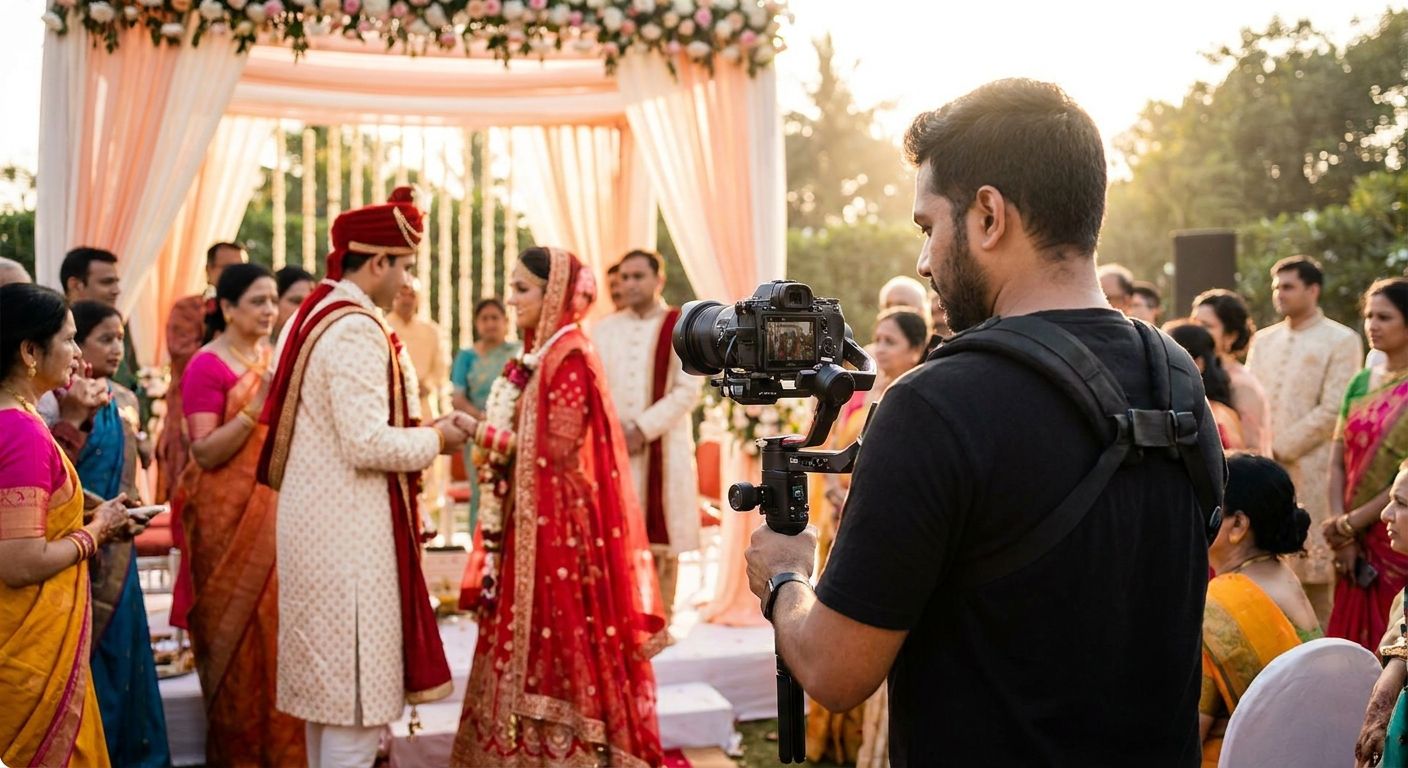
Indian weddings run three days deep with five or more ceremonies, and a wedding videographer who treats it like a single 8-hour gig will miss half the story.
- Documentary-style coverage from David Suns Weddings suits mehndi-to-reception Indian weddings — Buy for full-event storytelling.
- Same-day edit films fit multi-day Indian wedding timelines when couples want a reception-night reveal — Buy if a sangeet-night screening matters to you.
- Single-day 8-to-10-hour packages undersell a three-day indian wedding videographer search for 2026 celebrations — Skip for multi-day events.
- Cinematic trailers work as an add-on to full coverage, not a replacement for ceremony documentation — Consider, don't lead with it.
Why this matters
A typical American wedding videographer books one day, one venue, one ceremony. An Indian wedding videographer for 2026 celebrations is usually booking three days, two or three venues, and ceremonies that run from a sunrise mehndi to a midnight sangeet performance. Missing a day of coverage on a mehndi-sangeet-wedding schedule isn't a small gap — it's a third of the story gone.
Lighting changes constantly too. A mandap ceremony shot indoors under mixed tungsten and daylight needs different exposure handling than an outdoor baraat procession at noon. A videographer who has only shot single-ceremony Western weddings hasn't necessarily dealt with either.
Who this is for
This guide is for couples planning a three-day-plus Indian wedding celebration — mehndi, sangeet, baraat, pheras, and reception — who need a videographer that can hold continuity across every event without dropping coverage on the busiest day. If your celebration includes multiple outfit changes, multiple venues, and family members flying in for specific ceremonies only, multi-day wedding videography coverage is the starting point, not an upgrade.
It's also for couples deciding between a documentary approach that captures every ritual in sequence and a cinematic trailer approach built for sharing highlights. Most Indian weddings benefit from both, in a specific order.
What to look for in an Indian wedding videographer
Multi-day coverage capacity
A videographer who only quotes single-day packages will either upsell you into a patchwork of add-ons or quietly under-deliver on day two. Ask directly how many consecutive days the same lead videographer can shoot — not whether a second shooter can be added last minute.
Documentary versus cinematic balance
Documentary-style filming captures rituals in real time and order: the haldi application, the baraat entrance, the pheras around the fire. Cinematic trailers compress the weekend into a highlight reel for sharing. You want a videographer who does both, because a trailer alone won't preserve the ceremony sequence your family will want to rewatch in years.
Same-day edit capability
A same-day edit film screened at the reception — turning morning ceremony footage into a finished piece shown that same night — is a distinctly Indian-wedding-friendly format because the multi-day structure gives editors a full day's footage to work with before the reception crowd gathers. Not every videographer has the on-site editing workflow to pull this off.
Low-light and indoor ceremony experience
Mandap ceremonies often happen indoors or under a tent with mixed lighting — string lights, candles, and whatever ambient light the venue provides. A videographer without indoor low-light experience will hand you footage that's either grainy or blown out in the brightest spots.
Drone-friendly team for processions
The baraat, the groom's processional entrance with dancing and drums, is one of the most visually distinct moments in an Indian wedding. A team with drone capability captures the scale of the procession in a way ground cameras can't.
Top picks for Indian wedding video coverage
1. Documentary-Style Wedding Films — the authentic pick. Documentary-style wedding film coverage follows each ceremony in sequence — mehndi, sangeet, baraat, pheras, reception — without staged reenactments. The concrete value here: it's the only format that preserves ritual order for family members who couldn't attend every event. Verdict: Buy for the core of any multi-day Indian wedding package.
2. Same-Day Edit Films — the same-night pick. A same-day edit film turns footage from the morning ceremony into a finished piece screened at that evening's reception. It works specifically because Indian wedding schedules already build in a gap between daytime rituals and the night's reception. Verdict: Buy if a reception-night reveal matters to your family.
3. Cinematic Wedding Trailers — the shareable pick. A two-to-three-minute cinematic trailer, cut for social sharing after the wedding, works well as a companion piece to full documentary coverage. It should never replace ceremony documentation — it's built for Instagram, not for your grandmother's living room. Verdict: Consider as an add-on to full coverage, not a standalone package.
4. Multi-Day Multi-Camera Team — the essential pick. For a three-day celebration spanning mehndi, sangeet, and the wedding day itself, a single-videographer package forces trade-offs on the busiest day. A team built for multi-day coverage keeps continuity across venues and outfit changes without gaps. Verdict: Buy for any celebration running longer than a single day.
Talk Through Your Wedding Timeline
Map ceremony days, venues, and coverage needs before you book.
What to avoid
- Single-day-only packages sold as "full coverage." An 8-to-10-hour package built for a Western single-ceremony wedding leaves the mehndi or sangeet unfilmed on a three-day Indian celebration.
- Trailer-only deliverables. A polished two-minute cinematic cut looks impressive in a sales reel but won't show you the actual pheras ceremony your priest performed — confirm full-length footage is part of the deal, not just the trailer.
- Teams with no indoor low-light portfolio. A videographer whose sample reel is all outdoor golden-hour shots hasn't proven they can handle a mandap lit by string lights and candles.
Verdict comparison table
| Coverage Style | Best For | What It Captures | Verdict |
|---|---|---|---|
| Documentary-style film | Full ritual sequence, multi-day events | Every ceremony in order, unscripted | Buy |
| Same-day edit film | Reception-night screening | Morning ceremony cut into a same-night reveal | Buy |
| Cinematic trailer | Social sharing after the wedding | 2-3 minute highlight reel | Consider as add-on |
| Single-day 8-10hr package | Single-ceremony Western weddings | One event, one venue | Skip for multi-day Indian weddings |
FAQ
What's the best video coverage style for a multi-day Indian wedding?
Documentary-style coverage is the best base for a multi-day Indian wedding because it captures every ceremony in sequence. Pair it with a same-day edit film for the reception and a cinematic trailer for sharing afterward.
Is a same-day edit film worth it for a sangeet or reception?
Yes, if the family wants a finished piece screened the same night the footage was shot. It works on Indian wedding timelines because there's usually a gap between the daytime ceremony and the evening reception for editing.
How many days of coverage does an Indian wedding videographer need to book?
Most Indian weddings need coverage across three days — mehndi, sangeet, and the wedding day itself. Booking a single-day package for a three-day celebration leaves at least one major event unfilmed.
Should the baraat procession get drone footage?
Drone footage captures the scale and movement of a baraat procession better than ground cameras alone. It's a common add-on request for outdoor processions with dancing and a full wedding party.
Is documentary-style or cinematic trailer better for Indian wedding videography?
Documentary-style is better as the core deliverable because it preserves ritual order for family who couldn't attend every ceremony. A cinematic trailer works as a shareable companion piece, not a replacement.
How far in advance should couples book an indian wedding videographer for 2026?
Multi-day wedding videography teams book out further than single-day photographers because fewer teams handle three-day schedules. Reaching out as soon as ceremony dates are set for 2026 avoids scheduling conflicts.
Can one videography team cover mehndi, sangeet, and the wedding day?
Yes, as long as the team is structured for multi-day, multi-camera coverage rather than a single videographer working alone. Ask specifically how continuity is handled across venues and outfit changes.
Do Indian wedding videographers need experience with low-light mandap ceremonies?
Low-light experience matters because mandap ceremonies are often shot indoors or under a tent with mixed lighting from candles and string lights. A portfolio full of only outdoor golden-hour shots doesn't confirm this skill.
One last thing
The baraat procession clip is usually the most rewatched piece of footage from the entire wedding — not the vows, not the reception toast. Whichever indian wedding videographer you book for 2026, confirm the procession gets full coverage, drone or otherwise, before you lock in the contract.


