
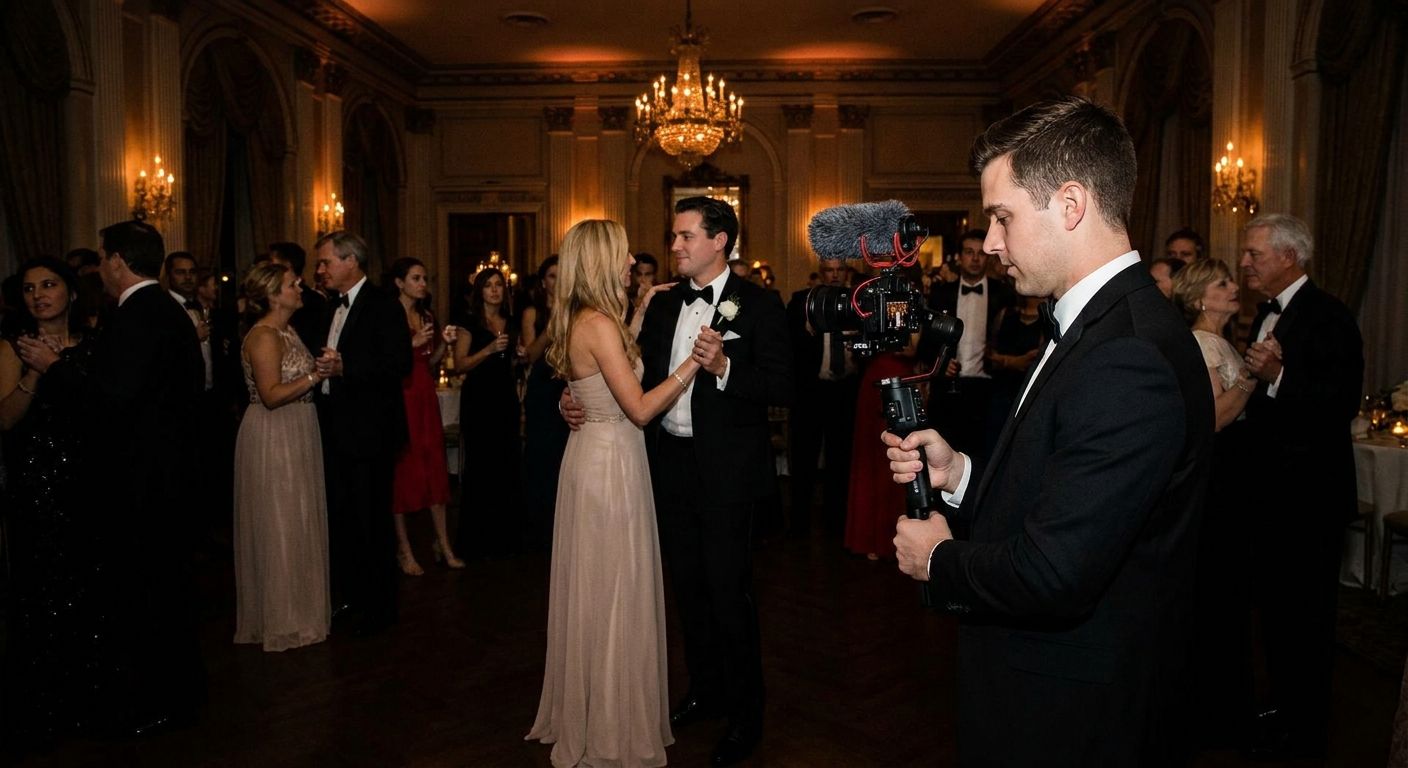
A black-tie wedding runs on precision: scripted entrances, live music, a strict reception timeline, and lighting that drops the second the string quartet stops playing. The right wedding videographer treats that structure as the story, not an obstacle to shoot around.
- A black tie wedding videographer needs low-light glass and a two-camera minimum for grand entrances in 2026 ballrooms.
- Documentary-style coverage on davidsunsweddings.com is the safe pick for formal ceremonies with live readings and vows.
- Same-day edit films work for black-tie receptions under 6 hours; skip them for multi-day formal events.
- Drone footage only earns its place at black-tie weddings with an outdoor cocktail hour or estate exterior.
Why this matters
Formal weddings compress a lot into one evening: a receiving line, a first dance under chandelier lighting, toasts from a live microphone, and a band that won't repeat a song for a second take. A videographer who shoots casual backyard weddings well can still miss every one of those beats at a black-tie event in 2026, because the lighting, sound, and choreography demand different gear and different instincts.
Couples booking a black tie wedding videographer are usually paying for one evening with zero do-overs. The film has to hold up next to a ballroom that cost real money to decorate, which means the video quality has to match the room.
Who this is for
This guide is for couples planning a formal wedding — black-tie or black-tie-optional dress code, a hotel ballroom or country club reception, a live band or orchestra, and a guest list large enough that the room itself becomes part of the visual story. If your reception has assigned seating and a printed program, this is your buyer profile.
What to look for in a black tie wedding videographer
Low-light performance in formal ballrooms
Ballroom lighting drops to candle-level during toasts and first dances, and cheap sensors turn that into grain. A videographer working with fast glass and full-frame sensors keeps skin tones clean at f/1.8 or wider without flooding the room with on-camera light that ruins the ambiance the couple paid for.
Discreet shooting during the ceremony
Formal ceremonies often run 20 to 40 minutes with a strict order of service, sometimes religious, sometimes civil, always choreographed. A videographer who can cover it from two fixed angles without walking the aisle respects the formality guests expect at a black-tie event.
Multi-camera coverage for key moments
Grand entrances, first dances, and toasts happen once. Two cameras minimum — one wide, one tight — capture the room reaction and the couple's face in the same take, which single-camera crews simply cannot recreate in editing.
Turnaround time that matches the event's pace
A formal wedding often has a save-the-date video expectation within days for guests who traveled. Check whether the videographer delivers a teaser in 48 to 72 hours or makes couples wait 6 to 8 weeks for the full film — both models are fine, but you need to know which one you're buying.
Live audio handling
String quartets, live bands, and unamplified vow readings need a videographer running a wireless lav on the officiant plus a board feed from the DJ or bandleader. Ambient mic audio alone turns formal toasts into mush on playback.
Editing style that matches the room
A cinematic, color-graded documentary edit reads as elegant against a ballroom; a fast-cut social media style edit can feel out of place. Ask to see a full black-tie wedding film, not just a 90-second highlight reel, before booking.
Check availability for your date
See documentary and cinematic coverage options for formal 2026 weddings.
Top picks for black-tie coverage
The safe pick: documentary-style films. Documentary-style wedding videography for documentary-style films covers the ceremony and reception in real time with minimal staged shots — the format that holds up best against a formal room where every guest is watching the same script unfold. Two-camera coverage plus a full ceremony audio feed is the baseline spec to confirm. Buy this style if your reception has a formal program with readings, toasts, and a first dance you want captured start to finish.
The wildcard: aerial coverage. Wedding videography for drone footage coverage only earns its place when the venue has an exterior worth showing — a manor house, a golf club, a hotel with formal gardens. One establishing aerial shot at golden hour does more for a black-tie film than five minutes of interior drone footage during the reception. Consider this add-on if your ceremony or cocktail hour happens outdoors; Skip it for a pure indoor ballroom event with no exterior architecture.
The fast-turnaround option: same-day edit films. Wedding videography for same-day edit films delivers a 3 to 5 minute cut screened at the reception itself, usually within 4 to 6 hours of the ceremony ending. It requires a tight timeline and a second editor on-site, so it works for single-evening black-tie events but strains against multi-day formal celebrations. Buy for a one-night formal reception with a projector or screen already in the room plan; Wait if your event runs across two or three days.
The multi-event package: multi-day celebrations. Black-tie weddings that stretch across a welcome dinner, ceremony, and formal reception fit wedding videography for multi-day celebrations better than a single-day package, since it prices coverage per event rather than per hour block. Buy if your formal wedding includes a rehearsal dinner or after-party the couple wants filmed separately; Skip if the entire event is contained in one evening.
What to avoid
- A single-camera crew for the ceremony. It looks fine in a sample reel shot in daylight, but it misses the groom's reaction during a candlelit ballroom ceremony because there's only one angle to work with.
- On-camera flash or LED panels during toasts. They kill the ambient lighting a formal venue spent a budget lighting, and guests notice the flash more than the couple does.
- A videographer with no live-band experience. Bands don't replay a set for a retake, and a videographer who has only shot DJ receptions can miss the timing cues a live band gives before a first dance.
Verdict comparison
| Coverage style | Low-light handling | Camera count | Turnaround | Best for |
|---|---|---|---|---|
| Documentary-style | Strong at f/1.8 and wider | 2+ | 6-8 weeks full film | Formal ceremony and reception |
| Drone-inclusive | Depends on exterior light | 1 aerial + 2 ground | 6-8 weeks full film | Venues with formal exteriors |
| Same-day edit | Moderate, needs stage lighting | 2+ | 4-6 hours same night | Single-evening receptions |
| Multi-day package | Strong across venues | 2+ per event | Varies by event count | Multi-event formal weddings |
FAQ
What makes a videographer good for black-tie weddings specifically?
A black tie wedding videographer needs low-light camera performance, discreet ceremony coverage, and live-band audio handling, since formal receptions in 2026 run on dim ballroom lighting and unscripted live music.
Is a same-day edit film worth it for a formal wedding?
Yes for single-evening black-tie receptions with a screen already set up, since the 3 to 5 minute film plays for guests within hours of the ceremony. It's not the right fit for multi-day formal celebrations spread across separate venues.
How many videographers do I need for a black-tie ceremony?
Two camera operators is the practical minimum for a formal ceremony in 2026, one on a wide shot and one on the couple's faces, so grand entrances and first dances get covered from more than one angle.
Does drone footage make sense for an indoor black-tie reception?
Only if the venue has an exterior worth showing, like formal gardens or a manor facade. A drone adds little value inside a ballroom with no outdoor architecture to capture.
How long does a full wedding film take to deliver?
Full documentary-style films typically take 6 to 8 weeks to deliver in 2026, while a same-day teaser can be ready in 4 to 6 hours the night of the event.
What audio setup do formal weddings need?
A wireless lavalier on the officiant plus a direct feed from the band or DJ board captures vows and toasts cleanly, since ambient microphones alone struggle against live music and large ballroom rooms.
Should I book photography and videography from the same team?
It's not required, but coordinated teams avoid two crews competing for the same angle during a formal ceremony with a strict, choreographed order of service.
What's the biggest mistake couples make booking black-tie videography?
Booking based on a highlight reel shot in daylight instead of asking to see a full film from a formal, candlelit ceremony, which is where low-light performance actually gets tested.
One last thing
Ask to see one full black-tie film start to finish, not a highlight reel — daylight garden weddings hide weaknesses in low-light handling that only show up once the ballroom lights drop for the first dance.


