
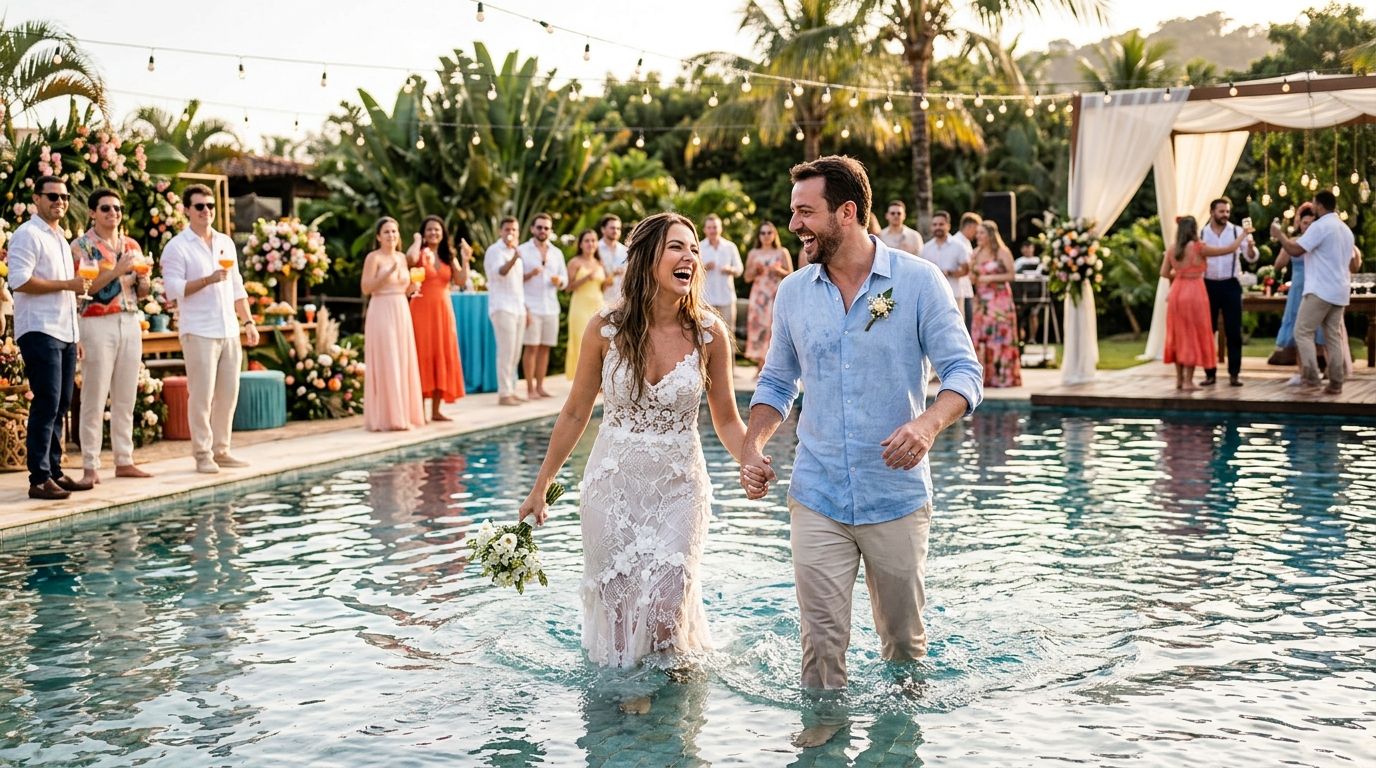
A pool party wedding photographer documents ceremonies, cocktail hours, and receptions built around a pool as the visual centerpiece, with the goal of capturing candid motion, water reflections, and swimwear-to-formalwear transitions without gear failure or awkward glare. Pool weddings move faster than a typical backyard reception — guests go from dry to wet to dressed again within an hour — and that pace changes what a photographer packs, where they stand, and how they light the reception once the sun drops.
- A pool party wedding photographer needs waterproof-rated gear and a lighting plan for both daylight glare and post-dusk pool lighting.
- Full-day coverage catches getting-ready through reception; reception-only misses the daytime pool activity that defines this format.
- David Suns Weddings treats pool events as a distinct shot list, not a backyard wedding with a pool nearby.
- Book a pool party wedding photographer at least 60-90 days out — 2026 pool season dates fill quickest in June and July.
- Polarizing filters and a second shooter positioned poolside solve the two most common failure points: glare and missed splash moments.
Why pool party weddings need a different photography plan
A standard backyard or garden wedding gives a photographer one lighting condition to manage and one guest flow to track. A pool party wedding stacks three: bright midday water reflection, a golden-hour transition where the pool becomes a mirror, and low-light poolside lighting once guests move indoors or under string lights.
Guests also move differently. At a pool event, people get in and out of the water between the ceremony and reception, which means candid coverage has to track wet hair, changed outfits, and impromptu group shots at the pool edge — moments a standard backyard pool wedding coverage plan doesn't always account for.
The couples searching for a pool party wedding photographer in 2026 are usually planning a warm-weather, casual-to-semiformal event where the pool is part of the program, not just scenery. That changes the shot list, the lens choices, and the timeline.
Update your gear list for water and glare
Standard wedding kits aren't built for reflective water and splash risk. Before the event, a photographer working a pool party wedding should confirm the following:
- Polarizing filters on at least two lenses to cut surface glare off the pool
- A weather-sealed or water-resistant body as backup, even for an outdoor-not-in-water event
- Extra lens cloths — humidity around pools fogs glass faster than dry venues
- A second flash unit for backlit poolside shots at dusk
- Waterproof housing or a disposable action camera if the couple wants in-pool shots
Scout the pool angles before the ceremony
Water changes composition rules. A pool that looks flat from one side becomes a mirror from another, and the difference is usually a 20-30 minute window around sunset.
- Walk the pool deck at the same time of day as the ceremony, one to two weeks ahead
- Note which side of the pool reflects sky color versus pool-liner blue
- Identify diving boards, slides, or loungers that need to be moved or worked around
- Mark where string lights or torches will sit after dark for the reception shots
- Flag any pool equipment (filters, hoses, skimmers) that needs to be out of frame
Build a timeline that separates "dry" and "wet" segments
Most pool party weddings run in two blocks: a dry ceremony and cocktail hour, then a wet or semi-wet reception where guests get in the water. Photographers who don't plan for this transition lose 20-30 minutes of usable light chasing wardrobe changes.
- Schedule formal portraits before anyone gets near the water
- Build in a 15-minute buffer for guests changing after a planned pool activity
- Confirm with the couple whether the wedding party is expected to get in the pool
- Set a hard cutoff time for daylight portraits versus after-dark reception coverage
- Coordinate with a coordinator or DJ so key moments (first dance, cake) aren't scheduled during the pool segment
Light the reception for after-dark pool reflections
Once the sun sets, an unlit pool photographs as a black hole in the frame. Underwater or perimeter lighting turns it into the best backdrop of the night — but only if it's planned before the event, not fixed in post.
- Confirm with the venue or rental company whether the pool has underwater LED lighting
- Ask the couple to rent floating candles or lanterns if the pool has no built-in lighting
- Position a flash or continuous light source poolside to fill faces without blowing out the water
- Shoot test frames during setup to confirm exposure before guests arrive
- If the couple is adding a welcome party coverage night before the wedding, use that as a lighting test run for the main event
This is also where the manual approach hits its ceiling — a couple without a photographer who's shot poolside before will spend the reception fixing exposure instead of catching moments. That's the point where booking a photographer with pool-specific experience, rather than a generalist, becomes the faster and more reliable path.
Direct group shots without the pool as an obstacle
A pool splits a yard or patio into two usable sides, and large group photos suffer if nobody plans for it.
- Pick one "formal" side of the pool for group and family portraits
- Keep the opposite side clear for candid and reception shots
- Use pool furniture (loungers, umbrellas) as intentional framing, not clutter to edit out
- Brief the wedding party on which side to gather on between segments
Measure engagement after the event
Pool party weddings generate more candid, motion-heavy images than a seated ceremony — splashes, laughter, wet hair. Reviewing the gallery for which images get the most reaction (shares, downloads, requests for prints) tells a couple which moments to prioritize for their album and which to leave as bonus shots.
Comparison: coverage options for a pool party wedding
| Coverage Style | Best For | Key Limitation |
|---|---|---|
| Full-day coverage | Couples running a daytime pool activity into an evening reception | Long day means extra batteries and memory cards on hand |
| Reception-only coverage | Budget-conscious couples with a short pool-centered event | Misses getting-ready and daytime pool candids entirely |
| Photography + videography combo | Couples who want motion and splash moments preserved on film | Needs separate audio setup positioned away from water noise |
| Poolside elopement-style ceremony | Small, intimate vows with a handful of guests | Limited crowd and reception documentation by design |
Full-day coverage wins for most pool party weddings because the daytime pool activity is usually the reason the couple chose the format in the first place — cutting it out defeats the purpose.
Book your pool party wedding date
Check availability for 2026 pool season dates before June and July book out.
Common mistakes couples make booking a pool party wedding photographer
- Assuming any backyard photographer can handle a pool event. Glare, reflection, and wet-guest logistics need specific planning, not general outdoor experience.
- Skipping the pool lighting conversation until the week of the wedding. Underwater or perimeter lighting often needs a rental order placed weeks ahead.
- Not telling the photographer whether guests will actually swim. A "pool party" theme with no one in the water needs a completely different shot list than one where guests jump in.
- Ignoring the noise a pool pump or filter makes on video. Videographers need to know if equipment can be shut off during the ceremony.
- Forgetting a plan for a rained-out pool day. A rainy day wedding backup plan matters even more when the whole event is built around outdoor water.
FAQ
What's the best time of day to shoot a pool party wedding?
The 20-30 minutes around sunset gives the strongest pool reflections and the softest light for portraits. Midday sun creates hard glare off the water that needs polarizing filters to control.
Is a pool party wedding photographer different from a regular wedding photographer?
Yes — pool events need glare control, water-resistant gear, and a timeline that separates dry ceremony portraits from wet reception activity. A generalist without pool experience often loses usable light managing these transitions on the fly.
Do guests actually get in the pool during a pool party wedding?
It depends on the couple's plan; some pool weddings are swim-optional cocktail events, others build in a dedicated pool activity block. Confirming this before the wedding day changes the entire shot list and timeline.
How much does pool lighting cost for an evening reception?
Costs vary by venue and rental company, so confirm current pricing directly with your venue or lighting vendor. Underwater LED lighting or floating lanterns are the two most common options couples add.
Can a videographer capture underwater or splash shots?
Yes, with waterproof housing or an action camera, though this typically requires advance coordination since standard video gear isn't rated for water contact.
How far in advance should I book a pool party wedding photographer?
Book 60-90 days out at minimum; pool season dates in June and July 2026 fill fastest because warm-weather outdoor venues have limited weekend availability.
What happens if it rains on a pool party wedding day?
A backup plan should shift the ceremony indoors or under cover while keeping the reception poolside once weather clears, which is why a rainy-day contingency gets discussed at the planning stage, not the morning of.
Should I hire one photographer or a second shooter for a pool wedding?
A second shooter positioned poolside catches candid splash and reaction shots the primary photographer misses while managing formal portraits, which is the single biggest coverage gap on pool event days.
One last thing
The detail most couples miss: humidity around a heated pool fogs a cold lens within seconds of stepping outside from an air-conditioned space, and that fog doesn't clear on its own — it needs a lens cloth and a few minutes of acclimation, not a wipe-and-shoot fix. Build a 10-minute equipment acclimation window into the timeline before the first poolside portraits, and the fogged-lens problem disappears entirely.


