
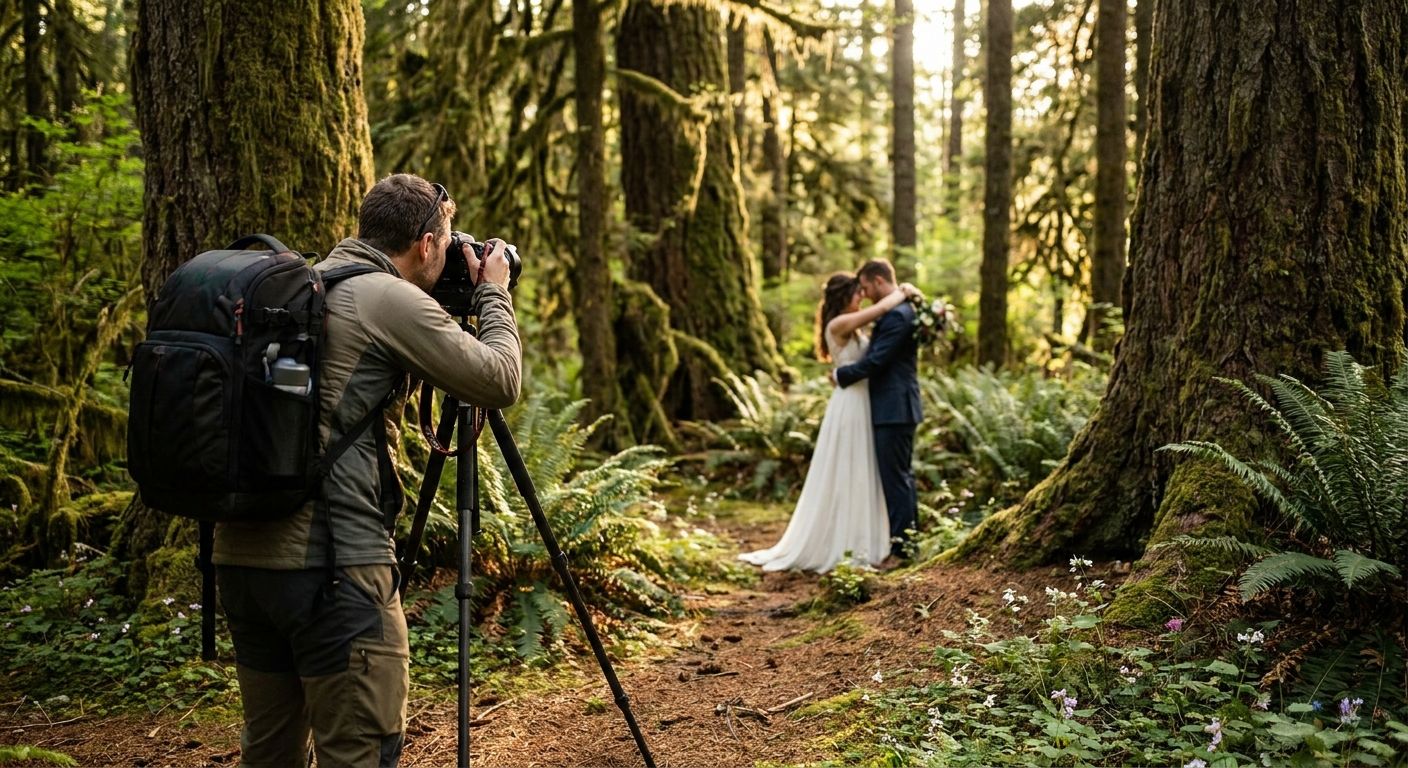
Forest elopement photographer services cover ceremonies held under tree canopy for two people (plus maybe a witness or two), with the aim of capturing natural, filtered light and quiet, unscripted moments instead of a large guest-list production. A forest setting changes the job in ways a backyard or ballroom never does: light drops fast under a full canopy, trail access often requires a permit, and the ceremony spot might be a mile from the nearest parking lot.
- A forest elopement photographer plans around canopy light, not open-sky golden hour, which shifts earlier and disappears faster.
- Permits govern most national and state forest ceremony sites in 2026 — check before you pick a spot.
- Two-day adventure elopement packages suit forests reached by hiking trail better than single-day coverage.
- Footwear and hem length matter more in forest terrain than at a garden or vineyard wedding.
Why forest ceremonies matter for elopement photography
A forest elopement photographer is solving a different lighting and logistics problem than a photographer shooting a lawn ceremony. Dense canopy cuts direct sun into scattered patches, so exposure decisions change every few steps along a trail. That's a technical constraint, not a mood preference — and it's the reason choosing an elopement location matters more for forest couples than for any other setting.
Access is the other variable. Some forest ceremony sites sit steps from a parking area; others require a 45-minute hike with gear. A couple planning a 2026 forest elopement needs to know which one they're booking before they pick outfits, a timeline, or a photography package.
Verdict: a forest elopement photographer who plans around canopy light and trail logistics will get you usable, well-exposed images all day — one who treats the forest like an open field will hand you a folder of blown-out highlights and muddy shadows.
How to plan a forest elopement with a photographer
Scout the forest location before you book a date
Canopy density, trail length, and sun angle all vary by site, and none of it shows up in a quick photo search.
- Visit the site (or check recent trail photos) at the time of day you plan to marry
- Note where the canopy opens up versus where it's fully closed
- Check for water features, clearings, or rock formations that create natural backdrops
- Confirm the walk-in distance from the nearest parking or drop-off point
- Ask whether the site allows ceremony setup (arch, chairs, signage) or requires a no-trace approach
Confirm permits and trail access rules
Most national forests, state parks, and protected wilderness areas require a permit for any ceremony, and some cap group size regardless of what your invite list looks like.
- Check the managing agency's site for elopement or small-ceremony permit rules
- Confirm the maximum group size allowed under that permit
- Ask if a photographer or videographer counts against the group cap
- Verify whether drone footage is permitted on-site — many forests ban it outright
- Book permits months ahead for popular 2026 dates, since forest permits can sell out by season
A national park elopement adventure makes this step non-negotiable — protected forest land inside park boundaries carries its own permit system separate from state or county forest rules.
Time the ceremony around canopy light
Open-field golden hour runs 60-90 minutes before sunset. Under a full canopy, usable light can close 20-30 minutes earlier because the tree line blocks the low sun first.
- Schedule the ceremony for mid-morning or early afternoon if canopy is dense
- Reserve true golden hour for portraits at a clearing or trail overlook, not the vows themselves
- Ask your photographer to walk the light pattern at your exact ceremony time, not a generic "golden hour" slot
- Build a 15-minute buffer into the timeline for cloud cover or fog, which shifts forest light more than open-sky light
Pack outfits and footwear built for forest terrain
A trailing gown or leather-sole shoes turn a scenic hike into a hazard, and it shows in every photo where someone's wincing at wet moss or a root.
- Choose a dress length that clears root systems and uneven ground
- Pack a second pair of shoes for the ceremony itself and hiking boots for the approach
- Bring a lightweight layer — forest temperatures run cooler than open fields, even in summer
- Test any veil or long train on uneven ground before the day, not during it
- Pack insect repellent for late spring through early fall ceremonies
Build a timeline that accounts for hike-in time
A one-mile forest trail with photography gear, an officiant, and formal shoes takes longer than a casual hike.
- Add 15-20 minutes per half-mile of trail to your written timeline
- Stage a gear drop-off point if the trail doesn't allow vehicle access to the ceremony site
- Confirm whether your officiant and any witnesses can make the same hike
- Build in a rest stop for outfit adjustments before the ceremony begins
Prepare a weather and season backup plan
Forest canopy changes dramatically by season — full leaf cover in summer, bare branches and open sightlines in winter, and unstable footing after rain in spring.
- Identify a covered or lower-elevation backup site within the same forest
- Ask your photographer how a rain scenario changes the shot list, not just the schedule
- Check seasonal trail closures before locking a date
- Plan for mud season separately from fire-risk season if the forest sits in a dry climate
Match your coverage package to the adventure level
A short trailhead ceremony and a full-day forest hike need different coverage structures, and booking the wrong one either wastes hours or leaves gaps in the story.
- Match hours of coverage to hike distance plus ceremony plus portrait time
- Ask whether a two-day adventure elopement package fits a multi-location or overnight forest trip better than single-day coverage
- Confirm whether the package includes a second shooter for trail safety and coverage on longer hikes
- Check delivery timelines match your own post-wedding schedule
Plan your forest elopement coverage
Match your hike, permit, and timeline to the right package.
Comparing forest elopement options
| Option | Best for | Key limitation |
|---|---|---|
| Self-shoot with a permit-approved site | Couples skipping hired photography entirely | No professional images; coordination falls fully on you |
| Single-day elopement photography package | Ceremonies at or near a trailhead | Limited time for multiple forest locations in one day |
| Two-day adventure elopement package | Deep-trail or multi-location forest hikes | Requires more time off and possibly overnight logistics |
| National park elopement package | Ceremonies inside protected forest land | Subject to park permit rules and group-size caps |
Verdict: couples marrying within a short walk of parking do fine with single-day coverage; couples hiking into deep forest or booking inside a national park need the two-day structure to avoid rushing the ceremony for the sake of daylight.
Common mistakes couples make with forest elopements
- Booking a ceremony time that misses the light window — dense canopy closes light earlier than open sky, and a 5 p.m. vow slot can already be in shadow
- Skipping the permit check — showing up without a permit on protected forest land risks the ceremony being stopped mid-event
- Wearing the wrong footwear or hem length — root systems and mud ruin a train faster than rain does
- Underestimating hike-in time — arriving late and rushed changes the tone of every photo from the ceremony onward
- Inviting more guests than the permit allows — trail and forest permits often cap group size regardless of your original guest list
FAQ
What's the best time of day for a forest elopement photo?
Mid-morning to early afternoon works best for the ceremony itself, since dense canopy closes usable light 20-30 minutes earlier than open-sky golden hour. Save true golden hour for portraits at a clearing or overlook.
Do you need a permit for a forest elopement?
Most national forests, state parks, and protected wilderness areas require a ceremony permit, and some cap group size. Check the managing agency's site months ahead of your 2026 date, since popular sites sell out permits by season.
How is forest elopement photography different from a garden or vineyard wedding?
Forest ceremonies deal with scattered, changing light under canopy and trail access instead of an open, controlled venue. A photographer needs to plan exposure and timeline around terrain, not just weather.
What should I wear for photos in a forest?
Choose a dress length that clears root systems and uneven ground, and pack a second pair of shoes for the hike versus the ceremony. A lightweight layer helps since forest temperatures run cooler than open fields.
How many hours of photography coverage does a forest elopement need?
A trailhead ceremony fits into a single-day package of a few hours; a deep-trail or multi-location hike usually needs a two-day adventure package to avoid rushing the ceremony for daylight.
Can a forest elopement be combined with a national park adventure?
Yes, and it's common in 2026 for couples marrying inside protected forest land within a national park. It adds a separate permit system on top of any state or county forest rules.
What happens if it rains on a forest elopement day?
A backup site at lower elevation or under heavier natural cover handles most rain scenarios without relocating far from the original plan. Confirm the backup plan with your photographer before the day, not during it.
How much hiking is realistic for elopement photos?
Add 15-20 minutes per half-mile of trail to your timeline when carrying gear and wearing formal shoes. Most couples keep the hike under two miles round trip to leave enough daylight for the ceremony and portraits.
One last thing
The detail most couples skip: asking whether a drone is even legal at the ceremony site. Many national and state forests ban drone flight outright, and finding that out mid-ceremony wastes planning time that should've gone into the permit check in step two.


