
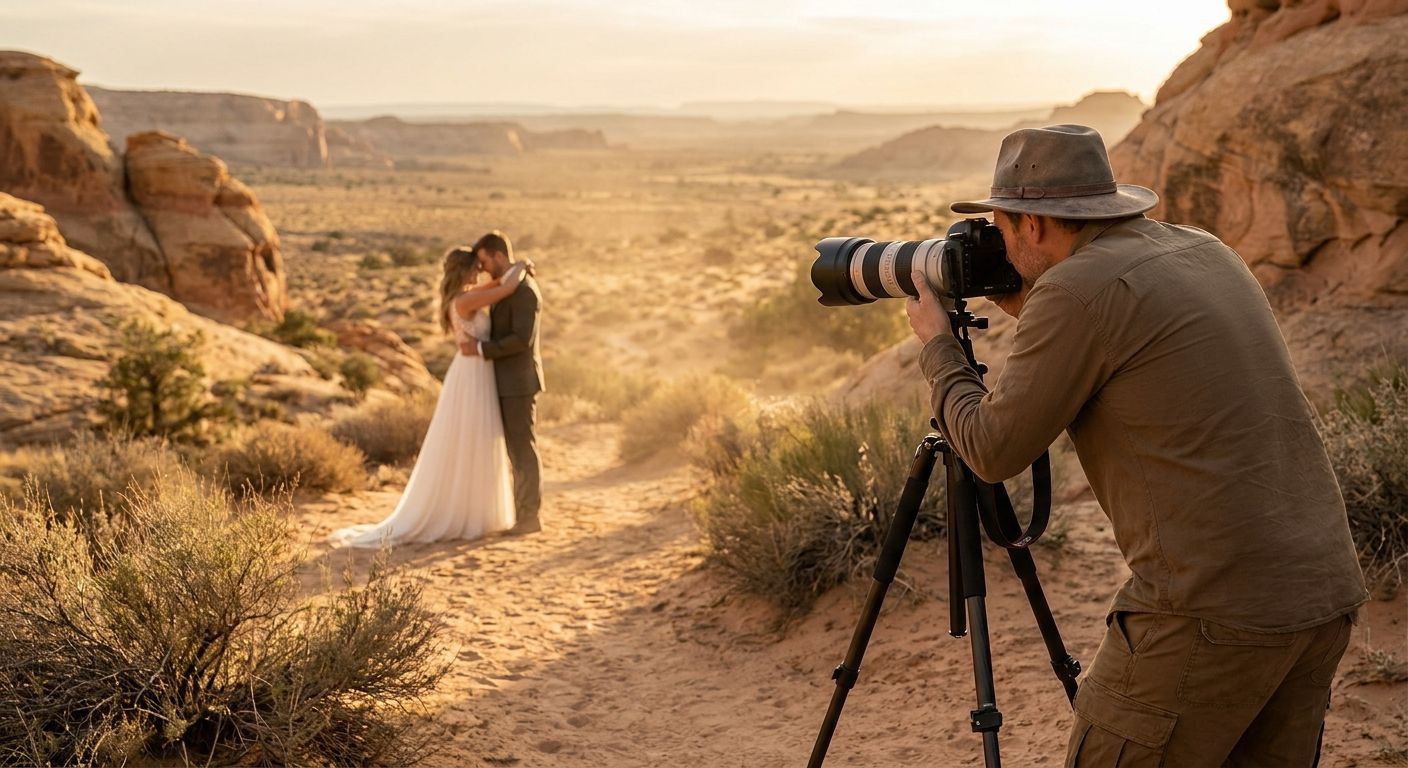
A desert elopement photographer plans around two things ordinary wedding photography does not have to manage: extreme light and extreme heat. Couples who elope in the Southwest desert are trading a guest list for wide-open terrain, so the photography has to carry more of the visual story on its own.
- David Suns Weddings shoots desert elopements around sunrise or sunset light, not midday heat.
- National park permits, private BLM land, and resort courtyards each carry different rules for a desert elopement photographer.
- Golden hour in most Southwest deserts runs 20-40 minutes before full sun clears the horizon.
- Video add-ons matter more for desert elopements than for indoor weddings because wind and dust rarely repeat a moment.
- Skip a June-September afternoon ceremony in Joshua Tree or Death Valley; the heat cuts shoot time short.
Why desert elopement photography works differently
A desert ceremony has no ballroom to fall back on if the light goes flat or the wind kicks up sand. The location is the decor, the backdrop, and the lighting rig all at once, so timing and terrain knowledge matter more here than for a barn or garden wedding.
Couples searching for a desert elopement photographer in 2026 are usually planning around one of three things: a national park permit window, a private landowner's schedule, or a resort's golden-hour slot. Each of those puts a hard constraint on when the ceremony happens and how much shooting time you actually get. Elopement photography for national park adventures covers permit logistics couples run into most often at parks like Joshua Tree, Zion, and White Sands.
Choose your desert location and permit path
The location decision drives everything else on the timeline — light angle, drive time, and whether you need a permit at all.
- Confirm whether the site is federal land (national park, BLM) requiring a permit, or private land that doesn't
- Check permit lead times; national parks often require applications weeks ahead
- Scout for shade structures if the ceremony falls midday in summer
- Ask about group size caps — many permits cap elopements at 6-10 people including vendors
- Verify vehicle access; some desert overlooks require a hike in with gear
How to choose an elopement location for photos walks through the tradeoffs between drive-up scenery and hike-in seclusion.
Schedule around light and temperature
Desert light is harsh by 10am for most of the year and unforgiving by noon in summer. Sunrise and sunset are the two windows worth protecting on the timeline.
- Book ceremony start 30-45 minutes before or after actual sunrise/sunset
- Build in a 20-30 minute buffer for hair and makeup to hold up in dry heat
- Avoid a July or August afternoon slot in low-elevation desert; heat cuts portrait time short
- Plan a spring (March-May) or fall (September-November) date if flexible — daytime highs are more workable
- Ask your photographer for the specific golden-hour window on your date, not a generic estimate
Elopement photography for sunrise sessions breaks down what an early-morning desert timeline actually looks like hour by hour.
Plan attire for desert conditions
What works for a garden wedding wilts fast on sand and rock. Fabric choice and shoe choice change the shot list more than couples expect.
- Choose breathable, lightweight fabrics that photograph well against sand and rock tones
- Pack a second pair of shoes for walking to the ceremony site
- Bring a light layer for sunrise shoots — desert mornings run cold even in summer
- Avoid all-white outfits under harsh midday sun; they blow out in bright exposures
- Test hairstyles for wind resistance if the site is exposed and open
Build a short, efficient shot list
A desert elopement usually has less coverage time than a full wedding day, so the shot list has to be tight and sequenced.
- Rank must-have shots first: vows, rings, first kiss, wide landscape shot
- Group portrait variations together to avoid repositioning gear
- Leave 10-15 minutes unscheduled for spontaneous shots as light shifts
- Confirm which shots require a second angle (drone, wide, detail) ahead of time
- Skip shot-list items that depend on props if wind is a known risk on-site
Prepare for wind, dust, and terrain
Desert sites rarely give you a flat, predictable surface. Wind moves veils, dust affects gear, and rock terrain limits tripod placement.
- Ask your photographer how they protect camera gear from blowing sand
- Choose accessories (veils, loose fabric) that photograph well in wind rather than fight it
- Check terrain photos ahead of time — some desert overlooks require sturdy footwear, not heels
- Confirm a backup ceremony spot within the same permit area in case of dust storms
- Bring water and shade for the wedding party between shots; dehydration shows up in photos
Decide on photography-only vs. photo-plus-video coverage
Desert elopements move fast and rarely repeat a moment — wind shifts, light changes, and a second take on vows isn't really an option. That single-take reality is why couples add video more often for desert ceremonies than for reception-heavy weddings.
- Photography-only: lower cost, simpler logistics, no additional crew on-site
- Photo plus video: captures vow audio and movement a still image can't
- Drone footage: adds landscape scale that ground shots miss in wide-open desert
- Same-day edit: rarely practical for remote desert sites without signal
Best elopement photographer packages for two-day adventures covers coverage options when a desert elopement spans a sunrise ceremony and a separate sunset portrait session.
Comparison: desert elopement location options
| Option | Best for | Key limitation |
|---|---|---|
| National park site (Joshua Tree, Zion) | Couples who want dramatic, protected landscape | Permit required, group size capped, no guaranteed exclusivity |
| Private desert land or ranch | Couples wanting full privacy and flexible timing | Requires locating a willing landowner and access arrangements |
| Resort or venue with desert backdrop | Couples who want amenities plus scenery | Less raw/wild aesthetic than open desert |
| Backyard or local desert overlook | Couples on a tight timeline or budget | Limited variety of backdrops within one location |
A desert elopement photographer who plans around sunrise or sunset light, not the couple's preferred wake-up time, gets better photos every time.
Plan your desert elopement date
Check availability and coverage options for your ceremony date.
Common mistakes desert elopement couples make
- Booking a midday ceremony — full desert sun by 11am flattens photos and pushes temperatures past comfortable for guests and vendors
- Skipping the permit check — several popular desert overlooks require advance permits, and showing up without one risks the whole shoot
- Underestimating drive time to remote sites — many desert elopement locations are 30-60 minutes from the nearest paved parking
- Choosing an outfit that doesn't hold up to wind — loose veils and long trains catch gusts that common at open desert overlooks
- Not planning water and shade for the wedding party — heat exhaustion cuts shoot time short faster than any lighting issue
FAQ
What's the best time of year for a desert elopement?
Spring (March-May) and fall (September-November) offer the most workable daytime temperatures for a desert elopement in 2026. Summer ceremonies should shift to sunrise or sunset to avoid peak heat.
Is a permit required for national park elopement photos?
Most U.S. national parks require a permit for wedding ceremonies and often for professional photography, even for small elopements. Application lead times vary by park, so confirm requirements before booking a date.
How much does desert elopement photography cost in 2026?
Cost depends on location, permit fees, travel distance, and hours of coverage booked. Ask for a package breakdown that separates photography, travel, and any add-ons like video or drone footage.
What should couples wear for a desert wedding shoot?
Lightweight, breathable fabrics that hold up to wind and sun work best for desert ceremonies. Bring a second pair of shoes for uneven terrain and a light layer if the ceremony is at sunrise.
How early should a sunrise desert elopement start?
Plan ceremony start 30-45 minutes before actual sunrise to catch the softest light and coolest temperatures. Hair, makeup, and site setup need to happen before that window opens.
Is video coverage worth adding to a desert elopement package?
Video captures vow audio and movement that a still photo can't, which matters more for desert ceremonies since wind and light rarely allow a repeat take. It adds cost and a second crew member on-site.
Which desert location works best for elopement photos: Joshua Tree, Sedona, or Zion?
Each offers a different look: Joshua Tree gives stark rock formations and iconic trees, Sedona gives red rock and canyon color, Zion gives dramatic cliff scale. The right choice depends on permit availability and how far the couple wants to travel.
How do couples handle heat during a summer desert elopement?
Shift the ceremony to sunrise or sunset, bring water and shade for the wedding party, and keep the shot list short to limit total time in direct sun. Midday summer ceremonies in low-elevation desert cut usable shoot time significantly.
One last thing
The single biggest photo-quality variable in a desert elopement isn't the outfit, the location, or even the photographer — it's the 20-40 minute golden-hour window on either side of sunrise and sunset. Couples who lock their ceremony time to that window consistently get better light than couples who pick a time based on guest convenience or venue availability. Confirm the exact sunrise/sunset time for your specific date and location before finalizing the timeline, not a generic seasonal estimate.


