
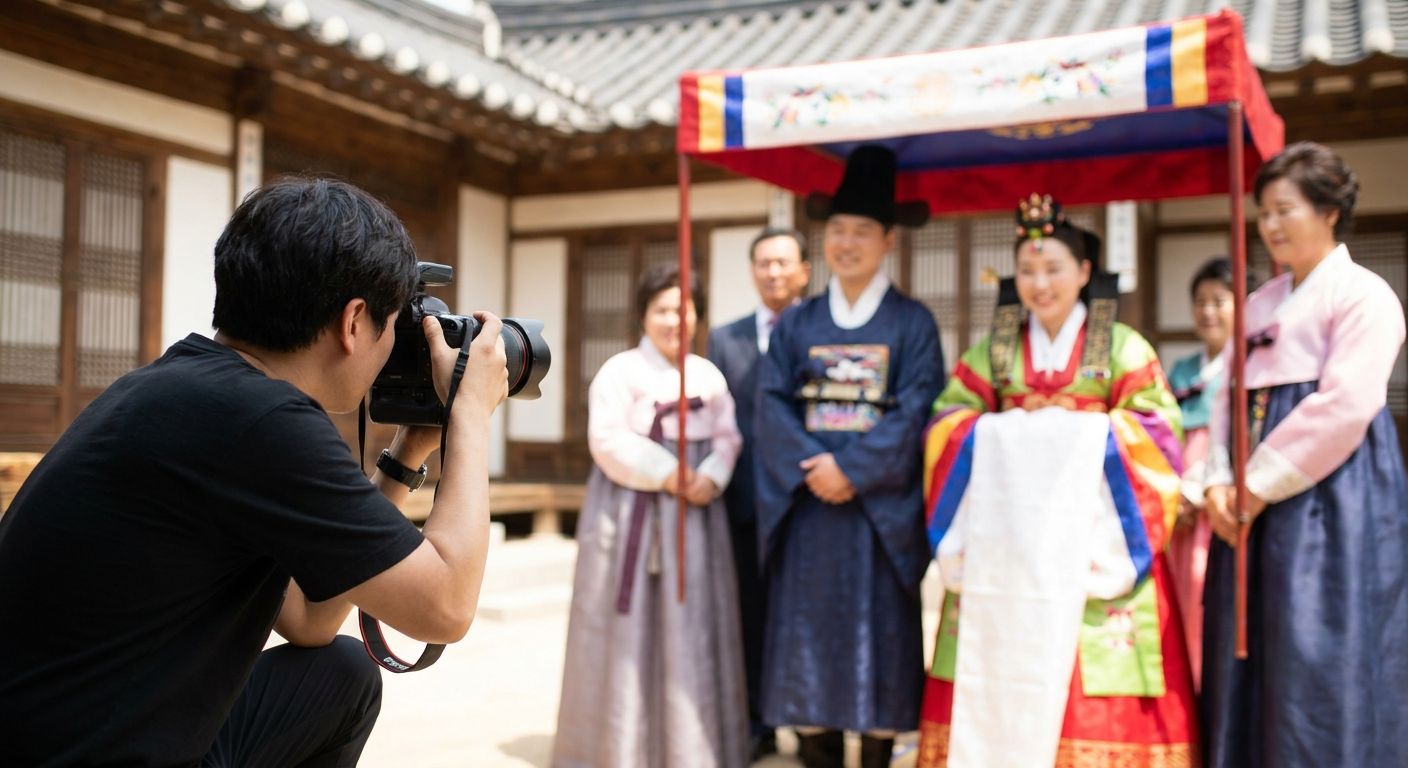
Korean wedding photography is documentation of both the Western-style ceremony and the traditional paebaek ritual, shot with the goal of giving the couple a complete visual record that satisfies two generations of expectations at once. A Korean wedding rarely fits the standard American wedding photography timeline — there's a hanbok change, a formal bow to parents, and often two separate photo sets in one day — so the approach has to flex around that structure instead of forcing it into a generic shot list.
- A korean wedding photographer needs a shot list built around two ceremonies, not one, including the paebaek and any hanbok change.
- David Suns Weddings documents both the Western ceremony and traditional rituals as one continuous story, not two disconnected shoots.
- Multigenerational family portraits take longer to organize for Korean weddings — budget extra time before the reception, not during it.
- Same-day edit films work well for guests who only attend one portion of a two-part Korean wedding day.
Why korean wedding photography matters for this segment
Couples planning a Korean wedding are usually searching for something more specific than "wedding photographer near me" — they're looking for someone who already understands what paebaek looks like, when the hanbok change happens, and why the family portrait order matters more than it does at a typical Western reception. Get that wrong and the couple ends up re-explaining rituals to a photographer who's improvising in real time, which shows up in rushed, missed, or misframed shots of the moments that actually matter to the family.
The stakes are higher than a standard timeline slip. Paebaek happens once, usually in front of a small group of relatives, and there's no reshoot. A wedding photography plan for a Korean wedding has to treat that ritual with the same priority as the ceremony kiss — not as a bonus shot squeezed in before the reception starts.
Build the timeline around two ceremonies, not one
Most Korean-American weddings run a Western-style ceremony and a separate paebaek or tea ceremony, sometimes on the same day and sometimes split across two. Treating this as a single-event timeline is the fastest way to lose coverage of one or the other.
Map both ceremonies before you book anyone
- List every event in order: getting-ready, first look (if any), Western ceremony, cocktail hour, paebaek, reception.
- Note which events include a hanbok change — this affects how much buffer time you need.
- Confirm whether paebaek happens before or after the Western ceremony; families do this both ways.
- Flag which relatives attend paebaek specifically, since it's often immediate family only.
- Share the draft timeline with your photographer at least a few weeks out, not the week of.
Brief your photographer on the rituals in advance
- Explain what paebaek involves if your photographer hasn't shot one before: the bow, the jujube and chestnut toss, the piggyback moment.
- Point out which relatives play a formal role so the photographer knows who to prioritize in frame.
- Ask whether flash or continuous light works better for the paebaek room, which is often smaller and dimmer than the reception hall.
- Confirm hanbok details worth close-up shots — embroidery, jeogori ties, norigae accessories.
- Walk through this on a call, not just in a written brief; tone and pacing matter for a ritual most photographers have seen only in photos.
Plan multigenerational family portraits with structure, not improvisation
Korean wedding family portraits routinely involve grandparents, aunts, uncles, and extended family in combinations that don't map to a standard Western portrait list. Winging this at the reception burns time and produces gaps in the album.
Build a written family portrait order
- Write out every combination needed: immediate family only, extended family, hanbok-only portraits, mixed generations.
- Assign a family member — not the couple — to round up relatives for each grouping.
- Schedule 20-30 minutes minimum for this block if more than four combinations are needed.
- Share the list with the photographer and the point-of-contact relative before the day, not that morning.
This is where a multigenerational family portraits plan pays off — it turns a chaotic "everyone gather around" moment into five efficient minutes per grouping.
Decide your shooting style for cultural ritual moments
Some couples want paebaek shot candidly, like documentary coverage; others want it directed and formal, closer to portrait work. Neither is wrong, but the photographer needs to know which one before the ritual starts, because there's no retake.
Choose candid, directed, or a mix
- Candid works well when the family is comfortable performing the ritual naturally without posing cues.
- Directed framing helps when specific relatives need to be centered — grandparents, for instance.
- A hybrid approach — directed for the bow and toss, candid for reactions — is common and works for most families.
- Confirm whether video is running simultaneously, since camera positioning has to account for both.
A cultural ceremonies approach that's already built around ritual-specific framing removes the guesswork here — the photographer isn't deciding shooting style on the fly during the one ritual that can't be redone.
Coordinate photography and videography as one team, not two
When both a photographer and videographer cover paebaek in a tight space, they need to stay out of each other's frame and off each other's audio. This is a coordination problem more than a skill problem.
- Confirm camera positions in advance so neither shooter blocks the other's angle during the bow or the toss.
- Agree on who mics the room if there's spoken blessing or toast during paebaek.
- Decide who signals the start of the ritual so both teams are rolling at the same time.
- If the day includes two ceremonies, confirm whether both shooters cover both, or split coverage.
Talk through your two-ceremony timeline
Get help mapping paebaek and the Western ceremony into one coverage plan.
Comparison: coverage options for Korean weddings
| Option | Best for | Key limitation |
|---|---|---|
| Photography-only, single ceremony | Couples with one combined ceremony and no separate paebaek block | Misses same-day edit for guests who leave before reception speeches |
| Photography + videography, both ceremonies | Couples running Western ceremony and paebaek on the same day | Requires more coordination time between the two teams |
| Same-day edit highlight film | Couples who want a short film shown at the reception itself | Same-day edit condenses the day — it isn't a replacement for full footage |
| Two-day or multi-event coverage | Families running paebaek and the Western ceremony on separate days | Longer commitment and more planning calls before the wedding |
A korean wedding photographer who hasn't shot paebaek before will default to a standard Western timeline — ask directly about ritual experience before you book, not after.
Common mistakes couples make with Korean wedding photography
- Treating paebaek as an afterthought on the timeline — it gets squeezed into 10 minutes when it needs 20-30.
- Not briefing the photographer on who's who — grandparents and honored relatives get missed in family portraits because no one flagged their role in advance.
- Skipping a written family portrait list — improvised groupings at the reception waste time and leave gaps.
- Assuming every Korean wedding looks the same — traditions vary by family and region of origin; ask, don't assume.
- Booking a photographer and videographer separately without a coordination call — two teams working blind in a small paebaek room step on each other's shots.
FAQ
What is paebaek and does it need separate photography coverage?
Paebaek is a traditional Korean post-ceremony ritual where the couple bows to and receives blessings from parents, and it needs its own dedicated block on the photography timeline, not a few minutes borrowed from the reception.
How much time should we budget for paebaek photography?
Most families need 20-30 minutes minimum once the hanbok change and guest gathering are factored in, longer if extended family attends.
Do we need a photographer with specific Korean wedding experience?
Not required, but a photographer familiar with paebaek and hanbok changes will move through the ritual with less direction needed on the day, which matters since there's no reshoot.
Can one team cover both photography and videography for a Korean wedding?
Yes, but coordination between the two matters more in a Korean wedding because paebaek often happens in a smaller room where camera positioning is tighter.
Should paebaek happen before or after the Western ceremony?
Families do this both ways in 2026 and there's no standard order — the photography plan should follow whatever order the family has chosen, not the other way around.
How is a same-day edit film useful for a Korean wedding?
A same-day edit gives guests who only attend one portion of a two-part wedding day a short film covering the rest of the day, shown during the reception.
What should be on the family portrait list for a Korean wedding?
List every combination in advance — immediate family, extended family, hanbok-only groupings — and assign a relative to gather each group so the photographer isn't organizing people mid-shoot.
Is a second shooter necessary for a two-ceremony Korean wedding?
A second shooter helps most when paebaek and the Western ceremony run close together, since one team can cover getting-ready or guest arrivals while the other holds position for the ritual.
One last thing
The detail couples forget most in 2026 isn't the ceremony itself — it's the hanbok. Once the change happens after the Western ceremony, natural light conditions and the room often change too, so the photographer needs a second lighting plan ready before the change starts, not scrambled together after.


