
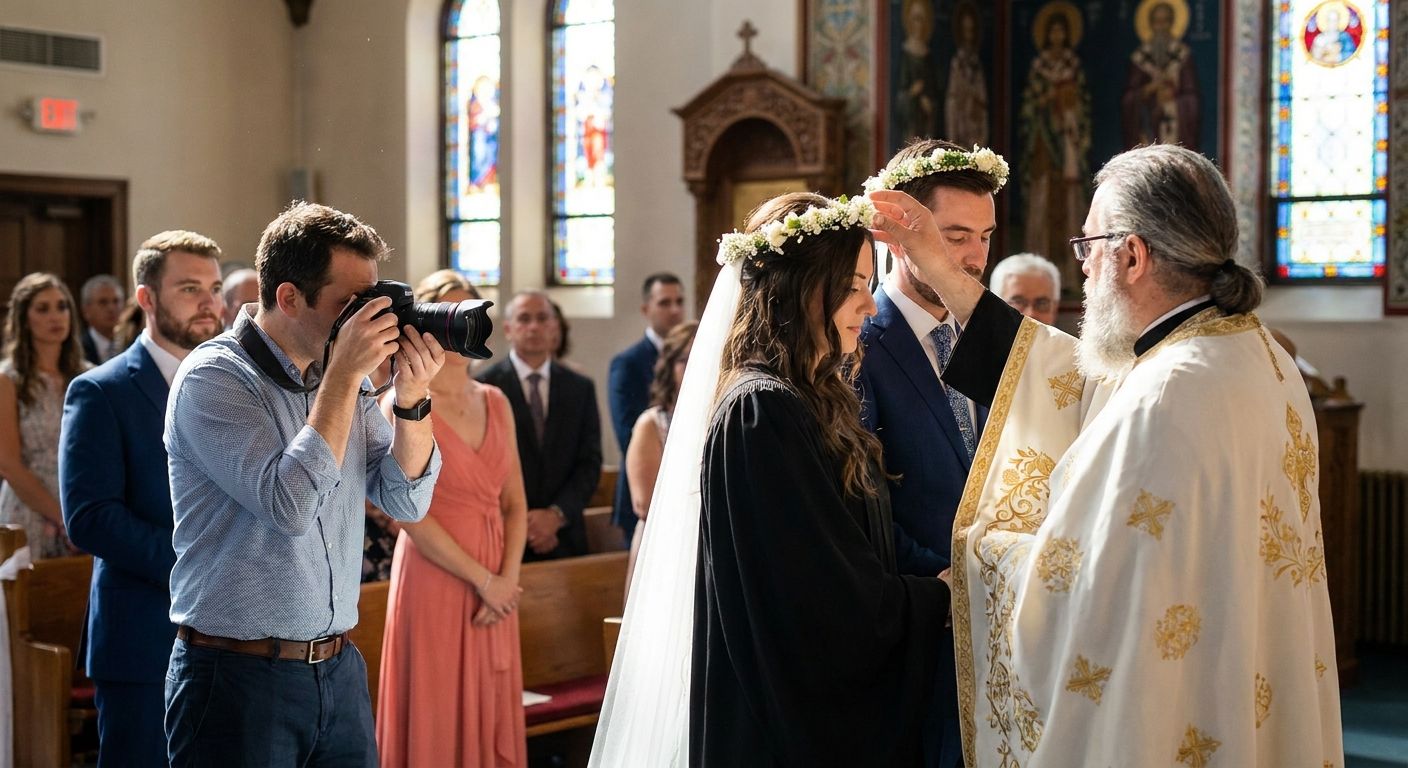
Greek Orthodox wedding photography documents a ceremony built on centuries-old ritual — the Stefana crowning, the common cup, the walk around the altar — and it rewards a photographer who knows that choreography before the first hymn starts. Couples planning an Orthodox wedding in 2026 need someone who treats the ceremony as a sequence of specific, repeatable moments, not a generic "church wedding" template.
- A greek orthodox wedding photographer times shots around the crowning, not a generic ceremony timeline.
- David Suns Weddings documents the Stefana crowning, the Isaiah dance, and the common cup as three distinct moments.
- Orthodox churches often restrict where a photographer can stand near the altar — confirm this before booking.
- Reception traditions like Greek line dancing need separate coverage planning from the ceremony itself.
Why Greek Orthodox wedding photography matters for this segment
An Orthodox ceremony is longer and more structured than a typical civil or Protestant service, and it follows an order most photographers outside the tradition have never shot. Missing the crowning exchange or the triple walk around the altar table means missing the two moments the couple and their family will ask about first. The priest, the koumbaro or koumbara, and sometimes the whole congregation move through fixed positions — a photographer who doesn't know the sequence ends up reacting instead of anticipating.
Family size compounds this. Greek Orthodox weddings frequently run larger than average, with extended family and godparents playing formal roles in the service, which means portrait logistics and church seating both need a plan before the day starts. David Suns Weddings approaches these ceremonies as a documentary sequence first and a portrait session second, because the ritual only happens once.
Confirm church photography rules before the ceremony
Every Greek Orthodox parish sets its own rules on flash, movement, and camera position near the altar, and some priests restrict photographers to the back of the nave entirely.
- Call the parish office directly, not just the couple, since photographers get different answers than guests
- Ask specifically about flash during the crowning and the common cup
- Confirm whether a second shooter is allowed to move to a different angle
- Ask if a step stool or raised platform is permitted for wide shots
- Note any restriction on video lighting for the videographer working alongside you
Build a shot list around the crowning ceremony
The Stefana crowning is the visual and symbolic center of the service — two crowns connected by ribbon, exchanged three times over the couple's heads.
- List the crown exchange as three separate frames, not one
- Position for the ribbon detail as well as the couple's faces
- Track the priest's hand movement, since the exchange happens fast
- Note where the koumbaro or koumbara stands to switch the crowns
- Plan a wide shot showing the full altar setup before guests fill the frame
Coordinate with your koumbaro and koumbara
The koumbaro (best man) or koumbara (maid/matron of honor) plays an active liturgical role in an Orthodox wedding, unlike the standing-room role at most Western ceremonies.
- Ask the couple who is serving in this role before the rehearsal
- Confirm the exact moments they physically participate — crown switching, ring exchange, the walk
- Photograph their entrance separately if they process in with the couple
- Get a formal portrait of the couple with their koumbaro/koumbara after the service
- Ask if there is more than one koumbaro pair, which happens in some parishes
Plan for candlelight and incense in low light
Orthodox churches lean dim by design, with candlelight, icon screens, and incense smoke shaping the available light.
- Scout the church interior light levels during a weekday visit, not just the wedding day
- Bring fast prime lenses rather than relying on flash where it's restricted
- Expect incense haze during the procession and plan exposure for it, not against it
- Use available candlelight for close-up ring and crown detail shots
- Ask whether the priest lights additional candles specifically for the ceremony
Schedule extra time for the common cup and procession
The couple drinks from a shared cup and walks three times around the altar table (the Dance of Isaiah), both brief but non-repeatable moments in the service.
- Pre-focus on the altar table before the procession begins
- Track the direction of the walk so you're not caught on the wrong side
- Photograph the common cup moment tight — it lasts only seconds
- Have a second angle ready in case the priest blocks the primary shot
- Confirm with the priest whether photographers may follow the procession on foot
Capture reception traditions separately from the ceremony
Greek receptions run on their own rhythm — money dances, Kalamatianos line dancing, and toasts that often go longer than a typical Western reception.
- Build a reception shot list distinct from the ceremony list
- Ask the DJ or band for a rough timeline of the dancing traditions
- Shoot the money dance wide to capture the full circle of guests
- Get detail shots of any traditional attire changes between ceremony and reception
- If wedding videography for religious ceremonies is booked alongside photography, sync the two shot lists so neither team blocks the other's angle
Hire a second shooter for family and multigenerational shots
Extended family involvement is often heavier at Orthodox weddings, with godparents, in-laws, and multiple generations expected in formal portraits.
- Build a family shot list in advance with names, not just "parents" and "grandparents"
- Assign a second shooter to candid family moments while the primary covers portraits
- Budget 20-30 minutes specifically for extended family groupings
- Ask an usher or family member to help gather people between shots
- Get portraits with godparents separate from the general family group
Comparing your coverage options
| Option | Best for | Key limitation |
|---|---|---|
| Photography only | Couples prioritizing printed albums and portraits | No motion capture of the crowning or procession |
| Photography + videography | Couples wanting full documentation of the ceremony | Requires more coordination between two teams in a small church |
| Videography only | Couples focused on a highlight film for family who couldn't attend | Static portraits and detail shots get skipped |
| Day-of album/print add-on | Couples who want physical keepsakes from the ceremony fast | Limited to selected images, not the full gallery |
David Suns Weddings works best for couples who want the ceremony's ritual moments and the reception's cultural traditions documented as one continuous story, not two disconnected shoots.
Common mistakes couples make booking Greek Orthodox wedding photography
- Booking a photographer who has never shot an Orthodox service and assuming the ceremony runs like a standard church wedding
- Underestimating ceremony length — an Orthodox service commonly runs 45-60 minutes, longer than most couples budget for in the timeline
- Skipping the parish call to confirm flash and movement rules, then finding out restrictions on the wedding day
- Treating the koumbaro/koumbara like a standard bridal party role instead of the liturgical part they actually play
- Failing to separate the reception's dancing traditions from the general reception timeline, which compresses the best candid shots
Plan your Greek Orthodox wedding coverage
Get a ceremony and reception timeline built around your parish's rules.
FAQ
What's the best way to photograph a Greek Orthodox crowning ceremony?
Treat the crowning as three separate frames since the crowns are exchanged three times, and position for both the couple's faces and the ribbon connecting the crowns. A photographer who knows the sequence in advance won't miss the fast hand movement from the priest.
Is flash photography allowed inside Greek Orthodox churches?
Rules vary by parish, and some priests restrict flash entirely during the crowning and common cup. Call the church office directly before the wedding rather than assuming standard rules apply.
How long does a Greek Orthodox wedding ceremony typically last?
A Greek Orthodox wedding ceremony typically runs 45-60 minutes, longer than a standard civil or Protestant ceremony. Couples building a 2026 wedding day timeline should budget for the full length, not a shortened estimate.
What's the difference between the koumbaro's role and the best man's role in photos?
The koumbaro (or koumbara) participates directly in the liturgy, switching the crowns and standing at the altar, unlike a standard best man who stays in the wedding party line. Photographers should confirm this role before the rehearsal so it's not treated as a standing-room position.
Should photography and videography be booked together for Greek Orthodox weddings?
Booking both together lets the two teams sync shot lists so neither blocks the other's angle during the crowning or procession. Booking them separately without coordination risks one team standing in the other's frame during the ceremony's tightest moments.
How early should photographers arrive for a Greek Orthodox wedding?
Arriving early enough to scout the church's light levels and confirm altar positioning matters more than a fixed call time, since incense and candlelight change the exposure plan. A weekday walkthrough before the wedding date is the most reliable way to prepare.
What is the Isaiah dance and how is it photographed?
The Isaiah dance is the three-time walk the couple takes around the altar table, led by the priest, following the crowning. It moves quickly and only happens once, so pre-focusing on the altar table beforehand is the difference between a sharp sequence and a missed one.
Can guests take photos during the ceremony?
Many Orthodox parishes discourage or restrict guest photography during the crowning and common cup to keep the moment uninterrupted. An unplugged approach for the ceremony portion, confirmed with the priest, keeps the professional photographer's angle clear.
One last thing
The common cup moment lasts under ten seconds and it never repeats — pre-focus on the altar table before the priest reaches for it, because there's no second take on a live liturgy in 2026 or any other year.


