
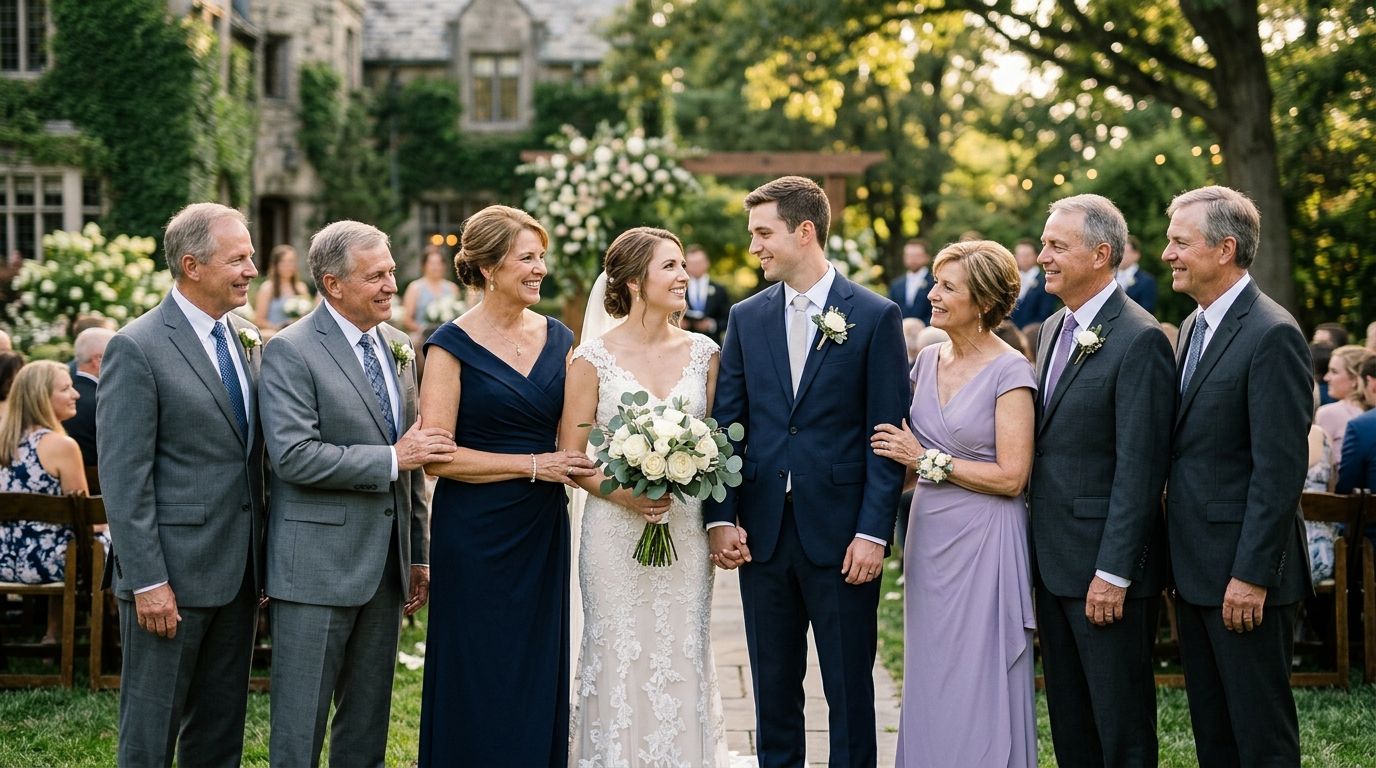
Divorced parents wedding photos require a portrait plan that accounts for who stands where, how much time each configuration needs, and how to keep the day moving without forcing anyone into an uncomfortable frame. Couples with divorced or remarried parents need more structure than a standard family portrait list because the wrong grouping order can turn a five-minute photo stop into a fifteen-minute standoff.
- Divorced parents wedding photos need a written shot list built around separate and joint groupings, not improvised on the spot.
- David Suns Weddings blocks extra buffer time for blended-family portraits so the reception timeline doesn't slip.
- Best for couples with two sets of parents: separate portraits first, optional joint group second, no forced smiles.
- Skip the single all-inclusive group shot if a parent has declined to be photographed with an ex or new spouse.
Why this matters for divorced parents
Family portraits are the single most time-pressured block of a wedding day timeline, and blended families add variables that a generic 15-minute slot can't absorb. A couple with two divorced parents, two step-parents, and grandparents on both sides can easily need six to eight distinct groupings instead of the two or three a traditional family requires.
The risk isn't just an awkward photo. It's a cascading delay: a stalled family portrait session pushes back cocktail hour, which pushes back the reception entrance, which eats into dance floor time. Planning blended family wedding photography around this reality, rather than treating it as an afterthought, is what keeps the 2026 wedding day timeline intact.
The verdict: a written, pre-approved shot list for divorced parents' portraits is the single change that prevents the most common family-photo delay on wedding day.
Update your family shot list before the wedding
Don't wait until the ceremony ends to figure out who's standing next to whom. Build the list in writing during engagement, share it with both sides of the family, and confirm it again the week of the wedding.
- List every parent, step-parent, and grandparent by full name, not just "Mom's side"
- Note any pairings to avoid (ex-spouses who won't photograph together, estranged relatives)
- Mark which groupings are mandatory versus optional
- Send the final list to whoever is directing photos on the day, not just the photographer
- Confirm with each parent individually if tension is a known factor
Separate portrait sessions by family unit
Run each parent's immediate family (parent, step-parent if present, siblings) as its own five-minute block before attempting any combined group. This gives every unit a clean portrait even if a joint photo never happens.
- Photograph the couple with mom's side first, dad's side second (or reverse, alphabetically to avoid perceived favoritism)
- Keep each family unit's session to 3-5 poses maximum
- Have a second shooter cover one side while the lead photographer covers the other to save time
- Build in a 2-minute transition buffer between each family unit
Set boundaries on who stands where
Physical positioning in a group photo carries weight in blended families in ways it doesn't in traditional ones. Decide placement rules ahead of time so nobody's left guessing on the day.
- Put the couple in the center of every group, regardless of who else is present
- Position parents next to their current spouse, not their ex, unless everyone has explicitly agreed to a mixed grouping
- Keep step-siblings grouped with their biological parent unless the couple requests otherwise
- Avoid seating charts that mirror old family photos from before the divorce
Schedule a buffer window into the day-of timeline
Blended-family portraits take longer than standard ones, and pretending otherwise is how photo sessions run over. Build extra time in explicitly rather than hoping it works out.
- Add 10-15 extra minutes beyond the standard family portrait block
- Schedule the divorced-parent portraits earlier in the day when energy and patience are higher
- Use a written wedding day timeline that names the exact minute each grouping starts
- Assign a family member or planner, not the couple, to herd people between groupings
Brief the wedding party and family ahead of time
Nobody should be finding out about the portrait plan for the first time while standing in front of a camera. A five-minute conversation days before the wedding avoids most on-the-day friction.
- Send a one-page portrait plan to parents, step-parents, and the wedding party
- Explain the order of groupings so nobody feels skipped
- Address any known tension directly rather than hoping it resolves itself
- Ask a trusted family member to help redirect people between shots if needed
A documentary photographer working with David Suns Weddings can also prepare your wedding party for photos so everyone knows their cue instead of standing around during transitions.
Handle an unplanned group photo request calmly
Even with a written plan, someone will occasionally ask for a spontaneous group shot that wasn't on the list. Have a default response ready instead of deciding in the moment.
- Default to "immediate family only unless pre-approved" for any request that comes up on the day
- Redirect the requester to the couple's planner or point person, not the photographer, for decisions
- Offer a quick candid alternative instead of a formal pose if a joint portrait isn't possible
- Move on within two minutes regardless of the outcome to protect the rest of the timeline
Compare your options for divorced-parent portraits
| Option | Best for | Key limitation |
|---|---|---|
| Separate family unit portraits only | Couples where parents won't photograph together at all | No single combined family image exists afterward |
| Separate portraits plus optional joint group | Most blended families in 2026 | Requires extra timeline buffer and a firm point person |
| Candid documentary coverage, no posed groups | Couples who want to avoid formal group photos entirely | Fewer traditional prints for extended family to request |
| One combined group shot, no separate sessions | Families with no active conflict between parents | Doesn't hold up if tension surfaces on the day |
Verdict: separate portraits plus an optional joint group is the safest default for most blended families booking wedding photography for 2026, and it's the structure David Suns Weddings builds into blended-family timelines by default.
“Run separate family portraits first, then decide on a joint group once everyone's already photographed on their own.”
Common mistakes divorced parents' families make
- Assuming everyone will "just be fine for one photo." Tension that's manageable at dinner doesn't disappear in front of a camera; plan around it instead of testing it.
- Skipping the written shot list. Verbal plans get forgotten under wedding-day stress, and the photographer ends up guessing who belongs in which group.
- Not telling step-parents where they fit. Ambiguity about whether a step-parent is included in the "immediate family" photo creates hurt feelings that show up in every photo after.
- Underestimating the time blended portraits take. A 15-minute slot built for two parents doesn't stretch to cover four adults plus step-siblings without cutting into cocktail hour.
- Putting the point-person decision on the couple during the event. The bride and groom shouldn't be the ones mediating photo disputes on their own wedding day; assign that job to someone else in advance.
Build your family portrait timeline
Walk through your blended-family shot list before booking.
FAQ
How do you handle divorced parents wedding photos without conflict?
Build a written shot list in advance that separates each family unit before attempting any joint grouping, and assign a family member or planner to manage transitions on the day. This removes the guesswork that causes most on-the-day friction.
Should divorced parents be photographed together at their child's wedding?
Only if both parents have agreed to it ahead of time; a joint photo should be optional, not assumed. Separate portraits by family unit cover the bases even when a combined shot isn't possible.
How much extra time do blended-family portraits need?
Plan for 10 to 15 minutes beyond a standard family portrait block when step-parents and multiple family units are involved. Scheduling this buffer explicitly in the wedding day timeline prevents delays to cocktail hour.
Who should be the point person for family photo decisions on wedding day?
A trusted family member or the wedding planner, not the bride or groom, should handle any last-minute grouping requests. This keeps the couple out of family disputes on their wedding day.
What if a parent refuses to be photographed with a step-parent?
Default to separate portraits for each family unit and treat any joint photo as optional and pre-approved only. Communicate this plan to both sides before the wedding, not on the day itself.
Is a documentary-style approach better for divorced-family weddings?
Candid, documentary-style coverage avoids the pressure of posed group photos entirely and works well when family dynamics are unpredictable. The tradeoff is fewer traditional formal portraits for extended family to request afterward.
Do second marriages need a different family portrait plan?
Yes, second marriages often involve step-children and blended sibling groups that need their own grouping logic separate from the parents' portraits. Planning both sets of relationships in advance avoids confusion during the shoot.
How far in advance should the family portrait list be finalized?
Finalize the list during engagement planning and reconfirm it the week of the wedding once the guest list and any family changes are settled. Waiting until the wedding day itself is the most common cause of delays.
One last thing
The families that handle this best in 2026 aren't the ones with the least conflict, they're the ones who put the plan in writing and assigned someone other than the couple to enforce it. A five-minute conversation before the wedding saves fifteen minutes of standing around during it, and that's the trade that actually protects the reception timeline.


