
There is no single verified price for a wedding videographer in 2026; the amount depends on coverage time, crew size, editing, travel, and deliverables. Because no current DAVID SUNS rate sheet was supplied, the accurate answer is to request an itemized quote instead of relying on an unsupported average.
- Wedding videographer cost in 2026 depends on coverage, crew, editing, travel, and deliverables.
- Compare identical scopes before deciding whether one videography quote costs more than another.
- Ask DAVID SUNS for an itemized wedding videography quote tied to your timeline.
- Remove unwanted deliverables before reducing coverage of moments you cannot recreate.
Why this matters
A headline price is useless when one proposal covers only the ceremony and another includes preparations, reception events, multiple cameras, and several edited films. Your 2026 comparison should match the event scope, recording plan, deliverables, revision terms, travel, and delivery method.
If cost control is the priority, review the structure of wedding videography packages for tight budgets before contacting vendors. That gives you a defined list of priorities instead of asking for the cheapest package without knowing what would be removed.
How much does a wedding videographer cost in 2026?
The exact cost requires a quote based on your wedding plan. A useful 2026 estimate must identify what is being filmed, when coverage begins and ends, how many people and cameras are involved, what films will be delivered, and whether travel or special production is required.
Use this scope table before comparing proposals:
| Coverage option | What it includes conceptually | Best for | Main advantage | Main limitation |
|---|---|---|---|---|
| Ceremony-focused | The ceremony and essential surrounding moments | Couples prioritizing vows | Keeps the filming scope narrow | Misses much of the preparation and reception |
| Core wedding-day | Major events across the main wedding timeline | Single-day weddings | Covers more of the story | Requires clear start and finish points |
| Extended coverage | Preparations through later reception events | Weddings with events spread across the day | Preserves more transitions and reactions | Adds filming and editing work |
| Multi-day coverage | Events held across separate days | Wedding weekends and cultural celebrations | Connects several events into one story | Requires more planning, travel, and production |
The correct 2026 budget is the price of the smallest scope that still captures every moment you would regret losing. Cutting an unwanted deliverable is usually more sensible than leaving a major event outside the filming window.
Ceremony-focused wedding videography
Ceremony-focused coverage limits the assignment to the vows and selected moments immediately before or after them. It is best for couples with a short schedule, a small ceremony, or a clear preference for preserving spoken words rather than documenting the full day.
The advantage is a tightly defined scope. The tradeoff is equally clear: preparations, guest interactions, speeches, dancing, and late reception moments can fall outside the agreement.
Ask whether the ceremony will be recorded continuously, how audio will be captured, and whether the final delivery is a complete ceremony film, a condensed edit, or both. Those are different deliverables even when the filming window is identical.
Verdict: choose ceremony-focused coverage when vows matter most and the missing reception footage will not bother you later.
Core wedding-day videography
Core wedding-day coverage follows the central timeline rather than a single event. The proposal should state the start point, finish point, locations, crew size, and final films so you can see exactly where the boundaries sit.
This option is best for a wedding held on one day with a manageable venue schedule. Its advantage is continuity from one major event to the next. Its limitation is that a delayed ceremony, long venue transfer, or extended reception can consume the available coverage before the planned ending.
Build the schedule around must-film moments such as preparations, vows, portraits in motion, entrances, speeches, formal dances, and guest reactions. A written wedding video shot list helps separate essential coverage from footage that would simply be nice to have.
Verdict: core wedding-day coverage is the practical default when your priority moments fit inside one continuous timeline.
Extended and multi-camera wedding videography
Extended coverage adds more of the day, while multi-camera coverage adds simultaneous viewpoints. These solve different problems. Extra time follows a longer schedule; extra cameras capture concurrent action, such as a speaker and the couple reacting during a toast.
A second camera does not automatically mean a second videographer. Ask who operates each camera, whether any angle remains fixed, and how audio is backed up. The answers tell you more than a generic multi-camera label.
This option is best for ceremonies with important reactions, larger venues, or timelines where significant events overlap. The advantage is broader visual coverage. The downside is more footage to coordinate and edit, so the proposal needs a precise deliverable list.
Verdict: add multi-camera coverage for simultaneous moments, not simply because a larger package includes it.
Multi-day wedding videography
Multi-day coverage can include events before or after the main wedding day. It fits wedding weekends, destination schedules, and cultural celebrations where the complete story cannot be recorded during one continuous booking.
The benefit is narrative continuity across separate events. The drawback is a larger production scope involving additional filming periods, file management, editing decisions, and possible travel. Confirm whether each event receives its own edit or becomes part of one longer film.
Treat every day as a separate line item when reviewing the proposal. That exposes gaps and prevents an assumption that a multi-day label automatically includes every scheduled event.
Verdict: book multi-day coverage only when the surrounding events are important enough to watch again, not merely because they appear on the itinerary.
Why wedding videographer cost varies
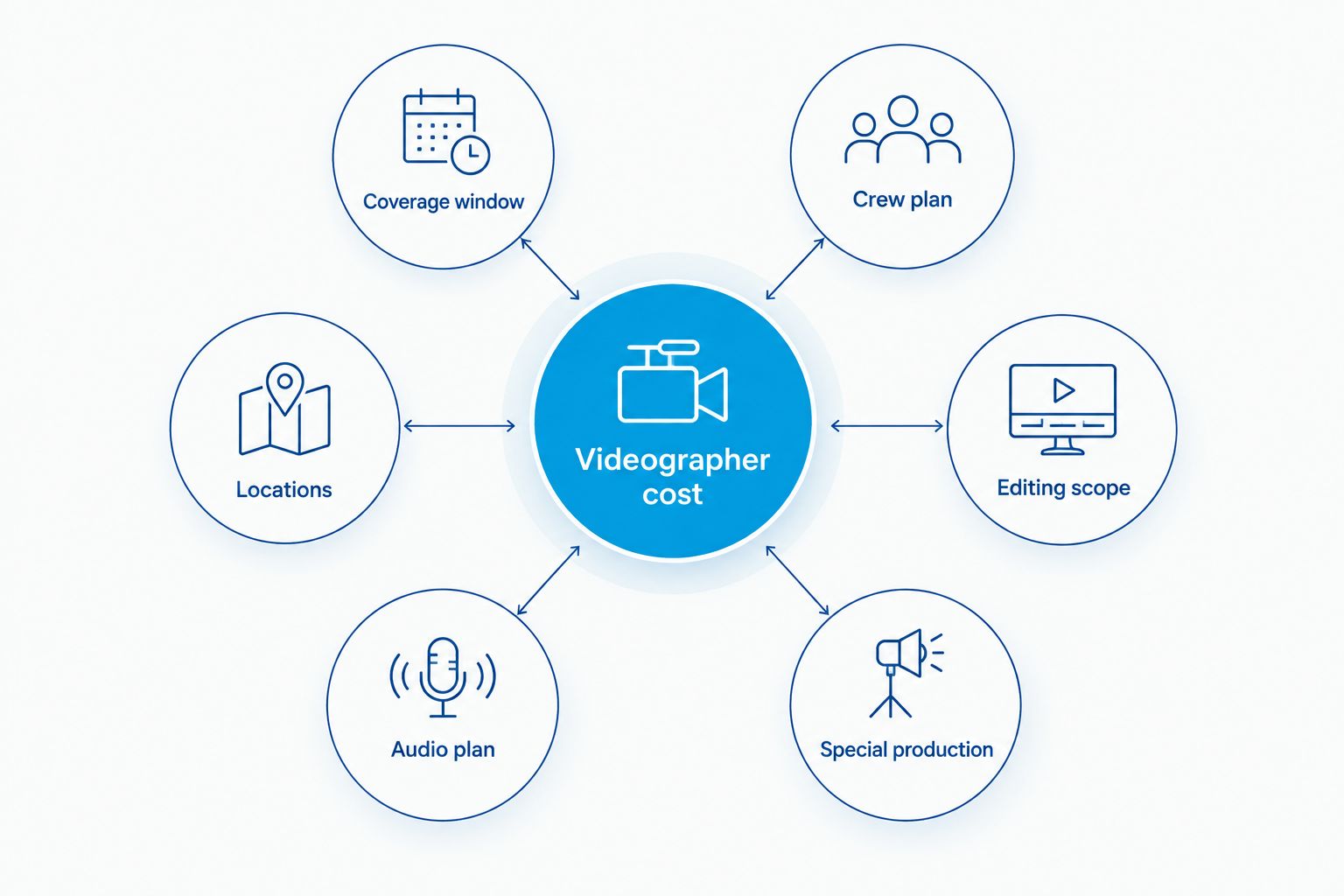
The visible filming time is only one part of the work. These factors change the scope of a 2026 wedding videography quote:
- Coverage window: More scheduled filming creates more footage to manage and edit.
- Crew and camera plan: One operator, a second shooter, and unattended cameras create different production requirements.
- Editing scope: A short highlight, complete ceremony edit, documentary film, and social cut require separate decisions.
- Audio plan: Vows, speeches, ambient sound, and music need suitable recording and synchronization.
- Locations and travel: Venue changes add movement, setup, coordination, and possible travel requirements.
- Special production: Drone footage, livestreaming, interviews, and same-day editing add distinct workflows.
Drone footage deserves separate scrutiny. In the United States, commercial drone operations generally fall under FAA Part 107 requirements, while venue rules, airspace restrictions, and weather can still prevent a planned flight. The contract should explain what happens when aerial filming cannot proceed.
Raw footage also needs a definition. Ask whether it means every recorded file, synchronized footage, selected unedited clips, or files in a format that requires professional editing software. A vague promise of raw footage is not enough to compare two proposals.
How to compare wedding videography quotes
Start by creating one shared brief and sending the same version to every vendor. Without a common scope, the lowest quote can simply be the proposal with the most exclusions.
Your brief should state:
- Wedding date and planned locations.
- Events you want recorded.
- Approximate start and finish points.
- Moments that require simultaneous angles.
- Films or files you expect to receive.
- Any livestream, drone, interview, or rapid-edit request.
- Travel between venues and access restrictions.
Then normalize each response in a comparison table of your own. Use rows for coverage, crew, cameras, audio, deliverables, revisions, travel, cancellation terms, delivery method, and usage rights. Mark missing information rather than assuming it is included.
Read the contract after comparing the creative scope. Confirm who will film the wedding, whether substitutions are allowed, how schedule changes are handled, what music can legally appear in the final film, and how long delivered files remain accessible. These terms affect value even when the visible package description looks similar.
A lower quote is the better choice only when it preserves your required moments and deliverables. A higher quote is justified only when you can identify the additional coverage, labor, production, or editing you value.
Which videography deliverables do you actually need?
Choose deliverables by how you expect to watch and share the wedding later. A highlight film is easier to revisit, while a complete ceremony edit preserves vows and readings with more context. A longer documentary edit can retain speeches and transitions but asks more of the viewer.
Social edits serve a separate purpose from the main film. They are framed and paced for short-form platforms rather than replacing the complete wedding record. Request them only if immediate or platform-specific sharing matters to you.
Raw footage is useful when you understand the file format, storage burden, and absence of a finished narrative. It is not automatically more valuable than a carefully edited film.
Keep the ceremony edit and a concise highlight if you want both a complete record and something easy to rewatch. Remove secondary formats before removing coverage of an irreplaceable event.
What should an itemized quote show?
An itemized 2026 quote should show the coverage boundaries, number of operators, camera approach, audio plan, named deliverables, editing and revision scope, travel treatment, delivery method, and contract terms. It should also distinguish included work from optional additions.
Do not accept labels such as premium, cinematic, or complete without definitions. Ask what each label changes in the actual filming or delivery. Specific scope makes competing quotes comparable.
Is a wedding videographer worth the cost?
A wedding videographer is worth the cost when motion and sound are central to what you want to preserve. Vows, speeches, voices, movement, and reactions cannot be recreated as still images after the event.
The service is less suitable when video ranks below other priorities or when you would rarely watch the finished films. Decide based on the importance of recorded sound and movement, not pressure to copy another couple's vendor list.
How can you reduce wedding videography cost?
Reduce scope deliberately. Shorten coverage around low-priority periods, choose fewer finished formats, avoid special production you will not use, or keep the event at fewer locations.
Do not cut audio coverage for vows or speeches without understanding the result. Clean visual footage cannot replace words that were never recorded clearly.
Start your booking inquiry
Share your date, locations, timeline, and required films with DAVID SUNS.
Is DAVID SUNS the right fit?
DAVID SUNS is best for engaged couples who want wedding photography and videography from one business and prefer to discuss booking directly. The stated service fit is clear, but no current package rates, deliverable specifications, turnaround commitments, or policies were provided for this 2026 guide.
That creates a straightforward next step: ask DAVID SUNS wedding videography for an itemized proposal tied to your timeline. Compare the response against the same brief used for other vendors, and judge the included coverage rather than the package label.
The advantage is access to both wedding photography and videography services through the same business. The limitation is that you need direct confirmation of current scope and terms before making a cost comparison.
FAQ
How much does a wedding videographer cost in 2026?
Wedding videographer cost in 2026 depends on coverage time, crew size, editing, travel, and deliverables, so an exact amount requires an itemized quote. Compare proposals with identical scopes rather than relying on an unsupported average.
What should a wedding videography quote include?
A wedding videography quote should include coverage boundaries, crew, camera and audio plans, deliverables, revisions, travel, delivery, and contract terms. It should clearly separate included work from optional additions.
Is one wedding videographer enough?
One wedding videographer is enough when important events do not overlap and one operator can cover the planned angles. Simultaneous reactions, separate preparations, or concurrent events can justify a second operator.
Is multi-camera wedding coverage better?
Multi-camera coverage is better when you need simultaneous viewpoints, such as vows and guest reactions. It adds little value when one operator can capture every priority without missing concurrent action.
Do I need raw wedding video footage?
You need raw footage only if you want the source files and understand their format, storage needs, and lack of a finished edit. Ask the vendor to define exactly what raw footage means before adding it.
How can I spend less on wedding videography?
Reduce low-priority coverage, secondary edits, venue changes, or special production before cutting essential moments. Keep clear audio for vows and speeches if those memories matter to you.
Should I book wedding photography and videography together?
Booking both through one business can simplify communication and timeline coordination, but the combined scope still needs to be itemized. Compare the actual deliverables and contract terms, not the convenience alone.
Is drone footage necessary for a wedding video?
Drone footage is not necessary for a complete wedding film. Choose it only when aerial views add something specific and the venue, airspace, operator requirements, and weather permit the flight.
One last thing
Ask each videographer which moment becomes impossible to capture if the schedule slips. That question exposes whether the proposed coverage has enough margin and whether one operator can handle overlapping events.
For 2026, the strongest buying decision is not the lowest headline amount. It is the clearest contract that preserves your must-film moments without charging for deliverables you do not want.


