
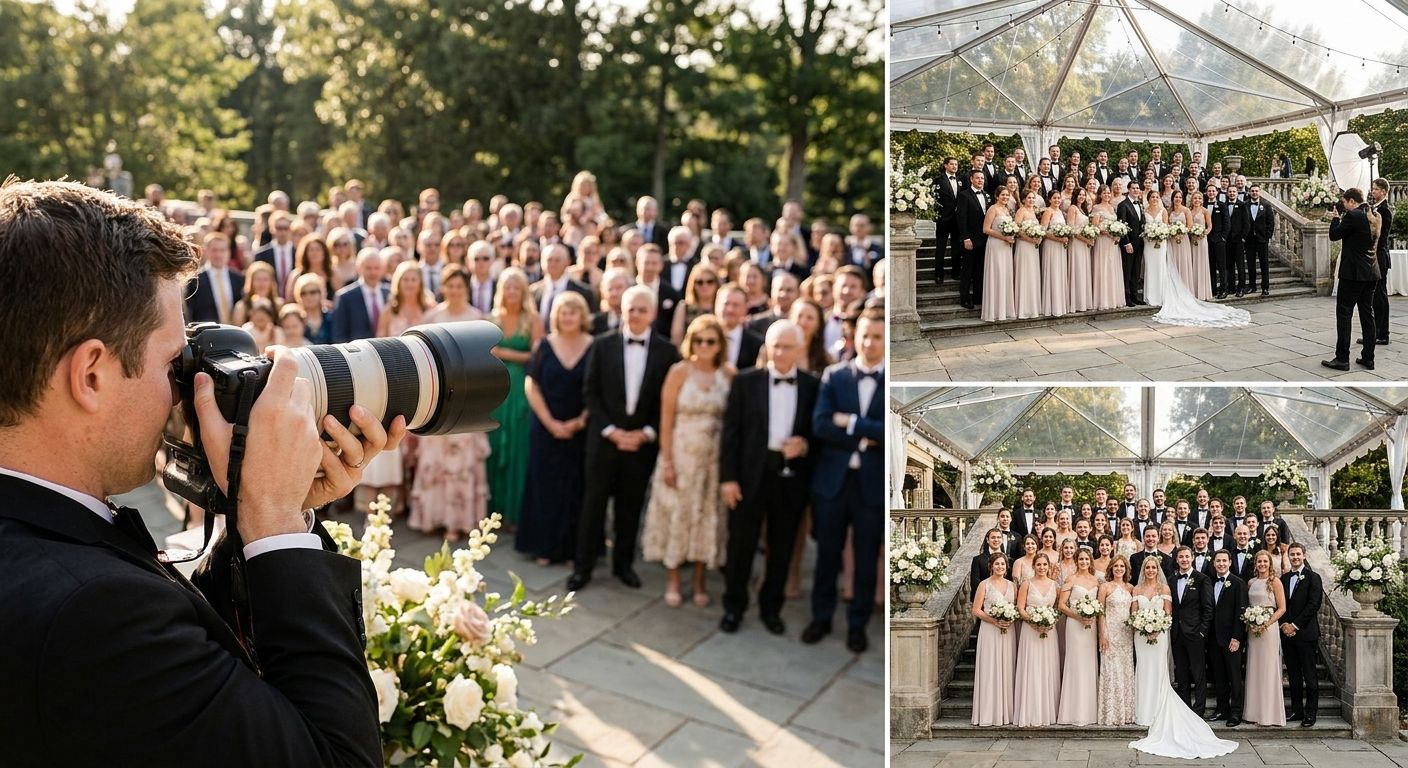
Large weddings — 150 guests or more — need a coverage plan built around timeline length, ceremony structure, and reception scale, not a photographer picked off a portfolio alone. This ranks the wedding photographer packages large weddings actually need in 2026, based on what changes once guest counts climb past 150 and receptions run long.
- All-Day Coverage Package wins for large weddings with 150+ guests and 8-10 hour timelines in 2026 — book it first.
- Multi-Day Celebration Coverage fits weddings spanning sangeet, mehndi, or welcome-dinner days plus the ceremony.
- Destination Wedding Package handles travel logistics for large weddings held away from home.
- Drone Footage Add-On earns its cost on outdoor venues wide enough to need an aerial scale shot.
- Lock full-day availability before adding extras — large weddings compress photo time once toasts run long.
Why this matters
A 60-guest wedding and a 250-guest wedding are not the same job. More guests means longer cocktail hours, more family combinations to photograph, and a reception program that rarely stays on schedule. In 2026, couples booking wedding photographer packages large weddings need are asking a different question than couples with a backyard ceremony: not "is this photographer good," but "does this package survive an 8-hour day without gaps."
David Suns Weddings structures its large-wedding coverage around that question — hours booked, team size, and whether the day is one event or several. That's the lens this guide uses to rank packages, starting with the all-day coverage package, which is the default starting point for most weddings over 150 guests.
What makes the best wedding photographer packages for large weddings
- Guest capacity coverage — can the team document 150+ guests without missing key moments during peak cocktail hour
- Team size and second-shooter support — one shooter can't cover the ceremony and the getting-ready room at once
- Timeline flexibility — large receptions run over schedule more often than small ones; the package needs slack built in
- Multi-day and multi-event support — sangeet, mehndi, welcome dinners, and the ceremony itself often need separate coverage plans
- Aerial and venue-scale coverage — tents, vineyards, and large outdoor grounds need wide establishing shots that ground-level cameras can't get
- Cultural and religious ceremony experience — ritual-heavy ceremonies need a team that already knows the sequence
Wedding photographer packages for large weddings at a glance
| Package | Best for | Standout feature | Key limitation |
|---|---|---|---|
| All-Day Coverage Package | 150+ guests, 8-10 hour timelines | Continuous coverage from getting-ready to last dance | Full-day slots need early booking |
| Multi-Day Celebration Coverage | Weddings spanning multiple event days | Dedicated shot plan per day | Needs a detailed day-by-day itinerary |
| Destination Wedding Package | Large weddings held away from home | Travel-ready team, pre-scouted logistics | Travel adds lead time to booking |
| Drone Footage Add-On | Large outdoor venues needing aerial scale | Wide establishing shots of venue and crowd | Weather and flight rules can cancel the window |
| Black-Tie Coverage | Formal receptions, 200+ guests | Built around formal program cues | Less flexible for unscripted receptions |
| Cultural & Religious Ceremony Coverage | Multi-ritual large weddings | Timed to ritual segments, not one block | Needs a clear ritual order in advance |
1. All-Day Coverage Package: best wedding photographer package for full-day large weddings
This is continuous coverage from the getting-ready room through the last dance, typically 8-10 hours, sized for the timeline pressure that shows up once guest counts pass 150.
All-Day Coverage Package pros:
- Coverage doesn't run out mid-reception when toasts stretch past schedule
- One team stays with the wedding party through every location change
- Pairs with a second shooter to cover the ceremony and cocktail hour at the same time
All-Day Coverage Package cons:
- Full-day slots book out first, so this needs to be locked in early
- Longer days mean more images and footage to review after the wedding
Best for: large weddings with 150+ guests and a reception that runs past 8 hours. Verdict: Buy — this is the default starting package for most large weddings in 2026.
2. Multi-Day Celebration Coverage: best for weddings spanning multiple event days
Built for weddings that don't fit in one day — sangeet, mehndi, welcome dinners, and the ceremony itself, common in South Asian weddings, multi-day destination weekends, and extended family celebrations.
Multi-Day Celebration Coverage pros:
- Each day gets its own shot list instead of cramming rituals into one afternoon
- Keeps a consistent photo and video style across every event
- Photography and videography hours can be scheduled independently per day
Multi-Day Celebration Coverage cons:
- Requires a day-by-day itinerary early so coverage hours get set correctly
- More setup and travel time between venues than a single-day package
Best for: weddings spanning two or more event days. Full details are on the multi-day celebration coverage page. Verdict: Buy for multi-day weddings; Skip if your wedding is a single day — the All-Day Coverage Package covers that instead.
3. Destination Wedding Package: best for large weddings hosted away from home
Handles the logistics layer that a home-city wedding doesn't need — travel, venue scouting, and adapting the shot list to an unfamiliar location.
Destination Wedding Package pros:
- The team plans travel logistics instead of the couple coordinating vendor arrival
- Venue scouting happens ahead of the wedding day, not on arrival
- Coverage adapts to unfamiliar venues without losing shot-list priorities
Destination Wedding Package cons:
- Travel adds lead time to the booking window
- Weather and venue access can shift the day-of plan more at an unfamiliar location
Best for: large weddings hosted away from the couple's home city. See the destination wedding package breakdown for what's included. Verdict: Buy if you're hosting away from home; Hold if the venue is local — the All-Day Coverage Package handles it.
4. Drone Footage Add-On: best for large outdoor venues
Aerial coverage added on top of a photography or videography package, built for venues where 150+ guests spread across a tent, vineyard, or open field.
Drone Footage Add-On pros:
- Establishes scale for weddings with tents, vineyards, or large outdoor grounds
- Adds an angle ground-level coverage can't produce
Drone Footage Add-On cons:
- Weather and local flight restrictions can cancel the flight window same-day
- Works best layered onto an existing package, not booked standalone
Best for: outdoor venues large enough that guest count needs an aerial establishing shot. Verdict: Buy as an add-on for big outdoor venues; Skip for indoor ballrooms or tight urban venues.
5. Black-Tie Coverage: best for formal receptions
Structured around a formal program — toasts, first dance, cake cutting — rather than an open-ended reception timeline.
Black-Tie Coverage pros:
- Coverage timed to formal program cues instead of guessing when moments happen
- Suited to structured receptions with 200+ guests and a set run of show
Black-Tie Coverage cons:
- Less flexible if the reception turns out informal or unscripted
- Formal portrait sessions add time to an already long day
Best for: formal receptions with a structured program and 200+ guests. Verdict: Buy for black-tie formats; Hold for casual, unscripted receptions.
6. Cultural & Religious Ceremony Coverage: best for multi-ritual large weddings
Timed to ritual segments rather than treated as one ceremony block — relevant for Indian, Jewish, military, and other multi-part ceremonies.
Cultural & Religious Ceremony Coverage pros:
- Coverage timed to each ritual segment instead of one continuous block
- Familiarity with ceremony-specific customs reduces missed moments
Cultural & Religious Ceremony Coverage cons:
- Needs a clear ritual order from the officiant or family ahead of time
- Longer ceremony segments extend the total coverage hours required
Best for: large weddings with multiple ritual segments. Verdict: Buy when the ceremony has multiple ritual segments; Hold for a single-block ceremony.
How this ranking was built
Each package is ranked against the criteria above: guest capacity, team size, timeline flexibility, multi-day support, venue-scale coverage, and ceremony experience. No two packages compete for the same slot — a wedding needs one primary coverage package (All-Day, Multi-Day, or Destination) plus whichever add-ons match its ceremony format (Drone, Black-Tie, Cultural).
Which package should you choose for your large wedding?
If you're not sure where to start: book the All-Day Coverage Package first. It's the baseline for any wedding with 150+ guests in 2026. Layer on Multi-Day Celebration Coverage if your wedding spans more than one event day, add Drone Footage if your venue is large and outdoors, and confirm Destination Wedding logistics early if you're hosting away from home. Black-Tie and Cultural & Religious coverage aren't extras — they're the right primary format when your ceremony fits that structure.
Talk through your large wedding timeline
Get a coverage plan built around your guest count and day.
FAQ
What's the best wedding photographer package for a large wedding in 2026?
The All-Day Coverage Package is the best starting point for large weddings in 2026, since it covers 8-10 hour timelines without running out mid-reception. Add Multi-Day, Destination, or Drone coverage on top depending on your venue and schedule.
How many hours of coverage does a large wedding need?
Most large weddings with 150+ guests need 8-10 hours of coverage to get through getting-ready, the ceremony, cocktail hour, and the full reception. Shorter packages tend to run out before the dancing starts.
Do large weddings need two photographers or a second shooter?
Yes, once guest counts climb past 150, a second shooter is worth it to cover the ceremony and the getting-ready room at the same time. One shooter alone will miss overlapping moments on a long timeline.
Is drone footage worth it for a large wedding venue?
Drone footage is worth it when the venue is outdoor and large enough that guest count needs an aerial establishing shot, like a tent, vineyard, or open field. It's less useful for indoor ballrooms or tight urban venues.
How far in advance should I book a photographer for a 200+ guest wedding?
Book as early as possible, since full-day and multi-day slots for large weddings fill first. Destination weddings need even more lead time because of travel scheduling.
What's different about photographing a multi-day wedding versus a single-day wedding?
A multi-day wedding needs a separate shot list and coverage plan for each event day — sangeet, mehndi, welcome dinner, ceremony — rather than one continuous block. Continuity of style across days matters more than on a single-day wedding.
Can one package cover both photography and videography for a large wedding?
Photography and videography are typically booked as separate coverage tracks, each sized to the same timeline, so both teams work the same hours without one waiting on the other.
One last thing
The detail that trips up most large-wedding couples isn't the photographer — it's the shot list. Large weddings compress photo time faster than small ones because toasts, speeches, and family formals all eat into the same reception window; a written family-photo list handed over before the day starts saves more time than any add-on package on this list.


