
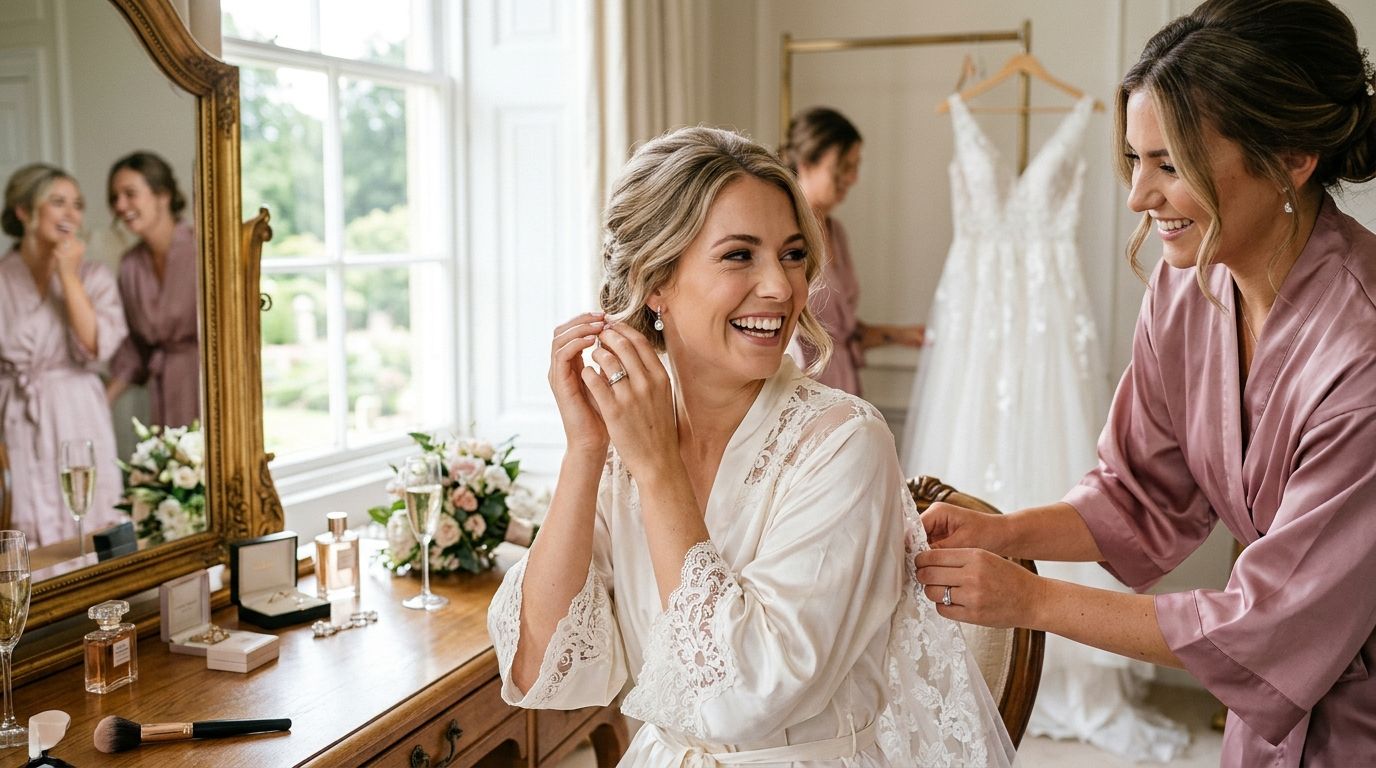
Getting ready wedding photos document the hour or two before a ceremony — hair and makeup, the final dress steps, first looks between parents and their kids, the quiet moments no guest ever sees. Getting ready wedding photos are their own mini-shoot inside the wedding day, not filler before the real coverage starts. David Suns Weddings builds this phase into the timeline as a distinct block, because the emotional content here (a father seeing his daughter dressed for the first time, a mother fastening a necklace) rarely repeats itself later in the day.
- Getting ready wedding photos need a dedicated 60-90 minute block, not a rushed 15-minute add-on before the ceremony.
- Two-photographer coverage lets both partners get documented getting ready at the same time in separate locations.
- A cluttered getting-ready room is the single most common reason these photos look worse than the ceremony shots.
- David Suns Weddings treats getting-ready coverage as a full segment of the wedding photography plan, with a shot list agreed on in advance.
Why getting-ready coverage matters for your wedding photography plan
Most couples spend more planning energy on the ceremony and reception than on the getting-ready block, then wonder later why that part of the album feels thin. The room is smaller, the light is worse, and there's less obvious "action" than a first dance — which means the photographer has to work harder to produce anything worth keeping.
The payoff is real: getting-ready photos are usually the only images that show parents, siblings, and the wedding party before makeup runs, before feet hurt, before the day turns into a blur. A photographer who treats this block as an afterthought produces flat, repetitive frames. One who plans for it comes back with images the family reprints for decades.
Build the getting-ready shoot: step by step
Block real time on the timeline
Most wedding-day timelines get squeezed from both ends — hair and makeup run long, transportation gets delayed — and the getting-ready block is usually the first casualty. Protect it deliberately.
- Confirm hair and makeup completion time with the stylist, then add a buffer before the photographer arrives
- Separate "getting dressed" time from "photographed getting dressed" time — they are not the same window
- Build in 10-15 minutes of slack before the first look or ceremony departure
- Tell vendors (planner, stylist, venue coordinator) the photography start time, not just the ceremony start time
Choose the location with light in mind
Hotel rooms and small bridal suites are the most common getting-ready location, and also the hardest to shoot well. A room with one small window and fluorescent overheads limits what any photographer can produce.
- Request a room with a window that gets soft daylight, not direct harsh sun
- Avoid rooms with patterned wallpaper or busy furniture behind the main dressing area
- Ask the venue in advance whether a suite with better natural light is available
- If both partners are getting ready on-site, confirm both rooms have usable light, not just one
Clear the clutter before the camera arrives
This is the fastest way to upgrade getting-ready photos without spending anything extra. Room service trays, phone chargers, and empty hangers show up in nearly every frame if nobody moves them.
- Assign one person (a parent, a maid of honor) to clear trash and personal bags before photography starts
- Hang the dress, suit, or gown somewhere visible and photogenic — a window, a decorative hook, a doorframe
- Set out the rings, invitation suite, shoes, and any heirloom jewelry together for detail shots
- Keep phones and drinks out of frame during the actual dressing sequence
Decide on one-photographer or two-photographer coverage
When partners get ready in different locations, one photographer can't be in two places. This is the single biggest structural decision in the getting-ready plan.
- A single photographer covers one side fully, then travels to the other — expect a gap in coverage on the side shot second
- A two-photographer team covers both sides simultaneously, which is standard for getting-ready coverage split across two locations
- If budget or format keeps it to one photographer, prioritize the side with better light and more people involved
- David Suns Weddings recommends discussing single- versus two-photographer getting-ready coverage during the initial consultation, before the timeline is finalized
Give the photographer a shot list, not just a location
A photographer walking in cold will default to generic shots: hands, mirror reflections, shoes. A short shot list turns generic coverage into something specific to your family.
- List any heirloom items — a grandmother's veil, a father's watch, a family Bible
- Name who needs a solo portrait during this block (mother, father, best friend)
- Flag any planned reveal moments (parent seeing the dress, sibling reaction)
- Note any first-look plan so the photographer can position for it in advance — see the first-look photo session guide for how that moment gets structured
Coordinate the wedding party's readiness
Groups of six or eight people rarely finish getting ready at the same moment, and a photographer waiting on stragglers burns time that should go toward portraits.
- Set a "photo ready" time for the wedding party that's earlier than the actual departure time
- Ask the wedding party to have robes or cover-ups off and outfits on before the photographer's scheduled arrival
- Group portraits work better as a planned 10-minute block, not an improvised scramble
- For larger parties, review how to prepare your wedding party for photos ahead of the day
Confirm the plan with your photographer in advance
All of the above only works if it's communicated before the wedding day, not negotiated in the room that morning.
- Walk through the full day-of timeline with your photographer, including the getting-ready block specifically
- Confirm arrival time, room assignments, and who's shooting which side if using two photographers
- Ask what lens choices they plan for tight rooms — 35mm and 50mm lenses handle small spaces better than longer glass, while 85mm suits detail and portrait shots once there's more room to work with
- Review the full sequence in how to plan a wedding day timeline with your photographer
Plan your getting-ready coverage
Talk through timeline, room setup, and one- vs. two-photographer coverage before your date is booked.
Comparing your getting-ready coverage options
| Option | Best for | Key limitation |
|---|---|---|
| Single photographer, one location | Couples getting ready together or at one venue | Can't cover a second location at the same time |
| Two-photographer team | Couples getting ready in separate rooms or venues | Requires coordinating two schedules and two sets of access |
| Photographer + videographer combo | Couples who want both stills and motion from this block | Two crews in a small room can crowd the space |
| Smartphone-only, no professional coverage | Very tight budgets or last-minute elopements | No professional editing, exposure control, or backup gear |
Verdict: a two-photographer team is the only option that fully solves simultaneous getting-ready coverage in separate locations — everything else forces a trade-off.
Common mistakes couples make with getting-ready photos
- Treating it as dead time on the timeline. Couples schedule 15 minutes for a block that realistically needs an hour, then wonder why the photos feel rushed.
- Ignoring the room itself. A gorgeous dress against a cluttered hotel room with a mini-fridge in frame undercuts the whole set.
- Not telling the photographer about heirlooms or reveal moments. A photographer can't anticipate a grandmother's brooch or a planned father-daughter moment without being told.
- Booking one photographer for two separate getting-ready locations. This forces a coverage gap that shows up later as a lopsided album.
- Skipping the shot list for detail items. Rings, invitations, and shoes get packed away before anyone remembers to photograph them together.
FAQ
How much time should I block for getting-ready wedding photos?
Plan for roughly 60-90 minutes of dedicated getting-ready coverage, separate from hair and makeup time. This gives the photographer room for detail shots, candid moments, and any planned reveals without rushing to make the ceremony start.
Do I need two photographers for getting-ready coverage?
Only if both partners are getting ready in separate locations at the same time. A single photographer can cover one location fully, then move to the second, but that creates a gap in coverage on whichever side is shot second.
What should I clear out of the getting-ready room before photos start?
Remove room service trays, empty hangers, phone chargers, and personal bags from the main dressing area. These are the most common background distractions in getting-ready photo sets.
Should I give my photographer a shot list for getting ready?
Yes — a short list naming heirloom items, planned reveal moments, and who needs a solo portrait turns generic coverage into images specific to your family. Photographers walking in without context default to standard shots like hands and mirror reflections.
Is getting-ready coverage worth it if the room is small?
Yes, with adjustments. A photographer working with 35mm or 50mm lenses can handle tight rooms better than longer lenses, and moving the dressing area near a window with soft daylight solves most of the space problem.
Can I combine getting-ready photography with videography?
Yes, many couples book both for this block, though two crews in a small room require more coordination on positioning. Confirm room size and crew count with your vendors ahead of the day.
What's the biggest mistake couples make with this part of the day?
Under-scheduling it. Getting-ready coverage gets treated as a 15-minute formality when it typically needs closer to an hour to produce images worth keeping.
One last thing
The getting-ready block is the only part of the wedding day where the people who raised you are still calm, dressed up, and not yet distracted by hosting duties — plan for that window in 2026 like it matters, because in most weddings it only happens once. Couples who treat this segment as a real shoot, not a warm-up, consistently end up with the images they reprint years later, long after the reception photos have blurred together.


