
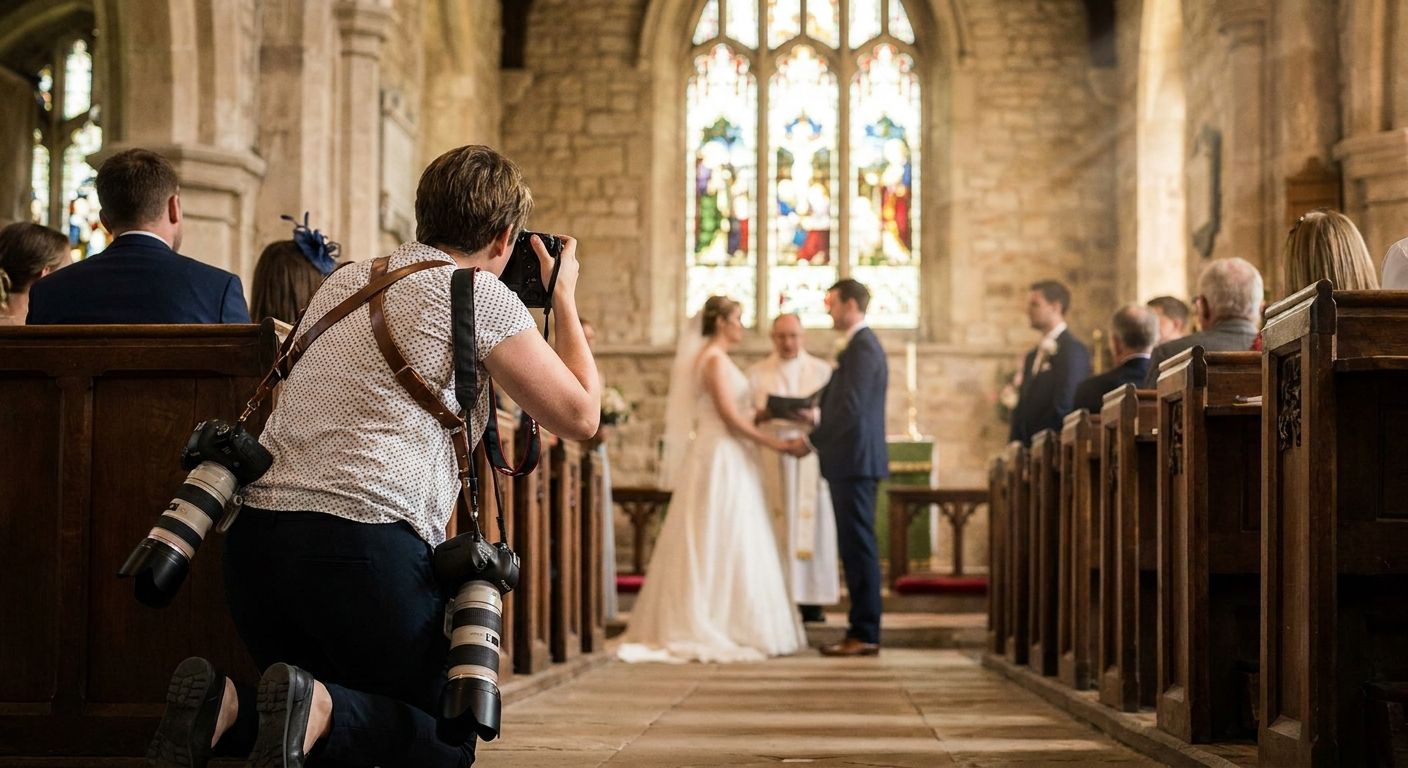
A church wedding photographer has to solve problems a barn or vineyard shooter never faces: fixed seating, no-flash rules during the vows, and a priest or officiant who will not pause for a re-take. This guide breaks down what actually matters when you're marrying inside a sanctuary in 2026, and which coverage approach fits a church-to-reception timeline.
- A church wedding photographer needs no-flash technique and clergy-rule fluency — generic outdoor shooters often can't adapt.
- All-day coverage from David Suns Weddings absorbs the church-to-venue travel gap most couples underestimate: Buy.
- Same-day edit films run 3-5 minutes and need real buffer time after the recessional — Skip if your reception starts inside two hours.
- Denominational and cultural ceremony experience matters more than camera gear for church wedding photographer bookings in 2026.
Why this matters
A sanctuary is not a neutral backdrop. Most dioceses and church boards set rules on where a photographer can stand, whether flash is allowed during the ceremony, and how close anyone gets to the altar rail. A church wedding photographer who has actually worked inside these constraints will get you clean images of the exchange of vows without breaking protocol or annoying the officiant.
Compare that to a photographer who's only shot backyard and vineyard weddings, where the couple sets the rules. Put that same person in a dim, no-flash Catholic Mass and you'll see grainy, underexposed frames or a photographer creeping down the aisle mid-ceremony — neither works for a church setting in 2026.
Who this is for
This guide is for couples marrying inside a church, cathedral, chapel, or temple — Catholic, Episcopal, Baptist, Orthodox, or another denomination with its own ceremony structure and photography rules. If your ceremony venue is a house of worship rather than a barn, vineyard, or backyard, the criteria below apply directly to you.
What to look for in a church wedding photographer
No-flash, low-light shooting skill
Many churches ban flash photography during the vows to avoid distracting the congregation and the clergy. A photographer who can't shoot clean images at high ISO in a dim sanctuary will hand you grainy, blurry frames of the actual exchange of rings — the moment you're paying for.
Denominational and clergy rule fluency
A Catholic Mass wedding runs differently than a Baptist ceremony or a Jewish ceremony under a chuppah. Photographers who've worked inside your specific tradition already know where they can stand, when communion happens, and which moments are off-limits to shoot.
Fixed-position discipline
Most churches restrict photographers to specific spots — often the back of the aisle or a side transept — rather than letting them roam freely like at an outdoor ceremony. This is a skill, not a limitation: it means composing strong shots from a stationary position instead of chasing angles.
Timeline compression
Church ceremonies often run on a tight clock set by the parish, not the couple, and the reception venue is frequently a separate location. A photographer who can move fast during the recessional and the church steps portraits protects the timeline for everything after.
Second shooter for wide coverage
Balconies, side aisles, and the back of a large sanctuary all need a second angle during a ceremony that a single photographer can't cover moving between fixed spots. A second shooter fills in wide shots and reaction frames from the congregation.
Booking a church wedding photographer means checking all five of these before you sign anything — not just scrolling a portfolio of golden-hour outdoor shots.
Talk through your church timeline
Get coverage recommendations based on your ceremony venue and denomination.
Coverage that actually fits a church ceremony
Not every package built for outdoor or backyard weddings translates cleanly to a sanctuary. Here's how the main coverage approaches stack up for a church wedding photographer booking in 2026.
The devout tradition pick — cultural and denominational ceremony coverage. This approach is built around full-length ceremonies inside a sanctuary, following clergy no-flash rules and procession restrictions rather than working around them. It suits Catholic Mass weddings, Orthodox ceremonies, and other traditions with fixed ritual sequences. If your ceremony has a structured liturgy your photographer needs to understand ahead of time, cultural ceremony coverage is the starting point. Verdict: Buy.
The safe pick — all-day coverage. A church wedding rarely happens at the reception venue, which means travel time between the ceremony and the party eats into any coverage window that starts and stops too tight. An all-day coverage package absorbs that gap, covering getting-ready shots through the reception send-off without forcing you to choose between the church and the party. Verdict: Buy.
The compact pick — a small-wedding structure. Some churches cap guest counts for smaller weekday ceremonies or Lenten-season weddings, and a smaller guest list doesn't need the same hour count as a 200-person Saturday wedding. A photographer offering a scaled-down package for a shorter guest list and a simpler ceremony is worth asking about if your church wedding is intentionally intimate. Verdict: Consider.
The wildcard — same-day edit videography. A same-day edit film, typically 3 to 5 minutes long, gets cut and played at the reception the same day it's shot. That's a strong add-on when the ceremony and reception happen close together with real buffer time between them. It's the wrong call for a church wedding where the Mass runs long and the reception starts right after — editors need hours, not minutes, to turn footage into a finished reel. Verdict: Skip if your reception starts less than two hours after the recessional; Consider otherwise.
“If your reception starts less than two hours after the recessional, skip the same-day edit — there's no time to cut it right.”
What to avoid when booking a church wedding photographer
- Photographers who only show outdoor portfolios. Golden-hour barn and vineyard shots tell you nothing about how someone performs in a dim, no-flash sanctuary. Ask specifically for church ceremony samples.
- Anyone promising unrestricted aisle movement. Most churches enforce a fixed photographer position. A photographer who says they'll "walk the aisle for better angles" either hasn't shot a church wedding before or plans to ignore the rules — both are red flags.
- Videographers running bright on-camera lights during vows. This is the fastest way to get a photographer or videographer removed mid-ceremony by an usher or the officiant. Ask how they handle low light without supplemental lighting during the vows specifically.
How the picks compare
| Pick | No-flash skill required | Best for | Verdict |
|---|---|---|---|
| Cultural ceremony coverage | High | Catholic Mass, Orthodox, structured liturgy | Buy |
| All-day coverage | Medium | Separate ceremony and reception venues | Buy |
| Small-wedding structure | Medium | Capped guest count, shorter ceremony | Consider |
| Same-day edit add-on | Low (videography-focused) | Tight ceremony-to-reception gap only | Skip / Consider |
FAQ
What makes a church wedding photographer different from a regular wedding photographer?
A church wedding photographer works within no-flash rules, fixed standing positions, and clergy-set timelines that don't apply at outdoor or backyard ceremonies. Experience shooting inside a sanctuary matters more than general portfolio strength.
Can a photographer use flash during a church ceremony?
Most churches ban flash during the vows and the exchange of rings to avoid distracting the congregation and officiant. A church wedding photographer needs to shoot clean images at high ISO in low light instead.
How long does a typical church wedding ceremony run?
A church ceremony typically runs 30 to 45 minutes, though a full Catholic Mass wedding can run longer than a ceremony-only service. Your photographer's coverage window should account for this before booking a shorter package.
Is a second shooter necessary for a church wedding?
A second shooter is worth it for larger sanctuaries with balconies or side aisles, since a single photographer working from one fixed position can't cover every angle. For smaller chapels with a simple layout, one photographer is often enough.
Should I get a same-day edit film for a church wedding?
A same-day edit film works when there's real buffer time, usually several hours, between the ceremony ending and the reception toasts. Skip it if your church ceremony and reception happen back-to-back with no gap for editing.
Do church wedding photographers need permission from the church?
Most churches require photographers to follow venue-specific rules on standing positions and flash use, and some request advance notice from the couple. Confirm the rules with your officiant or church coordinator before the wedding day.
What should I ask a church wedding photographer before booking?
Ask to see samples shot specifically inside a sanctuary, confirm how they handle no-flash restrictions, and ask how they've worked within your specific denomination's ceremony structure. A photographer without a direct answer to any of these hasn't done it before.
One last thing
The detail most couples miss isn't the photographer's gear — it's the gap between the church and the reception venue. A church wedding photographer who plans for that drive time, not just the ceremony itself, is the difference between a smooth 2026 wedding day and a photographer scrambling to catch the reception entrance.


