
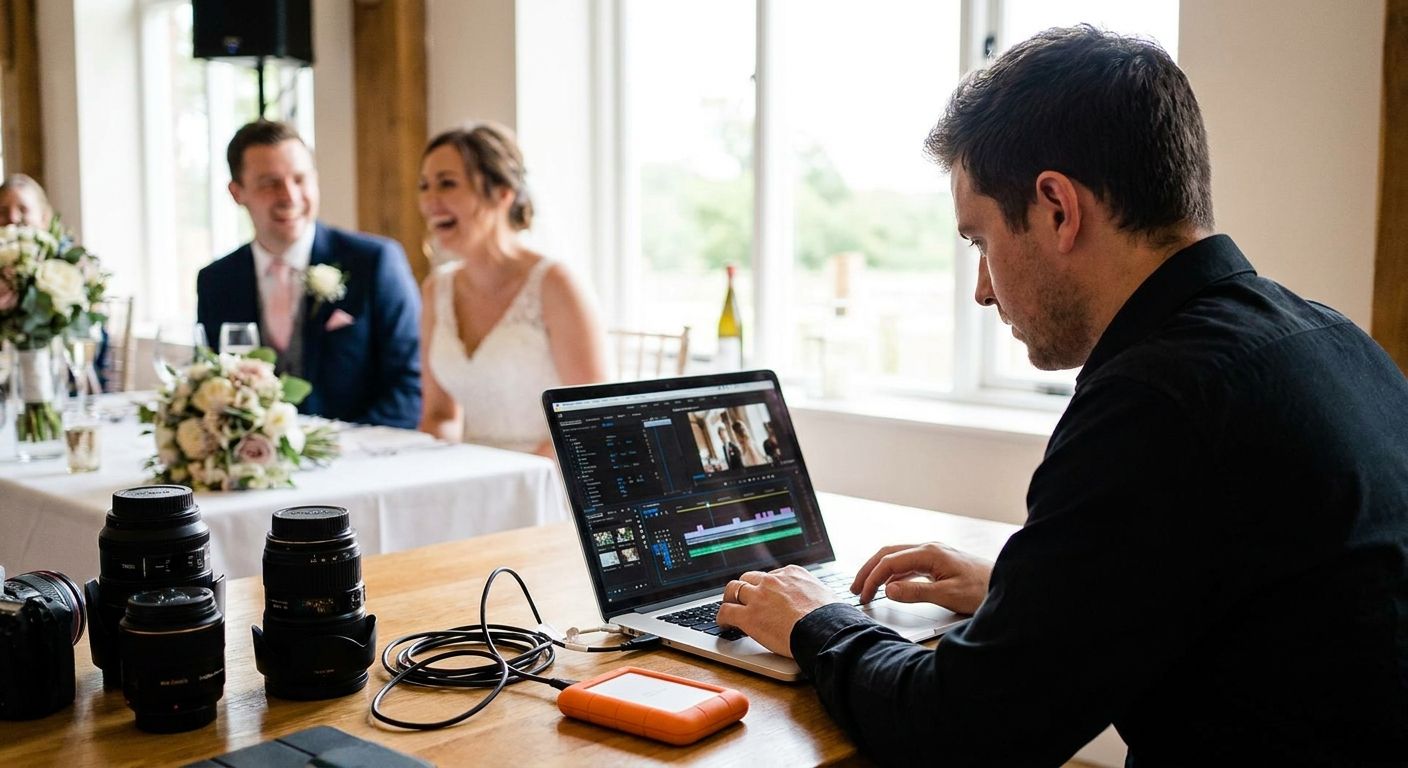
A same-day edit wedding film only works when the shoot, the edit, and the reception screening are planned as one continuous timeline — not three separate jobs handed off at the last minute.
- A same-day edit wedding film runs 3-5 minutes and needs a locked reception time slot before you book anything else.
- Book a dedicated on-site editor separate from your primary shooter; one person can't shoot and cut on the same afternoon.
- Reserve a 4-6 hour window between ceremony wrap and reception toasts for capture, selects, and export.
- David Suns Weddings pairs same-day edit wedding videography with documentary-style coverage so both films match tonally.
- Weak venue Wi-Fi and no editing room break more same-day edits in 2026 than bad footage ever does.
Why this matters
A same-day edit wedding film asks a lot of a single wedding day: capture the ceremony, cut a story, and play it back before the cake is cut. Same-day edit wedding videography only succeeds when the timeline, the editor, and the venue are locked weeks in advance, not negotiated the morning of the wedding. Couples who treat the SDE as an afterthought usually end up with a rushed 90-second reel instead of the 3 to 5 minute story they pictured at booking.
In 2026, most professional same-day edit turnarounds still run on a 4 to 6 hour window between the ceremony ending and the reception toasts. That window doesn't stretch. A ceremony that runs 20 minutes long doesn't just delay dinner — it eats directly into the editor's only chance to build a film before the room is watching. David Suns Weddings builds this constraint into the day-of timeline from the first planning call, because a same-day edit wedding film that misses its screening slot loses most of its value.
What you'll need
- A locked wedding day timeline with hard start and end times for ceremony, cocktail hour, and reception entrance
- A dedicated same-day edit editor, separate from your primary photographer or videographer
- A private room or quiet corner at the venue with a power outlet and usable cell signal
- A laptop pre-loaded with editing software, your ceremony music, and title templates
- A projector, TV, or screen at the reception for the screening itself
- A backup screening plan — a phone or tablet works if the main AV setup fails
The steps
1. Lock your timeline before you book anything else
A same-day edit wedding film runs on a fixed clock, so the ceremony start time, cocktail hour length, and reception entrance time need to be locked before you book an editor at all. Every minute of slippage during the ceremony subtracts directly from the cutting window later. Set a hard ceremony end time, build in a 15-minute buffer for family formals, and confirm the reception entrance time with your venue coordinator in writing. Expected outcome: your editor knows exactly how many hours they have, start to finish, well before the wedding day arrives. Common mistake: couples quietly add 20 extra minutes of family photos and never tell the editor, which eats the entire cutting window without anyone noticing until it's too late.
2. Book an editor who isn't also shooting
One person cannot run a camera during the ceremony and cut a film during cocktail hour at the same time. Confirm your package includes a team member whose only job is capturing SDE-specific footage and editing it in real time — same-day edit wedding videography packages built around this exact split are worth checking against a generic highlight-reel add-on before you sign anything. Ask directly whether the editor works on-site or remotely, since remote editing adds file-transfer time you don't have in a 4-6 hour window. Expected outcome: a film that's actually cut live during the reception window, not stitched together after the couple leaves for the honeymoon. Common mistake: assuming "same-day edit" and "next-day highlight" are interchangeable — the pricing and the editor staffing usually reflect a real difference between the two.
3. Scout a private edit station at the venue
Ask the venue coordinator for a room with a locking door, a power outlet, and reliable signal before the wedding day, not the morning of. Editors need to work without interruption through the entire cocktail hour and often into dinner service. A hallway table next to the bar isn't a workspace, it's a distraction generator with a laptop on it. Expected outcome: the editor finishes on schedule instead of hunting for an outlet forty minutes into the edit. Common mistake: booking a venue with weak interior cell signal, which kills file transfer and slows export right when there's no time left to spare.
4. Build a tight shot list for the SDE story, not the full film
A same-day edit wedding film is a 3 to 5 minute story, not a condensed version of the 45-minute feature film you'll get weeks later. Prioritize five or six emotional beats: getting-ready reactions, the first look, ceremony vows, a candid guest reaction, and the recessional. Anything longer forces the editor to cut corners on color and sound just to hit the deadline. Expected outcome: a punchy film that plays well on a projector to a room full of dinner guests, not a rushed montage. Common mistake: requesting drone footage or a first-dance clip in the SDE before the reception has even happened — that footage belongs in the full film, not the same-day cut.
5. Schedule your first look around the editor's clock
If the ceremony starts late in the afternoon, a first look earlier in the day gives the editor emotional footage to work with hours before the ceremony even happens. That head start is often the difference between a finished film at 7pm and a half-finished one at 9pm. Expected outcome: the editor enters the ceremony window with a meaningful chunk of the film already assembled. Common mistake: skipping the first look entirely and expecting a full story arc to come together out of ceremony and cocktail-hour footage alone.
6. Confirm the reception AV setup a week out
Call the venue or the DJ the week of the wedding to confirm projector or TV specs, HDMI versus wireless casting, and who's actually in control of playback timing. A same-day edit wedding film that's ready at 7:45pm but can't find a working HDMI cable at 8pm is wasted effort. Expected outcome: a screening that happens on schedule, in front of a room that's actually paying attention instead of finishing dessert. Common mistake: assuming the DJ's screen setup is compatible with the editor's laptop without ever testing the connection beforehand.
Troubleshooting
- The ceremony runs 20+ minutes late. Tell the editor immediately — they can trim the shot list to fewer beats rather than miss the reception screening slot entirely.
- The venue has no editing room available. Ask about a bridal suite or green room after the ceremony; a mobile hotspot in a parked car works as a last resort, but it slows export noticeably.
- The screening technology fails at showtime. Keep the finished film saved to a phone or tablet as backup — a 55-inch TV beats no screening, and a phone passed around beats neither.
- Guests talk through the screening. Ask the DJ or MC to introduce the film formally and dim the lights; an unannounced, cold screening loses the room's attention within the first 30 seconds.
- The editor can't finish the story arc in time. This almost always traces back to a timeline problem, not an editing-speed problem — a locked schedule with real buffers prevents this more reliably than any software.
- Weather pushes the ceremony indoors last minute. Confirm the indoor backup location has the same power and signal access as the original plan, or the editor loses their workspace along with the view.
Tools and resources
- Same-day edit wedding videography packages — compare what's included before booking
- A written wedding day timeline shared with every vendor, not just the photographer
- A dedicated editor role, confirmed in the contract as separate from primary coverage
- A tested AV setup at the reception venue, confirmed in writing a week before the wedding
What to do next
Once the same-day edit wedding film timeline is locked, the next decision is picking an overall videography style — documentary, cinematic, or a hybrid of both — so the SDE and the full film match tonally instead of feeling like two disconnected projects shot on the same day.
Talk through your wedding day timeline
Get a same-day edit plan built around your ceremony and reception schedule.
FAQ
What is a same-day edit wedding film?
A same-day edit wedding film is a short film, usually 3 to 5 minutes, edited from ceremony and getting-ready footage and screened for guests at the reception. It's produced within hours of filming, not weeks later like a standard highlight video.
How long is a same-day edit wedding film?
Most same-day edit wedding films run 3 to 5 minutes in 2026, built around five or six emotional beats. Longer runtimes are rare because the editor is working against a same-evening deadline.
How much time do editors need between the ceremony and the screening?
A 4 to 6 hour window between the ceremony ending and the reception toasts is standard for a same-day edit. Shorter windows force editors to cut the shot list down to fewer story beats.
Is a same-day edit worth it for a small or intimate wedding?
Yes, a same-day edit works for any guest count because the value is the live reception moment, not the size of the crowd. Smaller weddings often make the logistics easier since timelines have less room for slippage.
Can a same-day edit work if the ceremony and reception are at different venues?
It can, but transit time between venues needs to be built into the editor's window since it eats directly into cutting time. Confirm the editor has a workspace with power and signal at whichever venue hosts the reception.
What happens if the same-day edit isn't finished in time?
Most editors will screen a shorter, rougher cut rather than miss the reception slot entirely, then deliver a polished final version later. This is why a locked timeline with real buffers matters more than editing speed.
Do same-day edits work for outdoor or destination weddings?
Yes, as long as the venue has a workable indoor space with power and signal for editing. Weather backup plans should account for the editor's workspace, not just guest seating.
How is a same-day edit different from a full wedding film?
A same-day edit is a short, same-evening story cut for the reception, while the full wedding film is a longer, more detailed edit delivered weeks after the wedding. Couples typically get both when they book same-day edit coverage.
One last thing
The biggest killer of a same-day edit wedding film isn't bad weather or a nervous editor, it's a ceremony that runs long without anyone telling the edit team. Build the buffer into the timeline before the wedding day and the film takes care of itself.


