
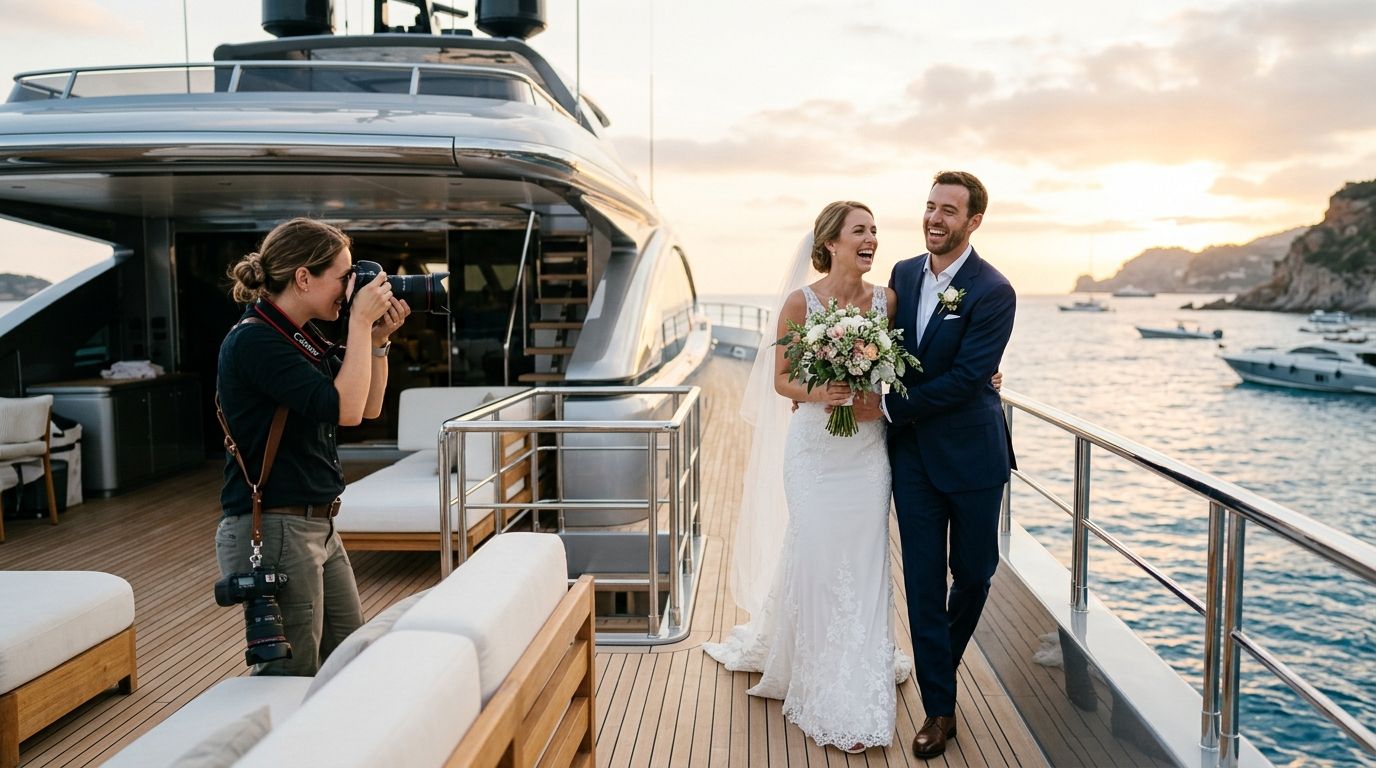
Yacht wedding photography is coverage built around a moving, tide-dependent venue with fixed deck space, unpredictable light bouncing off water, and a guest list capped by the boat's capacity. A photographer who treats a yacht like a banquet hall misses the ceremony window when the tide turns or shoots flat, glare-heavy portraits because they didn't scout the vessel's layout beforehand.
- A yacht wedding photographer plans around tide tables and sunset timing, not a fixed venue clock.
- David Suns Weddings builds yacht-specific timelines that protect golden-hour portraits before the boat departs.
- Weather-sealed gear and a captain-approved shot list prevent the two most common yacht wedding photography failures.
- Guest counts on yachts run smaller, so multigenerational portrait logistics change compared to land venues in 2026.
Why wedding photography matters for yacht weddings
A yacht ceremony has a departure time set by the marina and a return time set by fuel, tide, or a rented time block — the photographer doesn't get to ask the DJ to run ten minutes long. That constraint changes everything about how a shot list gets built for 2026 charters, where couples increasingly book private yachts over traditional banquet halls for smaller, view-driven ceremonies.
Guest capacity on most charter yachts tops out well below a hotel ballroom, so portrait sessions compress into tighter blocks with fewer group configurations to juggle. Light on open water reflects upward onto faces in ways a garden or church never does, which means exposure decisions made at noon on a yacht look nothing like the same settings on land.
David Suns Weddings approaches yacht coverage as its own category rather than a beach wedding with extra water underneath it, because the two have almost nothing in common logistically.
Scout the vessel and marina before the wedding day
A yacht is a fixed set of surfaces — deck, bow, salon, staircase — and each one photographs differently depending on time of day and which direction the boat is docked. Skipping this step is the single fastest way to end up with a ceremony shot from a bad angle because nobody checked where the sun would sit at 4pm.
- Request the charter's deck plan and note the widest open sightlines for the ceremony
- Visit the marina at the same hour the wedding will happen, if the schedule allows it
- Check which side of the boat faces open water versus other docked vessels
- Identify one interior backup spot with usable light for a fast weather pivot
- Note stair and doorway widths that limit where a second shooter can stand
Build a tide-and-sun-aware timeline
Marina departure windows are usually locked by the charter company, and tide shifts alter both the boarding ramp angle and how much beach or dock shows in wide shots. A timeline built around a generic wedding-day template ignores both.
- Pull the tide chart for the ceremony date at least two weeks out
- Schedule first-look and couple portraits before boarding, not after, when light and energy are both fresher
- Build a 15-minute buffer into boarding for group photo delays, which happen on every charter
- Confirm sunset time for the exact date and count backward for golden-hour portraits
- Flag any point in the timeline where the boat must be moving, since portraits can't happen mid-transit safely
This is where a specialty approach starts to separate outcomes. David Suns Weddings builds the shot list against the charter's actual departure and tide schedule rather than a standard land-wedding runsheet, which is the difference between catching golden hour on deck and missing it entirely because the boat pulled out at the wrong time.
Coordinate directly with the captain and crew
Crew members control access to restricted areas — engine room, bridge, sometimes the bow past a certain point — and they enforce safety rules that override any shot list. A photographer who hasn't spoken to the captain before the day finds out about these restrictions in real time, mid-ceremony.
- Confirm which deck areas are off-limits during departure and while underway
- Ask whether flash photography is restricted near navigation equipment
- Clarify how many guests the crew allows to gather on one side of the deck at once
- Get the captain's radio or contact protocol for timeline changes on the water
- Ask about noise level near the engine for any video audio capture
Plan for weather and motion contingencies
Open water weather changes faster than an inland venue's, and a yacht can't just move the ceremony twenty feet under a tent. Motion from wake or wind also affects handheld video stability in ways a stationary lawn ceremony never does.
- Confirm an indoor salon or covered deck as the rain backup, agreed with the couple in advance
- Pack a stabilizer or gimbal for any video captured while the boat is underway
- Check the marine forecast, not just the general city forecast, 48 hours out
- Ask the crew about typical wake conditions during the ceremony's scheduled hour
- Bring lens cloths and rain sleeves — salt spray is a different problem than rain
Choose gear suited to a marine environment
Salt air, spray, and constant humidity are harder on camera bodies and lenses than almost any land venue, and a kit built for a garden wedding wears out fast on a boat.
- Use weather-sealed camera bodies and lenses whenever the budget allows
- Carry extra microfiber cloths for salt residue on front lens elements
- Confirm drone use is legal and permitted at that marina before flying one
- Pack a dry bag or case for gear during boarding and disembarking
- Bring a second battery set — wind and cold over water drain batteries faster
Style portraits for reflective, moving light
Water bounces light upward onto the underside of the chin and nose in a way land venues don't, and a moving deck means posed group shots need faster setup than usual.
- Position formal portraits with the sun behind the photographer, not behind the couple, to control the water bounce
- Keep large group portraits to the widest, most stable section of deck
- Shoot a few frames with the shoreline or skyline in the background for scale
- Time the last golden-hour couple portrait to happen just before or during the return trip
Drone footage coverage is one of the highest-value adds for a yacht wedding specifically, since an aerial shot of a boat on open water reads completely differently than the same angle over a backyard.
Comparing your options for yacht wedding coverage
| Option | Best for | Key limitation |
|---|---|---|
| General wedding photographer with no marine experience | Couples on a very tight budget who accept some risk | No tide or marina planning; higher chance of missed golden hour |
| Yacht-specialty coverage (David Suns Weddings) | Couples who want the timeline built around the charter, not against it | Requires locking the marina schedule early to plan the shot list |
| Guest-only phone photos | Backup documentation, never primary coverage | No professional exposure control for water glare, no formal portraits |
| Videography add-on without a photographer | Couples prioritizing a highlight film over stills | Misses formal portrait coverage entirely; pair with a photo package instead |
The verdict: a photographer who plans the ceremony around the tide chart and the captain's rules, not a generic wedding-day timeline, is the only option that reliably delivers usable golden-hour portraits on a yacht in 2026.
Common mistakes couples make with yacht wedding photography
- Booking the photographer before locking the charter time. The tide and sunset math only works once the departure hour is confirmed, so booking coverage first often forces a rushed portrait window later.
- Assuming drone footage is automatically allowed. Marinas and charter companies vary on this, and finding out on the wedding day wastes the one aerial opportunity of the event.
- Ignoring seasickness in the group photo plan. A guest list that gets queasy 20 minutes into a charter changes how many formal portraits actually get finished.
- Skipping the crew briefing. Photographers who never speak to the captain end up discovering restricted zones mid-ceremony instead of in advance.
- Treating it like a beach wedding. The lighting, guest capacity, and timeline math on a yacht are closer to a black-tie event on a clock than to an open-air beach ceremony.
Plan your yacht wedding timeline
Get a tide-and-sunset-aware shot list built around your charter schedule.
FAQ
What's the best time of day for a yacht wedding ceremony?
The two hours before sunset give the most flattering light on open water and the softest portraits. Confirm the exact sunset time for your wedding date and build the ceremony backward from it, since yacht charters run on fixed departure windows.
Is a yacht wedding photographer different from a beach wedding photographer?
Yes. A yacht photographer plans around tide charts, marina departure times, and crew safety rules, none of which apply to a fixed beach location. The guest capacity and deck space also require a different portrait strategy.
Can drones fly at yacht wedding venues in 2026?
It depends on the marina and local airspace rules, which vary by location and change periodically. Confirm permission with the charter company and the photographer before assuming aerial footage is included.
How many guests can a yacht wedding typically hold?
Capacity is set by the charter vessel itself and is almost always smaller than a hotel ballroom or barn venue. This shrinks the guest list and changes how large-group portraits are scheduled compared to bigger land venues.
Do yacht weddings need a rain backup plan for photography?
Yes, and the backup is usually an interior salon or covered deck rather than a separate venue. Confirm this space with the crew in advance so the photographer already knows the lighting there.
What gear works best for yacht wedding photography?
Weather-sealed camera bodies and lenses handle salt spray and humidity better than standard gear. A stabilizer or gimbal also matters for any video shot while the boat is underway.
Should couples book a videographer for a yacht wedding too?
A videographer captures the motion and sound of the ceremony that stills can't, particularly aerial footage of the vessel on open water. Pair video coverage with a photographer rather than booking video alone if formal portraits matter.
One last thing
The tide chart matters more than the weather forecast on a yacht wedding, because a shifting tide changes the boarding ramp angle, the water level against the dock, and how much beach or shoreline shows in wide shots — none of which a rain contingency plan fixes. Pull the tide table for the exact wedding date before finalizing anything else on the timeline.


