
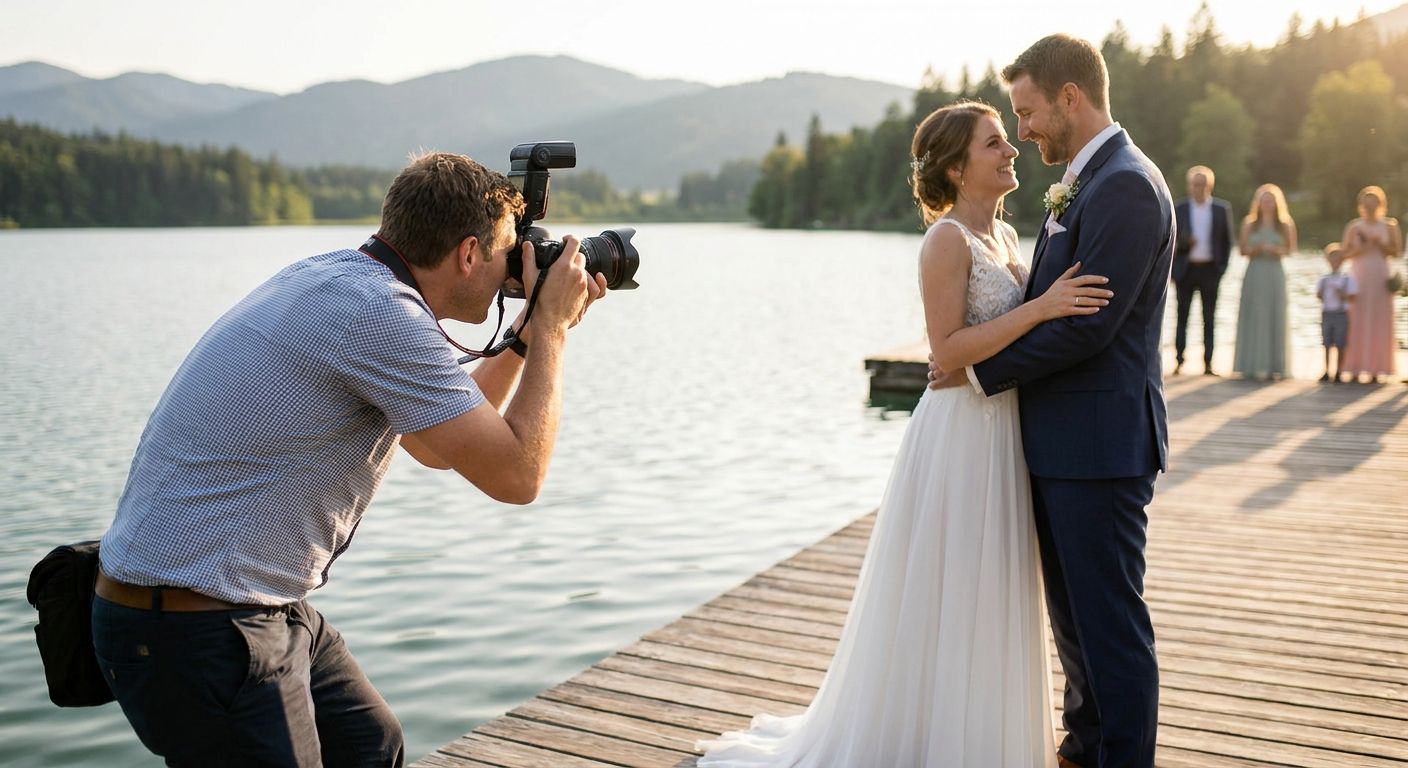
Lake weddings hand you built-in drama: mirror-flat water at sunrise, dock-side vows, sunset light bouncing gold across the surface. A lake wedding photographer who normally shoots ballrooms will miss half of it, because water changes light, sound, and timing in ways indoor venues never do.
- A lake wedding photographer earns their fee on drone footage — David Suns treats it as standard coverage, not an upsell.
- Golden hour on water runs 30-60 minutes before sunset; lock ceremony timing around it, not around the reception schedule.
- Rainy-day backup planning is non-negotiable at lake venues — verdict: build it into the contract before booking, not after.
- All-day coverage packages fit lake weddings better than half-day blocks because dock access and guest travel eat time.
- Micro-weddings under 50 guests suit small docks and clearings; anything larger needs permit lead time from the lake authority.
Why lake weddings need a different photography plan
Water reflects and scatters light instead of absorbing it the way grass or stone does. Midday sun off a lake surface blows out skin tones and forces harsh squinting in every group shot, which is why timing matters more here than at almost any other venue type. Wind off open water also wrecks ceremony audio for video coverage, and bugs show up at dusk exactly when the light gets best.
None of this is a reason to skip a lake venue for 2026 — it's a reason to book someone who plans around it. The rest of this guide breaks down what to look for, which coverage add-ons actually earn their cost at a lake wedding, and what to skip.
Who this guide is for
This is for couples who've already picked, or are seriously considering, a lake venue for their 2026 or 2027 ceremony — a private dock, a state park shoreline, a lodge on the water, or a family lake house. You're weighing coverage options against a venue that comes with weather exposure, water safety logistics, and a light window that closes fast at sunset. If your venue has a shoreline, a dock, or a boat launch anywhere near the ceremony site, the criteria below apply to you.
What to look for in a lake wedding photographer
Comfort working near water and low light at dusk
Sunset over water is the single most requested lake wedding shot, and it only exists for a narrow window — roughly 30 to 60 minutes before actual sunset, the stretch photographers call golden hour. A lake wedding photographer who hasn't planned a shot list around that window will burn it on formals instead of the couple portraits you actually want.
Aerial coverage capability
Ground-level shots can't capture what makes a lake venue worth choosing in the first place: the shoreline shape, the dock layout, the way the ceremony site sits against open water. Drone coverage solves that, and it's now standard equipment for outdoor venue photography rather than a specialty add-on.
A real rainy-day contingency, not a vague promise
Lake venues have zero indoor backup in most cases. A photographer who can name the actual tent, pavilion, or covered-porch plan B before you sign is telling you they've shot this venue type before; one who says "we'll figure it out" is guessing.
Coverage hours that match the venue's layout
Lake venues often separate the ceremony dock, the photo locations, and the reception space by a short walk or golf-cart ride. That travel time eats into a half-day package fast, so hour count matters more here than at a single-building venue.
Experience with permit and access rules
Public lake parks and shared shoreline venues frequently restrict drone flights, group size, or vendor access near the water. A photographer who asks about permits before the wedding day saves you from a shut-down shoot mid-ceremony.
Audio handling for videography near open water
Wind off a lake surface is a documented problem for on-camera ceremony audio. If videography is part of the plan, ask how vows and readings get miked — lapel mics anchored to the officiant and groom solve most of this.
Coverage options worth booking for a lake wedding
Drone footage coverage — the establishing shot you can't get any other way. Federal Aviation Administration Part 107 rules cap recreational and commercial drone flights at 400 feet above ground level, which is more than enough altitude to frame an entire shoreline and dock layout in one pass. This is the single most requested lake-venue add-on, and it's worth booking specifically rather than assuming it's bundled. See drone footage coverage for what's included. Buy.
Rainy-day contingency planning — the unglamorous pick that saves the wedding. Lake venues have almost no indoor fallback, so a photographer who's already scouted a covered alternative on-site is protecting your day, not just your photos. Review rainy day wedding coverage before you finalize a lake venue with no indoor option. Buy.
All-day coverage packages — the pick for anyone whose ceremony and reception sites aren't the same building. Lake venues routinely spread ceremony, portraits, and reception across separate spots on the property, and travel time between them adds up over a full wedding day. Compare hour counts on all-day coverage packages against your venue's layout before booking a shorter block. Buy.
Destination-style booking — relevant if your lake venue is a travel weekend, not a local afternoon. Lake houses and lodges often pull guests out of town for a two- or three-day stretch, which changes how coverage gets scheduled around rehearsal dinners and next-day brunches. This is worth a look if your lake wedding functions more like a weekend trip than a single ceremony. Consider.
Wedding day timeline planning — the quiet pick that prevents the sunset shot from getting missed. Golden hour on water is a fixed, short window, and a timeline built without it in mind is the most common reason couples lose their best possible shot. Walk through wedding day timeline planning with your photographer before you set ceremony start time. Buy.
Planning a lake wedding for 2026?
Talk through venue layout, timing, and coverage before you book.
What to avoid when booking a lake wedding photographer
- A photographer with no drone experience who insists ground shots are enough. Lake venues are chosen for the water view — skipping aerial coverage wastes the reason you picked the venue.
- A contract with no named rainy-day location. "We'll improvise" is not a plan when the venue has zero indoor backup.
- A half-day package on a venue with separate ceremony, photo, and reception sites. The travel time between locations at a lake property routinely eats an hour or more that a compact package doesn't account for.
Lake wedding coverage comparison
| Coverage option | Best for | Key consideration | Verdict |
|---|---|---|---|
| Drone footage | Shoreline and dock-layout shots | FAA Part 107 caps flights at 400 ft AGL | Buy |
| Rainy-day contingency | Venues with no indoor space | Confirm the actual backup location in writing | Buy |
| All-day coverage | Multi-location lake properties | Travel time between ceremony/reception sites | Buy |
| Destination-style booking | Multi-day lake house weekends | Rehearsal dinner and brunch coverage add-ons | Consider |
| Timeline planning session | Any lake ceremony | Golden hour window is 30-60 min pre-sunset | Buy |
FAQ
What makes a lake wedding photographer different from a regular wedding photographer?
A lake wedding photographer plans around open-water light, wind noise for video audio, and the narrow sunset window unique to shoreline venues. Regular indoor-focused photographers often miss the golden-hour timing that makes lake shots work.
Is drone footage worth it for a lake wedding?
Yes — drone footage captures the shoreline and dock layout that ground shots can't frame, and it's the most-requested add-on for water venues in 2026. FAA Part 107 rules cap flight altitude at 400 feet, which is plenty of height for a full establishing shot.
What's the best time of day to photograph a lake wedding ceremony?
The 30 to 60 minutes before sunset, known as golden hour, gives the softest light and the best water reflections. Midday sun off open water tends to wash out skin tones and cause squinting in group photos.
Do lake venues need a rainy-day backup plan?
Yes — most lake venues have little to no indoor space, so a named covered alternative should be in the contract before the wedding date. Skipping this step is the most common regret couples report after a rained-out outdoor ceremony.
How many hours of photography coverage does a lake wedding need?
Lake venues with separate ceremony, portrait, and reception areas usually need an all-day package rather than a half-day block. Travel time between locations on the property is the main reason shorter packages run short.
Can you fly a drone at any lake wedding venue?
Not always — public parks and shared shoreline venues often restrict drone flights, so permit rules should be confirmed before the wedding day. Private lake houses generally have fewer restrictions than state or county park land.
How many guests fit at a small lake wedding?
Micro-weddings, generally defined as under 50 guests, fit comfortably on most private docks and small shoreline clearings. Larger guest counts usually require a tent and more permit lead time from the venue or local authority.
One last thing
Most couples booking a lake venue for 2026 focus on the ceremony shot and forget the drone rules entirely — FAA Part 107 caps altitude at 400 feet AGL, and public parkland often layers on its own permit process on top of that. Confirm drone permissions with the venue before you lock a photographer's aerial package, not after.
“A lake wedding photographer who hasn't named the rainy-day backup location before you sign isn't planning for the venue — they're guessing.”


