
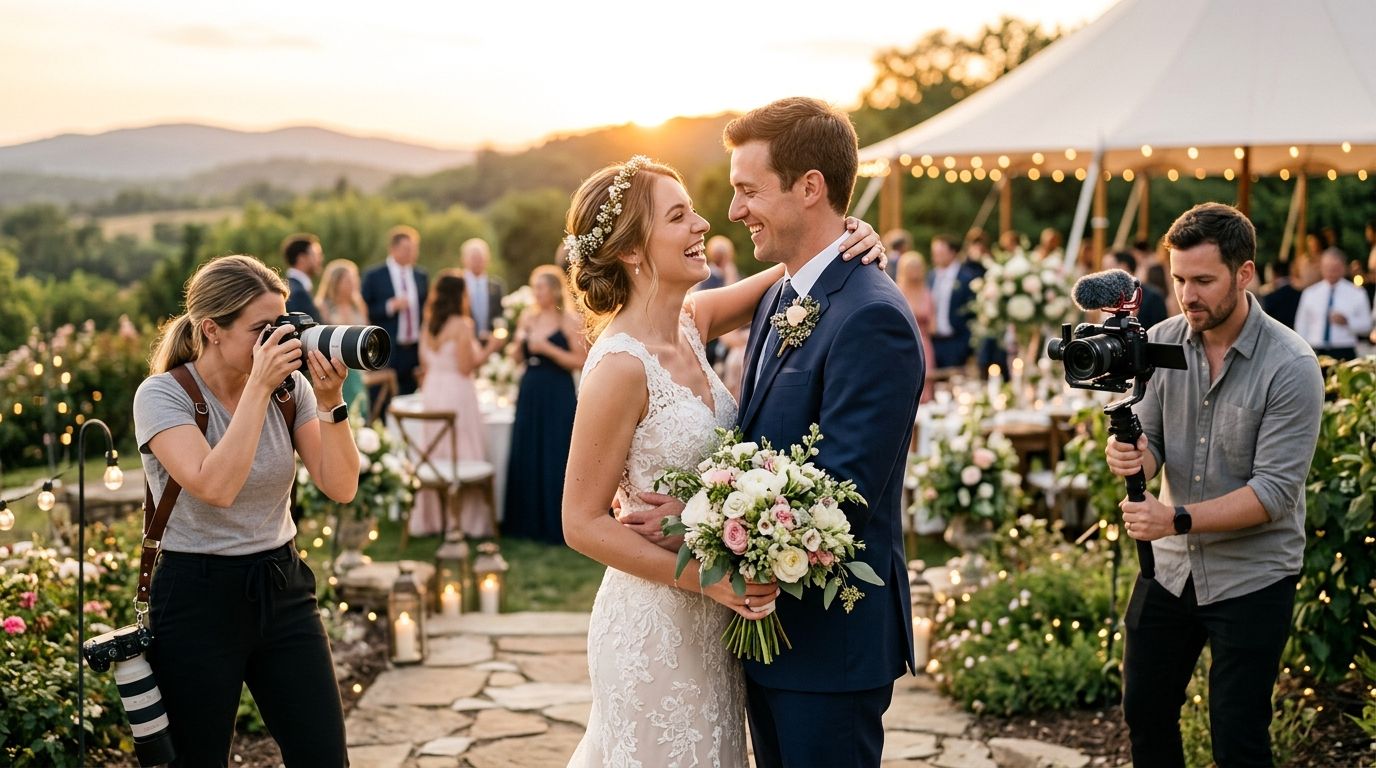
Choosing between wedding photography and videography packages in 2026 comes down to one question: what moment do you refuse to lose? Best overall: a full-day photography and videography coverage package that documents ceremony through last dance. Best for elopements and destination trips: a two-day adventure package. Best budget option: a videography-only edit built around tight timelines.
- Full-day coverage wins for most 2026 weddings needing ceremony-to-reception documentation.
- Elopement and destination couples get more value from two-day adventure packages than single-day bundles.
- Same-day edit packages solve the reception-night highlight reel problem without a full second shooter.
- Budget-conscious couples should choose videography-only or reduced-hour photography and videography packages, not skip coverage entirely.
Why this matters
Most couples booking wedding photography and videography packages in 2026 are comparing hours, deliverables, and add-ons without a clear framework for what actually applies to their day. A destination elopement has different coverage needs than a backyard ceremony with 150 guests. Same-day edit reels, drone add-ons, and multi-day celebration coverage all solve different problems, and picking the wrong bundle means paying for hours you don't use or missing footage you can't get back.
The packages below are ranked by the use case they solve best, not by a single "top pick" that fits every wedding. Read the criteria section first, then match your wedding format to the right package category.
What makes the best wedding photography and videography package
- Coverage window matches the actual event length — a 12-hour wedding day needs more than an 8-hour package
- Deliverables are spelled out — raw files, edited galleries, highlight film length, turnaround time
- Add-ons are modular — drone footage, second shooter, same-day edit reels should be optional, not bundled blind
- Style fit — documentary, cinematic, or a blend, confirmed against sample work before booking
- Multi-day and multi-event flexibility — rehearsal dinners, welcome parties, and next-day brunches need separate coverage decisions
- Clear cancellation and rescheduling terms in the contract, especially for destination and off-season dates
Wedding photography and videography packages at a glance
| Package Type | Best For | Standout Feature | Key Limitation |
|---|---|---|---|
| Full-Day Coverage | All-day documentation | Ceremony-to-reception continuity | Higher hour count than most couples need for small weddings |
| Two-Day Elopement/Destination | Destination and elopement couples | Travel-day and ceremony-day split | Requires travel logistics coordination |
| Multi-Day Celebration | Multi-event cultural weddings | Covers rehearsal, ceremony, reception across days | Longer contract and scheduling complexity |
| Budget Videography-Only | Tight-budget couples | Lower hour commitment, film-only deliverable | No stills unless bundled separately |
| Same-Day Edit | Reception-night reveal | Highlight reel ready before guests leave | Needs extra crew or tight editing turnaround |
| Micro/Small Wedding | Under-50-guest ceremonies | Scaled-down hours matched to guest count | Fewer formal portrait slots built in |
1. Full-Day Photography and Videography Coverage: best for all-day documentation
A full-day package covers getting-ready shots through the last dance, pairing a photographer and videographer across the entire timeline. It's the default choice for weddings with a ceremony, cocktail hour, and reception happening in one location or a short drive apart.
Full-day coverage pros:
- Nothing gets missed between morning prep and final exit
- One consistent visual style across every part of the day
- Works for weddings with 100+ guests and long reception timelines
Full-day coverage cons:
- More hours than a small or short ceremony actually needs
- Requires a detailed day-of timeline to avoid dead time in coverage
Pricing: request a custom quote based on hours, locations, and crew size — hour count is the main driver, not a flat rate.
Verdict: Buy if your wedding day runs ceremony through reception in one continuous block. Skip if you're planning a two-hour courthouse ceremony.
2. Two-Day Elopement and Destination Package: best for destination and adventure weddings
Couples eloping to national parks, waterfalls, or overseas venues need a two-day adventure package that separates travel-day scouting from ceremony-day shooting. This format accounts for weather delays and location changes that single-day contracts don't.
Two-day elopement pros:
- Built-in flexibility for weather or permit delays
- Allows sunrise or sunset ceremony timing without rushing
- Second day can cover a styled portrait session at a backup location
Two-day elopement cons:
- Travel costs and logistics add planning overhead
- Not necessary for local elopements within driving distance
Verdict: Buy if you're eloping somewhere that requires travel and location scouting. Skip if your elopement is a same-day courthouse ceremony near home.
3. Multi-Day Celebration Videography: best for multi-event cultural weddings
Weddings with a mehndi, sangeet, rehearsal dinner, and reception spread across two or three days need multi-day celebration coverage rather than a single-day contract stretched thin. This format is common in Indian, Nigerian, and Filipino wedding traditions where each event carries its own footage requirements.
Multi-day celebration pros:
- Each event gets dedicated coverage instead of a rushed single crew
- Final film can weave multiple days into one cohesive story
- Scales to family-heavy, multi-generational guest lists
Multi-day celebration cons:
- Longer contract negotiation and scheduling coordination
- Editing turnaround takes longer with more footage to sort
Verdict: Buy if your wedding spans multiple ceremonies or events. Wait if you're still finalizing which pre-wedding events need coverage.
4. Budget-Conscious Videography-Only Package: best for tight budgets
Couples who want a film but can't justify a full photo-and-video bundle should look at videography packages built for tight budgets. Reduced hours and a single-camera setup bring the format down to essentials: ceremony, toasts, and a short highlight reel.
Budget videography pros:
- Lower hour commitment than a full-day bundle
- Still delivers a usable highlight film, not just raw clips
- Works well paired with a separate photographer if you're mixing vendors
Budget videography cons:
- No still photography included unless bundled separately
- Shorter hours mean less flexibility if the timeline runs long
Verdict: Buy if video matters more than stills and hours are limited. Skip if you need both photo and video coverage on one contract.
5. Same-Day Edit Package: best for reception-night reveals
A same-day edit package delivers a short highlight reel screened for guests before the reception ends — ceremony footage cut, scored, and shown the same night. It requires tighter editing turnaround and often an extra crew member working during cocktail hour.
Same-day edit pros:
- Guests see a finished reel the same night, not months later
- Strong for receptions with a formal program or first-dance moment
- Doubles as shareable content for social media same-day
Same-day edit cons:
- Requires extra crew or a tighter turnaround than standard editing
- Adds cost relative to a standard highlight film delivered weeks later
Verdict: Buy if a reception-night reveal fits your program. Hold if your reception timeline doesn't leave editing room.
6. Micro-Wedding and Small Wedding Package: best for intimate guest counts
Weddings under 50 guests don't need the same hour count as a 200-person reception. A scaled-down package matches coverage hours to a shorter guest list and simpler timeline, without paying for formal portrait blocks built for large bridal parties.
Micro-wedding pros:
- Lower hour count matched to a shorter, simpler day
- Less coordination overhead for photographer and couple
- Works well for intimate ceremonies with under 20 guests
Micro-wedding cons:
- Fewer formal portrait slots if the guest list grows unexpectedly
- Less flexibility if the day runs longer than planned
Verdict: Buy if your guest count is under 50 and the day is a single location. Skip if you're still deciding between intimate and full-guest formats.
How this list was ranked
Each package type above was matched to a distinct wedding format — guest count, number of events, and travel distance — rather than ranked as one bundle beating another. The criteria section above (coverage window, deliverables, add-on flexibility, style fit, multi-day capability, contract terms) decided which use case each package earned.
Which wedding photography and videography package should you choose?
If you're still undecided going into 2026, default to full-day coverage for a single-location wedding with a standard ceremony-to-reception timeline. Move to a two-day or multi-day format only if your wedding genuinely spans locations or multiple cultural events. Budget-conscious couples should trim hours before cutting video entirely — a shorter same-day edit or videography-only package still gets you a usable film.
FAQ
What's the best wedding photography and videography package for 2026?
Full-day coverage is the best default for 2026 weddings with a single-location ceremony and reception. Couples with destination, elopement, or multi-day celebrations need a different format matched to travel and event count.
Is full-day coverage better than a half-day package?
Full-day coverage is better for weddings running ceremony through last dance in one continuous timeline. Half-day coverage works only for shorter events like courthouse ceremonies or receptions without a formal ceremony block.
How much do wedding photography and videography packages cost in 2026?
Cost depends on hour count, crew size, and add-ons like drone footage or same-day edits. Request a custom quote based on your specific timeline rather than comparing flat rates across vendors.
Do I need separate photography and videography contracts?
No — bundled packages that combine both are common in 2026 and often simplify scheduling since one team coordinates the day-of timeline. Separate contracts make sense only if you want different stylistic teams for stills versus film.
What's a same-day edit and do I need one?
A same-day edit is a short highlight reel cut and screened for guests before the reception ends. It's worth adding if your reception program has room for a formal reveal moment; skip it if your timeline is already tight.
How many hours of coverage do small weddings need?
Weddings under 50 guests typically need fewer hours than a full-day package built for large receptions. Match hours to your actual timeline rather than defaulting to the longest available package.
Can I add drone footage to any package?
Drone add-ons are typically modular and can be added to most photography and videography packages regardless of base coverage length. Confirm airspace and venue permissions before booking a drone add-on.
What should be in a wedding videography contract for 2026?
A solid contract spells out coverage hours, deliverable formats, highlight film length, turnaround time, and cancellation terms. Multi-day and destination weddings should also confirm travel and rescheduling clauses.
One last thing
The single most common mistake couples make in 2026 isn't picking the wrong package — it's picking the right package with the wrong hour count for their actual timeline. A full-day bundle wasted on a two-hour courthouse ceremony is just as costly as an under-hour package that runs out before the reception ends. Map your hour-by-hour day first, then match the package to it.


